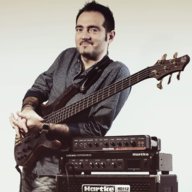
Somehow I have developed a muting technique where my thumb stays on the pickup and my ring finger comes to rest on the E string to mute it when I am playing on higher strings. The real beauty of it comes in how quickly I can use that muting finger to play notes on the E string during passages primarily on the D or G strings without having to make big jumps with my primary fingers. It is resting there ready to spring into action! I'm not really sure how I started doing this (I don't always do it, but I do it a lot. I'll still move my thumb to the E string during long passages on the D/G string, although then my ring finger usually ends up resting on the A string).
It feels totally natural to me, has some obvious benefits, and yet I can't seem to find anyone else who does it. The only thing I have ever seen that looks close is a video of James Jamerson playing a bass other than his usually P bass. I think it has something to do with how he adapted his playing style in the absence of that metal cover over the pickup. The camera angle is a bit tough to tell though.
Anyone else do this?? Am I a freak? A genius? Neither? Both?
It feels totally natural to me, has some obvious benefits, and yet I can't seem to find anyone else who does it. The only thing I have ever seen that looks close is a video of James Jamerson playing a bass other than his usually P bass. I think it has something to do with how he adapted his playing style in the absence of that metal cover over the pickup. The camera angle is a bit tough to tell though.
Anyone else do this?? Am I a freak? A genius? Neither? Both?