Janis Ian posted this tribute on her Facebook page.
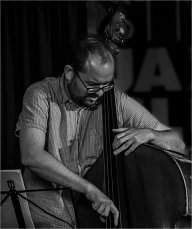
“In mourning for the great Richard Davis, my absolute favorite upright player. (Not to take anything from George Duvivier, the amazing bassist on "Society's Child" who set the course of that record. But I only worked with George once, and I worked with Richard most of my life.)
I learned so much from this man. The first time we met was during my "Stars" album. We cut a couple of things and I confessed to him that I was nervous about recording my first score, for a song called "Applause". We had 44 instruments coming in, representing a full quarter of the album budget. Ron Frangipane would be conducting, but the orchestra would know it was my score, a skinny 22-year-old who'd play piano and hope they'd be kind to me.
Came time for the date and the whole orchestra were there. Some were playing cards, some were reading, but mostly they were ignoring me. Until Richard walked in. At the time, he was playing with the New York Philharmonic, and he came to the session wearing his full concert dress - tux with tails, the works. He walked to the piano, put a hand on my shoulder, and said "Gentlemen. This is the lady's first score. Let's show her what we're made of and make it shine."
I adored him. We worked together until he could work no more. He came with me and Barry Lazarowitz when I "auditioned" for CBS Records on a bet Charles Koppelman had made with my producer, Brooks Arthur. The bet was that if I could get a standing ovation at their yearly marketing event, out of 250+ fairly drunk promotion men (and one woman), CBS would sign me and buy the "Stars" album. Richard was my confidence, my booster, my good luck charm. (And yes, I got the standing ovation, and the contract.)
He was a wonderful contradiction in terms. He'd sit and do cross stitch and needlepoint with my Uncle Bernie, sitting on a couch in front of the control room. He rode horses in Central Park, had awards for dressage (if that's the correct term).
When I played Carnegie Hall alone for the first time, Richard played with me, and he took the cello solo I'd written at the end of "Watercolors". Originally played by George Ricci, another amazing musician, no one believed Richard could hit the high notes on his upright - but he did, and brought the house down.
One album, he no longer lived in New York, so I tried to put him up at a really nice hotel. He chose a run down place nearer the Hit Factory Studio instead, saying he'd prefer to walk his bass to work every day.
The last album we did was "Billie's Bones", and between recordings he regaled us with stories of his life on the road with Sarah Vaughan, and when Miles Davis had tried to hire him away. I've rarely laughed so hard.
He died at 93, respected and adored. His work spanned greatness, over and over again - from Igor Stravinsky to Van Morrison. Without his glissandos on "At Seventeen", the record would never have been the same.
When he'd hear people arguing over whether rock and roll was "real" music, or classical was "real music", he'd just smile and quote Duke Ellington - there's good music, and there's bad music. Beyond that, it doesn't matter.
By God I will miss him being in the world. RIP, Richard. We were lucky to know you.
I am so lucky.”