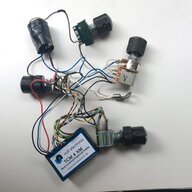
well, I don't think it's really frank to compare new Rockbasses with Squiers price-wise. for a price of a new RB Corvette in Europe you can buy two new CV Squiers or almost four new Affinitys. a top-of-the-line Indonesian Yamaha like BB735A or TRBX605 will be cheaper than a Rockbass.
the 2010 upgrade rose the price, now a Rockbass costs nearly a grand USD, that's not really a 'Squier market'. from that grand how much did they save by a cheaper preamp, like $50? and got a bass that's both not cheap and needs a preamp upgrade badly?
I admit that pricing in Oz might be a different story. but thanks for the warning.
Fair point - I think I’m biased by having set up a couple of Squier basses and my stepfather’s 28 year old Mexican Fender P over the holidays (I’ve graduated from ‘can you fix my computer’ to ‘can you fix my guitar/bass’ in my extended family) Squier’s are really aspirational starter instruments for many people, and Fender have done a spectacular marketing job on the brand over the years. The build and finish standard is more than ‘good enough’ but there’s nothing very complex about them - no active pickups, no 3D bridges, no laminated necks, no gig bag or strap locks, and especially no preamp. So yes, they’re cheaper but the economies of scale dwarf Warwick’s efforts many times over.
Essentially, none of the Fender-shaped objects I worked on over Christmas could be refined into a bass I wanted to keep playing, something that woke the musician in me. I’d probably feel very differently if i was a 15 yr old with one of them and a Rumble combo (now, those really are a good product) but I’m not. My RB corvette makes a lot of different sounds that speak to my decades of enjoying music, and it’s an instrument I don’t want to put down. It’s like the difference between a Walmart bike and an entry-level Giant or Cannondale if that world speaks to you, they benefit from a lot more time and imagination in the design process. And that costs money.
Having been involved in production (Pro Audio in my case) over the years, the cost of a component in a product is quintupled or sextupled by the time it hits your wallet. The cynic in me says that Warwick needed something to differentiate the RB line from the German instruments without fundamentally compromising the product, something that makes you wish you could afford the extra $1k. Modern electronics is pretty much buttoned up when it comes to signal to noise ratio and low distortion for low-voltage audio circuits, and it probably costs more to cover the time for the decent installation and shielding job - every audio cable in that Corvette cavity was shielded, though a couple solder joints were questionable - than to pay for the components in the preamp. I can imagine some Marketing manager saying ‘no, make it a bit noisier than the MEC preamps’ in order to preserve their aftermarket slice for those that care. Not too noisy, mind you, just not a quiet as the real thing. Another example of that - the RB Streamer NT is in danger of being a really serious bass, they even give it the bronze frets. So why do they turn that sexy streamlined shape into the slightly blobby RB version and cover it in shiny plastic? It’s not like Warwick have no design chops - no, I think they know exactly what they’re doing and it’s called product differentiation.