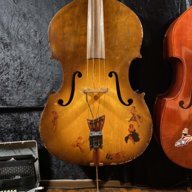
That's a handsome looking model.
There are several different string instrument factories in Reghin, Romania. A ton of what gets to the US has labels showing the importer, not the builder. This label doesn't say which builder or when it was made. The text, "Musik Instrumenten Fabrik," translates as "Musical Instrument Factory." (It has that charming typo, "Instrumentenf Abrik," too.) Speaking factually -- no offense meant:
> It's a student instrument from the latter half of the 20th century. You haven't said anything about how it sounds for bow or pizz.
> Based on the fact that the top has crack-repairs and 'wings' on the edges it's a sold spruce top. Carpathian spruce has been the violin-builder's topwood of choice for centuries and it literally grows on trees in Romania. There are no pics of the back or sides; they could be tonewood or plywood, plain or fancy. The fingerboard has a nice color; it may be ebony or dyed/painted maple. There's an obvious shadow of a knot showing on the top treble bout and a knot on the top of the cross-brace. That means 'lower grade instrument wood,' but after 20-50 hard years the way this bass sounds depends more on what has happened to it than on any inherent quality of the timber.
> Overall condition in those pics looks "fair." It has taken damage to the top and scroll, you haven't shown the back and sides, and it looks like there's a repaired neck-break right below the nut. (That last is often a major sale-depressor.) You've said that some or all of the repairs were done at home. Without knowing anything about you or your work it's accurate to say that 'home repair' can mean anything from 'museum-quality' to 'Gorilla Glue and Bondo.'
In sum: Romanian student bass, lower-line but not bottom-of-the-line, condition lowers value. Insufficient information to guess about price.
I'd smile and play it if it showed up at my jam session.



 The fingerboard and tailpiece is made of ebony.


