

Enjoy the benefits of a premium membership!
Upgrade Account
-
TalkBass has been independent since 1998. Add your voice.
Create a free account to reply to discussions, view embedded media, and browse with fewer display ads.
Join free Log in
Want zero display ads or expanded classifieds tools? Compare plans.
You are using an out of date browser. It may not display this or other websites correctly.
You should upgrade or use an alternative browser.
You should upgrade or use an alternative browser.
Rosewood vs maple or vice versa and why
- Thread starter Willie5String
- Start date
More options
Who Replied?
You “need” to have one of each…
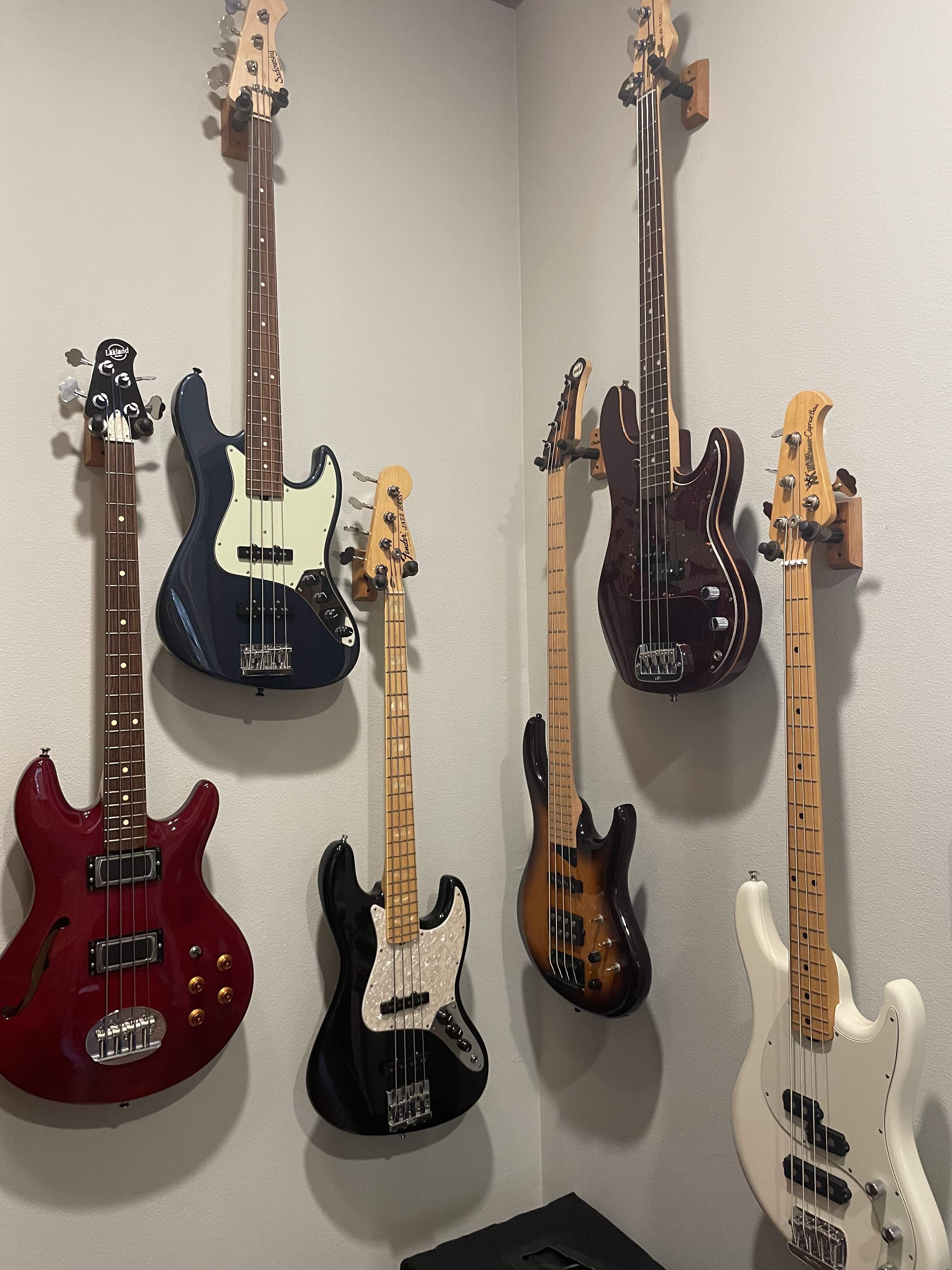
Pau Ferro and Maple Jazzes, Rosewood and Maple P & P/J.
FWIW, I saw a video somewhere with Roger Sadowsky and Michael Tobias being interviewed together and both stated that they felt fingerboard wood made more of a difference to the tone of the instrument than body wood.
Too many variables among the instruments above for me to give much of a comparison. Generally, with a broad brush, I’d say that my experience is that the rosewood boards are “mellower” than the maple. Pau Ferro is much tighter grained than my rosewood boards and to my ear, a little “snappier.”
Looks wise, I lean towards rosewood. Just because.
Pau Ferro and Maple Jazzes, Rosewood and Maple P & P/J.
FWIW, I saw a video somewhere with Roger Sadowsky and Michael Tobias being interviewed together and both stated that they felt fingerboard wood made more of a difference to the tone of the instrument than body wood.
Too many variables among the instruments above for me to give much of a comparison. Generally, with a broad brush, I’d say that my experience is that the rosewood boards are “mellower” than the maple. Pau Ferro is much tighter grained than my rosewood boards and to my ear, a little “snappier.”
Looks wise, I lean towards rosewood. Just because.
Last edited:


Maple, for me, I prefer it aesthetically. I've never noticed enough of a tone or feel difference to make it worth going for a wood I like the look of less. Although, if I played a bass I loved with a rosewood/pau ferro/ebony board I certainly wouldn't let it stop me buying it.
If I was going for a bass with a darker looking neck or board, I think I'd look towards roasted maple.
If I was going for a bass with a darker looking neck or board, I think I'd look towards roasted maple.

AQUANOVA
I'd agree with you, but then we'd both be wrong
I prefer rosewood.
Even though it’s negligible, I don’t care for the feel of lacquer under my fingers on a maple board.
When buying a new bass, I usually make my fretboard choice by what looks best with the overall color scheme.
Even though it’s negligible, I don’t care for the feel of lacquer under my fingers on a maple board.
When buying a new bass, I usually make my fretboard choice by what looks best with the overall color scheme.


I like contrast. Maple with dark bodies, Rosewood with light.
My black bass is maple with black blocks.
My sunburst is ebony (unlined fretless)
My burgundy mist is rosewood with pearl blocks.
My black bass is maple with black blocks.
My sunburst is ebony (unlined fretless)
My burgundy mist is rosewood with pearl blocks.
Looks, sound, play-ability I'd go with either. For repair and maintenance I'd go with rosewood (or better said, any "non-finished" board.) The reason is that if you have to do anything on a fret board (say filing frets due to fret sprout) it is much easier to do it on a board that you can just oil afterwords instead of having to refinish via some type of spray on finish.
I think the answer can easily be found in any of the endless 'which wood is better for....' threads that always seem to pop up here on TB. But if you really need to know and just can't use the search function. Here's your answer. You need to own both. And don't forget that there's also Rosewood and Pau Ferro. Like these.
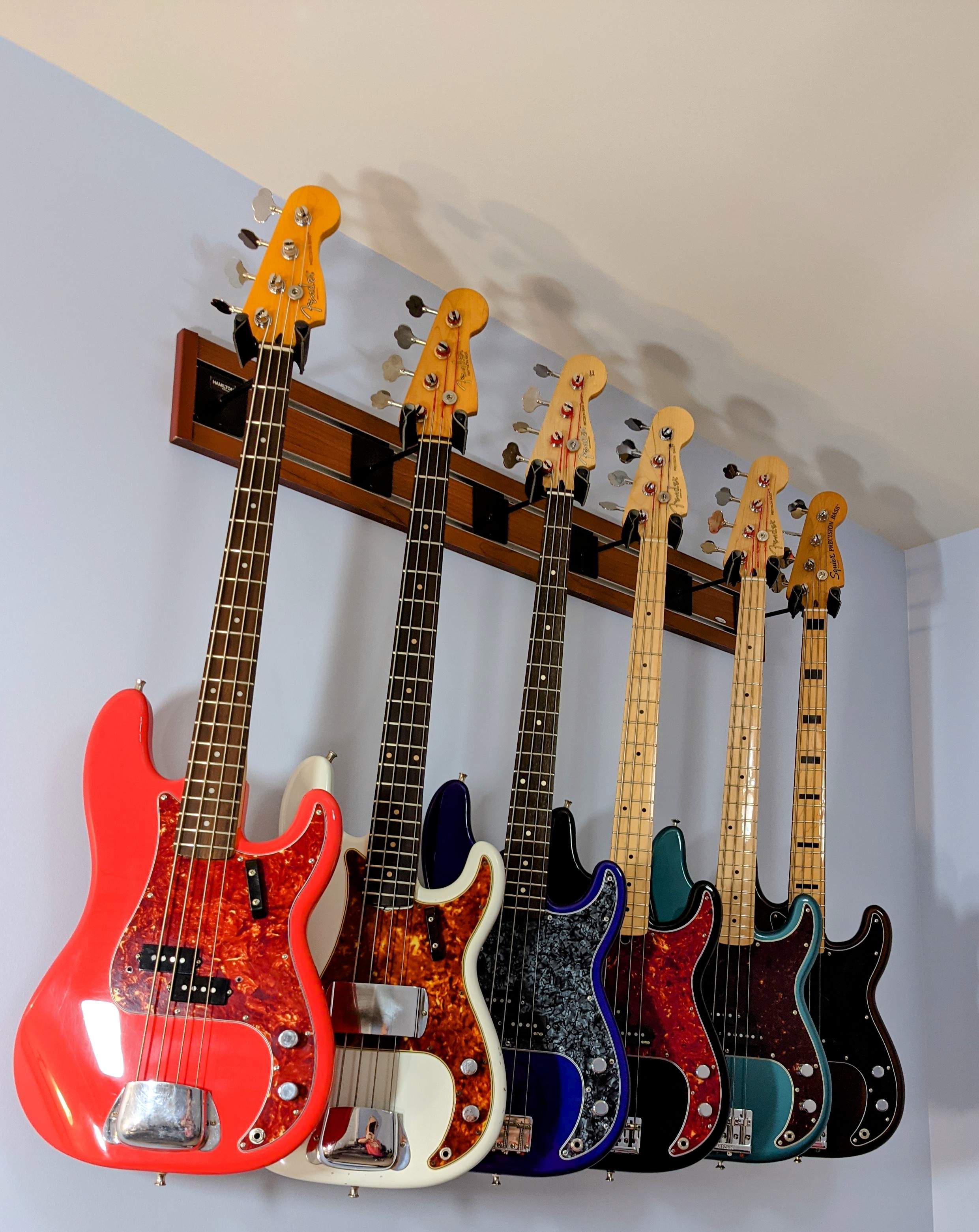
For those who want to know. From left to right.
2020 Fiesta Red parts build
1960 Precision refin in 86 to Olympic White. My number one since the early 70's when I bought it. Many years of honest wear from steady club gigs.
2016 Midnight Blue MIM Precision bass special, parts build
2008 Fender Am Standard built in late 07 as a 2008 model year bass
2018 Fender Special run for GC Player series P Ocean Turquoise
2020 Squier Classic Vibe 70's in Mocha which was recently changed to a Black 'n' Maple.
The Mocha loaded body is for sale in the classifieds right now.
For those who want to know. From left to right.
2020 Fiesta Red parts build
1960 Precision refin in 86 to Olympic White. My number one since the early 70's when I bought it. Many years of honest wear from steady club gigs.
2016 Midnight Blue MIM Precision bass special, parts build
2008 Fender Am Standard built in late 07 as a 2008 model year bass
2018 Fender Special run for GC Player series P Ocean Turquoise
2020 Squier Classic Vibe 70's in Mocha which was recently changed to a Black 'n' Maple.
The Mocha loaded body is for sale in the classifieds right now.
Last edited:

My '65 Jazz had and my 5-string has a rosewood board. However, my 1982 Jazz has white-bound all Maple neck. My '82 has significantly more sustain than my 1965 Jazz did and it looks killer on my Olympic White Jazz with white pickguard, white pickups, and white strat-type control knobs. So I'm a fan of the maple neck on my Jazz.I’ve always preferred a rosewood board, no tonal reason, just prefer the look.

I have basses and guitars with rosewood, ebony and maple boards. I can tell the difference very easily.
The most simple way to hear the difference is the maple is the most light colored, rosewood is medium to dark brown and ebony is exceptionally dark brown. Sonically the maple is closer to ecru and rosewood sounds closer to cocoa. I have a Daphne blue Tele with rosewood fingerboard, therefore, rosewood sounds best on a Telecaster that is blue. I have a P style with an ebony board that I like very much so ebony is better for P basses although I also have an all maple neck P bass and a 1 pc. rosewood neck P bass so depending on my mood whichever one I have on my strap is the brightest for bright songs and also the darkest for darker songs.
Also, as much as I like tort, I do not believe the pick guard color has any effect on the neck or fingerboard color.
The most simple way to hear the difference is the maple is the most light colored, rosewood is medium to dark brown and ebony is exceptionally dark brown. Sonically the maple is closer to ecru and rosewood sounds closer to cocoa. I have a Daphne blue Tele with rosewood fingerboard, therefore, rosewood sounds best on a Telecaster that is blue. I have a P style with an ebony board that I like very much so ebony is better for P basses although I also have an all maple neck P bass and a 1 pc. rosewood neck P bass so depending on my mood whichever one I have on my strap is the brightest for bright songs and also the darkest for darker songs.
Also, as much as I like tort, I do not believe the pick guard color has any effect on the neck or fingerboard color.
Most of my fingerboards are either ebony or wenge add that to the list of left out options. If I was custom building a guitar these days I would try to get the board made out of persimmon (aka white ebony).I think the answer can easily be found in any of the endless 'which wood is better for....' threads that always seem to pop up here on TB. But if you really need to know and just can't use the search function. Here's your answer. You need to own both. And don't forget that there's also Rosewood and Pau Ferro. Like these.
View attachment 4447320

All my basses accept my fretless are maple. I'm thinking of getting a Fender Player-plus active V with a Pau Ferro finger board.
Many believe that old myth that Maple is the best hardwood for necks. However, both Rosewood and Pau Ferro are harder than Maple.
These are the numbers according to the Janka Hardness Scale, the Bible of wood hardness ratings
Hard Maple comes in at 1450 but has a very tight grain making it ideal for crack resistance.
Brazilian Rosewood is listed as 2790
East Indian Rosewood is listed as 2440
Pau Ferro is listed as 1960
What's surprising is that Pau Ferro the current choice of many manufacturers as a Rosewood replacement is actually stronger than Hard Maple.
Source
The Wood Database
These are the numbers according to the Janka Hardness Scale, the Bible of wood hardness ratings
Hard Maple comes in at 1450 but has a very tight grain making it ideal for crack resistance.
Brazilian Rosewood is listed as 2790
East Indian Rosewood is listed as 2440
Pau Ferro is listed as 1960
What's surprising is that Pau Ferro the current choice of many manufacturers as a Rosewood replacement is actually stronger than Hard Maple.
Source
The Wood Database
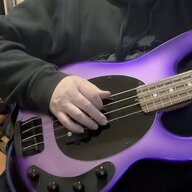
I generally prefer maple fretboards and love the snap I get with them. However I do have a couple of basses with rosewood fretboards and enjoy them as well. For me the rosewood has to compliment body colour before I will play it. Shallow, perhaps…but it works for me.

wEn gAyMasewood or Rople?
Oh, and how should one pronounce Wenge?

I like rosewood with flats and rounds on maple .


