
Enjoy the benefits of a premium membership!
Upgrade Account
-
TalkBass has been independent since 1998. Add your voice.
Create a free account to reply to discussions, view embedded media, and browse with fewer display ads.
Join free Log in
Want zero display ads or expanded classifieds tools? Compare plans.
You are using an out of date browser. It may not display this or other websites correctly.
You should upgrade or use an alternative browser.
You should upgrade or use an alternative browser.
Rosewood vs Pau Ferro
- Thread starter Turnaround
- Start date
More options
Who Replied?


I think a LOT of the hate comes from Fender’s recent swap. It’s understandable though. We’ve been used to seeing P and J basses with rosewood and now it has something different and lighter looking. It’s works for marketing too as even I’ve had to snap myself out of the... now I need to save for an Am Pro because it has a rosewood board!
Over the next few years we’ll all get used to it and the hate will die down / go away. As people have mentioned, pau ferro has been favoured on some high end basses for years, so there’s obviously nothing wrong with it.
Over the next few years we’ll all get used to it and the hate will die down / go away. As people have mentioned, pau ferro has been favoured on some high end basses for years, so there’s obviously nothing wrong with it.
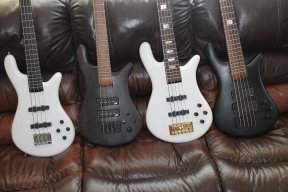
I've been happy with Pau Ferro on the Spector and Sadowsky basses I own or have owned. I actually prefer a lighter brown color aesthetically.
It is often hard to tell difference between the variants. My question is how are customs officials suppose to be able to tell? How can they actually say what is within regulations and what isn't?
It is often hard to tell difference between the variants. My question is how are customs officials suppose to be able to tell? How can they actually say what is within regulations and what isn't?


I'm a Maple fan but between Rosewood and Pau i prefer Rosewood. Looks better and definitely sounds better.


I really don't mind what the board on an instrument looks like and do not quite 'get' why some feel strongly about it.
For me The bass is a tool to make music with. It needs to sound good, be responsive to what I do, and feel good ( be not too heavy and not too light).
It needs to allow me to do what I hear in my head.
Whilst enjoying the look of a bass it is not important to me.
For me The bass is a tool to make music with. It needs to sound good, be responsive to what I do, and feel good ( be not too heavy and not too light).
It needs to allow me to do what I hear in my head.
Whilst enjoying the look of a bass it is not important to me.

For a while I owned two PJ Mustangs. One with a rosewood board and one with pau ferro. The pau ferro bass sounded snappier, with a slightly harder attack. The neck was also not finished quite so well, with filler missing from the ends of the fret slots, lacquer sinking into the slots and some lacquer flaking off the sides of the pau ferro.
I moved the neck from one bass to the other, and the brighter tone and harder attack changed moved with the neck. Even with different strings, pickups, wiring (500k pots in one, 250k pots in the other) the inherent tone was there.
My pau ferro board darkened with an application of oil and, honestly, it looks nice against the white finish on the body. People need to use their ears more and their eyes less!
I moved the neck from one bass to the other, and the brighter tone and harder attack changed moved with the neck. Even with different strings, pickups, wiring (500k pots in one, 250k pots in the other) the inherent tone was there.
My pau ferro board darkened with an application of oil and, honestly, it looks nice against the white finish on the body. People need to use their ears more and their eyes less!

I just love wood period but I know we have to get real. Some old growth forests will not replenish to a significant degree in our lifetime, some may never. If that means synthetic fretboards then that’s what I for one will embrace.

Great thread, topic! Thanks for starting it off Richard.
Just personal visual preference - in a non maple board - ... darker with or without marbling/srtreaks.
The light shades just appear to me as dried out. I do not claim any sense, fact, or reason to my statements.
Would like to see ebony and synthetic boards included for discussion along with PF and RW.
Finally, my most recent favorite necks have been roasted maple with ebony or rosewood boards.
Thank you Warmoth!
Just personal visual preference - in a non maple board - ... darker with or without marbling/srtreaks.
The light shades just appear to me as dried out. I do not claim any sense, fact, or reason to my statements.
Would like to see ebony and synthetic boards included for discussion along with PF and RW.
Finally, my most recent favorite necks have been roasted maple with ebony or rosewood boards.
Thank you Warmoth!

Pau Ferro | The Wood Database - Lumber Identification (Hardwood)
Maybe they should just start calling it Bolivian Rosewood?
Maybe they should just start calling it Bolivian Rosewood?
I always loved the look of the reddish fretboards of old black and white Rickenbackers. I never found out what wood it was. Can anybody tell me? Their website says these days it’s rosewood but they don’t look so red as they used to. How come? Against the black and white it looked so good.
I never cared much for maple fretboards but the roasted ones are a whole other ball game. They look great - I’m a fan now.Roasted maple is the best feeling neck as far as I’m concerned. I had a roasted maple/maple neck but ultimately sold it as the tone was to bright ( could have been the metal rods warmoth uses that also contributed to its overly bright tone). In the future I too believe we will see a lot of roasted options. The low end basses will be the ones that suffer as they get the “B” grade lumber. High end builders can and do hand pick only the best of any given species and that formula will almost always render a great sounding instrument. Nothing wrong with maple so if that’s still available in the future I can live with just maple as an option ( for body wood as well ), I’d put some flats on to take all that top end off thought

I always loved the look of the reddish fretboards of old black and white Rickenbackers. I never found out what wood it was.
Bubinga?

I really like Pau Ferro. I resisted at first but after playing a few really excellent Suhr guitars I'm sold.

It is "iron wood" after all...In terms of it's durability, Pau Ferro is significantly better than most of the Rosewood I have seen for years.


Jatoba, rosewood, bois du rose, ebony, maple, pau ferro ... I have them all and they all seem to play fine.
Guess I'm a wood slut.
Wait. That sounded wrong.
Guess I'm a wood slut.
Wait. That sounded wrong.
Wiki says they have used rosewood and bubinga for fretboards.I always loved the look of the reddish fretboards of old black and white Rickenbackers. I never found out what wood it was. Can anybody tell me? Their website says these days it’s rosewood but they don’t look so red as they used to. How come? Against the black and white it looked so good.
I seem to recall cherry being mentioned, but maybe that is just the red stain on the fingerboard. (i have a rick guitar) Cherry itself is of course a very whitish looking wood.

... but the sound and the look it makes for sure!On a fretted bass you're not feeling the fretboard much anyway ...

I’ve got an MIM Jazz parts bass that is an ash FSR body with a pau ferro Deluxe J neck and i like it just fine.
I don’t know if there is something other makers are doing that Fender is not, or the other way round, but i can’t tell any difference between the sound of my MIM J basses with rosewood and those with pau ferro when i play them.
First pic is the parts bass, second is a stock MIM Deluxe J, also pau ferro.
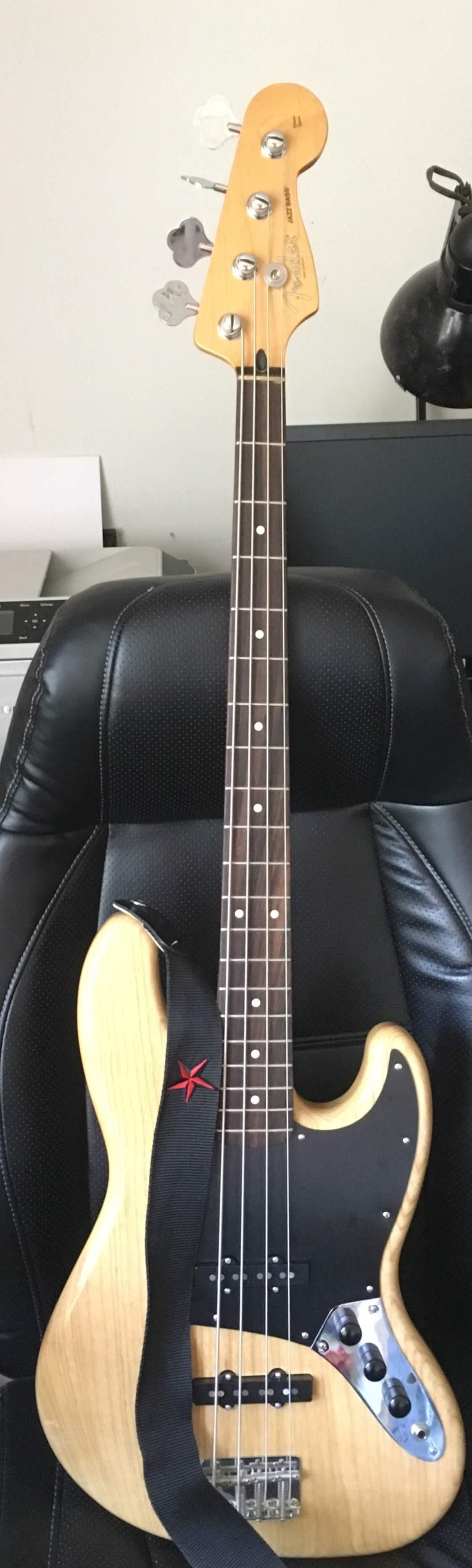

I don’t know if there is something other makers are doing that Fender is not, or the other way round, but i can’t tell any difference between the sound of my MIM J basses with rosewood and those with pau ferro when i play them.
First pic is the parts bass, second is a stock MIM Deluxe J, also pau ferro.


