

Enjoy the benefits of a premium membership!
Upgrade Account
-
TalkBass has been independent since 1998. Add your voice.
Create a free account to reply to discussions, view embedded media, and browse with fewer display ads.
Join free Log in
Want zero display ads or expanded classifieds tools? Compare plans.
You are using an out of date browser. It may not display this or other websites correctly.
You should upgrade or use an alternative browser.
You should upgrade or use an alternative browser.
Double Bass Sam Jones" Autumn Leaves transcribed?
- Thread starter BargeOn
- Start date
More options
Who Replied?
I just did this one and posted it on my blog.
Check it out, there is some analysis of some of the things that he plays and the entire tune in a PDF. I also post a link to Mr. Gourlay's site, for his Sam Jones book, in case anyone wants to check how many clams I wrote down by checking it against his.
Enjoy, and if you like it, leave a comment.
Thanks.
http://bassoridiculoso.blogspot.com/2011/01/sam-jones-bass-line-on-leaves.html
Check it out, there is some analysis of some of the things that he plays and the entire tune in a PDF. I also post a link to Mr. Gourlay's site, for his Sam Jones book, in case anyone wants to check how many clams I wrote down by checking it against his.
Enjoy, and if you like it, leave a comment.
Thanks.

The Autumn Leaves transcription is in my "Walking in the footsteps of Sam Jones" book along with 23 other lines.
Thanks for posting the links to Jamey Aebersold for the books!
Transcribing music is the best way to learn music there is.
Unfortunately it's also one of the most difficult!
I have seen incredible results from players using a combination of learning the lines from the books and then later working on their own transcriptions. The key is to immerse yourself in the music. Students who have learned/memorized the lines and played along with the original recordings A LOT have seen great results. As you practice the lines they get in "your ear" and you'll be able to recognize the sounds when you're doing your own transcriptions much more easily. Have fun!
Rob Gourlay
Books in the series:
Walking in the footsteps of Paul Chambers
Walking in the footsteps of Sam Jones
Walking in the footsteps of Doug Watkins
Available:
www.robgourlay.com
www.jazzbooks.com
I had thought of doing an Andy Simpkins books at some point....hmmmm
Talk about resurrecting an old thread and responding to an old post!
I just ordered your Paul Chambers, Sam Jones, and Ray Brown Books.
Totally psyched.
Someone on here published a PDF of his thesis which was transcriptions, analysis and comparison of the bass lines of Ron Carter, Sam Jones, and PC playing the same 3 tunes: Oleo, Autumn Leaves (the Sam Jones is from the Miles/Cannonball), and All the Things. It's fantastic! I did a quick search and couldn't find it, but maybe you can or someone else can help. He breaks down certain techniques - using an open string to jump to a lower or higher position for example - that you can apply to your own lines. Transcribing is good ear training, but doesn't necessarily teach you to play your own music. This kind of analysis of your transcriptions does.

Someone on here published a PDF of his thesis which was transcriptions, analysis and comparison of the bass lines of Ron Carter, Sam Jones, and PC playing the same 3 tunes: Oleo, Autumn Leaves (the Sam Jones is from the Miles/Cannonball), and All the Things. It's fantastic! I did a quick search and couldn't find it, but maybe you can or someone else can help. He breaks down certain techniques - using an open string to jump to a lower or higher position for example - that you can apply to your own lines. Transcribing is good ear training, but doesn't necessarily teach you to play your own music. This kind of analysis of your transcriptions does.
Cool - thanks.
I'll have a look around for it.
I have yet to dive into the world of transcribing, myself, but I'll get there.

User lurk mentioned the thesis, this looks like the one:
Josh Skinner - A Comparative Analysis of Three Jazz Bassists’ Walking Bass Lines
A Comparative Analysis of Three Jazz Bassists’ Walking Bass Lines
In measure 51 Sam Jones plays D E F# A over an A half diminished chord. Can someone help me understand what's going on here?

Josh Skinner - A Comparative Analysis of Three Jazz Bassists’ Walking Bass Lines
A Comparative Analysis of Three Jazz Bassists’ Walking Bass Lines
In measure 51 Sam Jones plays D E F# A over an A half diminished chord. Can someone help me understand what's going on here?
Last edited:
He's ignoring the ii part of the ii V and just playing V for two bars. This often works and soloists do it a lot, particularly in fast tempos, which this is not. Another common strategy is to toggle between the two twice as fast - 2 beats per 2x.User lurk mentioned the thesis, this looks like the one:
Josh Skinner - A Comparative Analysis of Three Jazz Bassists’ Walking Bass Lines
A Comparative Analysis of Three Jazz Bassists’ Walking Bass Lines
In measure 51 Sam Jones plays D E F# A over an A half diminished chord. Can someone help me understand what's going on here?
View attachment 4601297
Yeah man. That thesis is a bottomless pit of wonderful stuff. In a way I'm envious of bassists from that time. They could focus on a "narrow" area and really dive deep. Mostly quarter notes in 4 best meter stitching together chords generally following circle of 4ths patterns and variations. Nowadays we've got to deal with that and non-functional harmony, odd meters, modal stuff, various World Music styles, etc.@lurk
Thanks very much for the explanation. I was puzzled, now I get it.
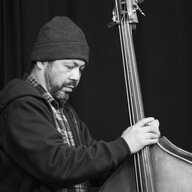
From Vol. 55? If so, this is John Goldsby. As good as it getsThe first transcription I did was a Aebersold version of All the things you are. Because the bass is on the left side, you can ear it very clearly.
And Aebersold bass player are fine musicians.
Latest posts
-
 Post a funnier picture than the one above - Parallel Universe Edition
- Latest: 5StringBlues
-

-

-

-
