• TalkBass has been independent since 1998. Add your voice.
    Create a free account to reply to discussions, view embedded media, and browse with fewer display ads.
    Join freeLog in
    Want zero display ads or expanded classifieds tools? Compare plans.

"Same fret" technique

Hello everyone

Another beginners question please. What technique do you experienced players use for playing consecutive notes on the same fret but the next string up or down?

Let me give an example song. Smoke on the water, once the great intro''s done there''s a series of triplets - E3 A5 D5, plus some others further on like D3 A3 E1.

Even the world''s most positive motivator wouldn't be able to describe my fingers as anything other than stubby, fairly short and not very slender.

So far I have two main methods. Say I'm playing the ascending one above, fret E3 with the index then I try and play the two 5''s with second/third or third/fourth by aiming more for the middle to leave some space to crowbar the other finger nearer the fret where it should be. Sometimes it works but my fingers do seem to get a bit in the way of each other.

The other way is to try and position early, having done E3 try to cover both 5s with the same finger and use a rocking technique of my finger pad to transfer. Definitely get a quicker transfer that way but I do miss some notes doing it.

Look forward to your thoughts, thanks everyone and stay safe out there.

Steve
 
It's useful to be able to do both so you're flexible. The greater context may require the application of either of those two approaches.

Both are totally valid, but I feel using seperate fingers (i/m/r) gives me more control, especially when it comes to muting. You need to practice both, and short stubby fingers won't hold you back. Works for me, and I play six strings which have wide necks (aka aircraft carriers).
 
Sorry mate, I don't know that one. What's he doing?
A mere mortal like myself would never assume how the legendary George Porter Jr does what he does.:D

But the bass line incorporates the same-fret across strings your post inquires about. Not sure how George makes it work, but I've found what works for me if I keep my fingers relaxed.
 
Hello everyone

Another beginners question please. What technique do you experienced players use for playing consecutive notes on the same fret but the next string up or down?
...
So far I have two main methods. Say I'm playing the ascending one above, fret E3 with the index then I try and play the two 5''s with second/third or third/fourth by aiming more for the middle to leave some space to crowbar the other finger nearer the fret where it should be. Sometimes it works but my fingers do seem to get a bit in the way of each other.
...
Steve

In 99 of 100 cases I will use separate fingers for each note. If your fingers are jostling for space, try getting a bit more curl in them and stopping the string with more tip and less pad...
20200420_214105.jpg
20200420_214146.jpg
20200420_214244.jpg
 
Here is a cut and paste paper that may help:

If you teach yourself your instructor does not know what he is doing. However, if you do teach yourself I'd start you off with knowing where the notes are on your fretboard. Why? So later on when your ear tells you, or you see a chord your fingers know what to do with that information. So lets get started. The following are some things you can work on before you get with a teacher -- that can tell you how to do it correctly.

upload_2014-8-24_6-54-41-png.468138


For this paper we will be referring to notes as A, B, C & 1, 2, 3. For example:

C Major Scale…….....…C, D, E, F, G, A, B, C (octave)
Scale degree number. 1. 2, 3,.4,.5, 6, 7, 8 (octave
)

The Major Scale Box Pattern and the one finger per fret method will also be used in our examples.
The Major Scale Box
………...Index...Middle..Ring...Little
G|~~|---A----|-------|---B---|---C---|1st string
D|~~|---E----|---F---|--------|--G----|
A|~~|---B----|---C---|-------|---D----|
E|~~|---------|---G---|-------|---A----| 4th string

C and D played on the A string.
E, F and G played on the D string.
A, B and C played on the G string.

Why did I place the C root note on the A string? If we place the tonic root note of the scale or chord progression on the A string the 4th and 5th scale degrees will be above and below the tonic root note. Why is that important? The I-IV-V chord progression finds its way into hundreds of simple songs. Having the I, IV and V root notes all together in one spot will prove to be an advantage.

Octaves - Playing the root of a chord and just pounding out root notes is safe - and boring. Think about octaves, which is the root in another octave, R-8, or R-8-R-8 or R-R-8-8, safe and simple. Hold on --- the 5 is always right below the 8 so the R-5-8-5 becomes another safe bass line you could get into muscle memory very easily. More on that later in the post where we use Arabic numbers instead of note names..

Any root note’s octave can be found up two strings and over two frets. To simplify this paper “over” will mean move toward the bridge and “back” will mean move toward the nut. OK this will find the 8 or octave note, if you want to return to the 1 note go down two strings and back two frets.

Find a C note. For its octave 8 go up two strings and over two frets. For the tonic 1 note go down two strings and back two frets.

5th fret rule
The A at the 5th fret is the same as the open A string.
The D at the 5th fret is the same as the open D string.
The G at the 5th fret is the same as the open G string.

7th fret rule
E at the 7th fret is the same as the E open string.
A at the 7th fret is the same as the A open string.
D at the 7th fret is the same as the D open string.

Finding the other notes
  • From any note where is its 2? Over two frets same string.
  • From any note where is its 3? Up a string and back one fret.
  • From any note where is its 4? Up a string same fret.
  • From any note where is its 5? Up a string and over two frets, or right below on the next string down, same fret.
  • From any note where is its 6? Up two strings and back one fret. Right over the 3.
  • From any note where is its 7? Up two strings and over one fret. If you want C’s 7th find a C and the 7th is back one fret. This comes in handy when moving back down a scale.
  • From any note where is its 8? Up two strings and over two frets.

Major scale box showing scale degree numbers (Arabic) and the root note on the 4th string.
…… Index..Middle...Ring...Little
G~|---2---|-------|---3---|---4---| 1st string
D~|---6---|-------|---7---|---8---|
A~|---3---|---4---|-------|---5---|
E~|-------|---R---|-------|---2---|4th string

This box, using scale degree numbers instead of note names will allow you to utilize the scale or chord spelling in your bass lines. See a Cmaj7 chord coming up in the song. The spelling for the Cmaj7 is R-3-5-7. Find those scale degrees within the box and you have a safe bass line. Start with just roots, need more add a 5. The 8 is always a safe addition. From there the correct 3 and 7 fill out a bass line very well.

Good luck, and welcome to the bottom end.
 
The answer is "it depends". It can depend on what I just did, or what I'm going to do next.

Thinking about it, I most often use a different finger for each note in the progression, but there are times when the "rocking" method works best. Again, depending on what I just did or what I'm doing next. If I was simply grooving back and forth between the same fret on two adjacent strings, I would be using different fingers.
 
Any way I read this section of @Malcom35's post above:

7th fret rule
E at the 7th fret is the same as the E open string.
A at the 7th fret is the same as the A open string.
D at the 7th fret is the same as the D open string.

...doesn't make sense. The E at the 7th fret is not the same as the E open string, it's B. No string at the 7th fret is the same as the open string.

As we all know, any string at the 12th fret is an octave of the open string. And of course, any string at the 5th fret is indeed the same note as the open string above it.

I don't get it as described.
 
What he is saying is 5th fret on the E string is the same as the open A string, and the 7th fret on the next string up is the same note an octave up from the lower open string.

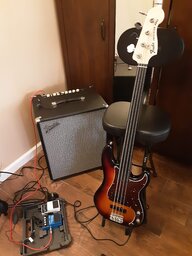
Everything discussed so far has been for fretted instrument. On a fretless you either rock your finger or play one of the notes on a different string as "I think" @Malcolm35 is implying.
 
Maybe my approach is unique, but I have no trouble using the same finger in barre fashion by shifting where on the finger the pressure is coming from. It’s part of my economy of motion ethos. May not work for everyone I concede.

Same here, but I have pretty long fingers so I suppose it's a bit easier for me.
 
Maybe my approach is unique, but I have no trouble using the same finger in barre fashion by shifting where on the finger the pressure is coming from. It’s part of my economy of motion ethos. May not work for everyone I concede.

Same here, but I have pretty long fingers so I suppose it's a bit easier for me.

Same here and I have short fingers. I've heard it's not a good technique but it works for me. I also rake with my right hand, which is also a 'no no' according to some.
 
  • Like
Reactions: skyline_01
What he is saying is 5th fret on the E string is the same as the open A string, and the 7th fret on the next string up is the same note an octave up from the lower open string.
...

Yes.

...
Everything discussed so far has been for fretted instrument. On a fretless you either rock your finger or play one of the notes on a different string as "I think" @Malcolm35 is implying.

IME there is no difference in technique beyond having to be more precise with fingertip placement...
FL_158.JPG
 
Maybe my approach is unique, but I have no trouble using the same finger in barre fashion by shifting where on the finger the pressure is coming from. It’s part of my economy of motion ethos. May not work for everyone I concede.
Not unique to you, no: I think lots of people do this, including me. Looked like Lee Sklar was doing it in a video I saw the other day, and if it's good enough for him it's good enough for me.

I don't barre every time I have same-fret notes on adjacent strings, sometimes I use different fingers, whatever feels best for the bass line in question.

Playing root, fifth, octave as in the OP's example can work either way, though a barre is easier at the lower frets. Playing root, fourth, octave only works comfortably for me if I play both the root and fourth with my index finger.
 
Last edited: