Here's a fresh chapter in the Scary Repairs series: Documenting bass repair jobs that look frightening, and are refused by most Luthiers. But here in the Secret Underground Laboratory, we take them on. We believe in saving fine old instruments.
Most of the work on this job will be done by Alex. He joined us recently, and has set up a shop right down the hall from mine. We old grey-haired Luthiers have been teaching him the instrument repair business and helping him get going at it. You may have seen the thread where he repaired a sweet old Spector with a broken-off headstock. I guided him through the job, and documented it here:
Spector NS-5 USA Model w/ Broken Headstock Thoughts?
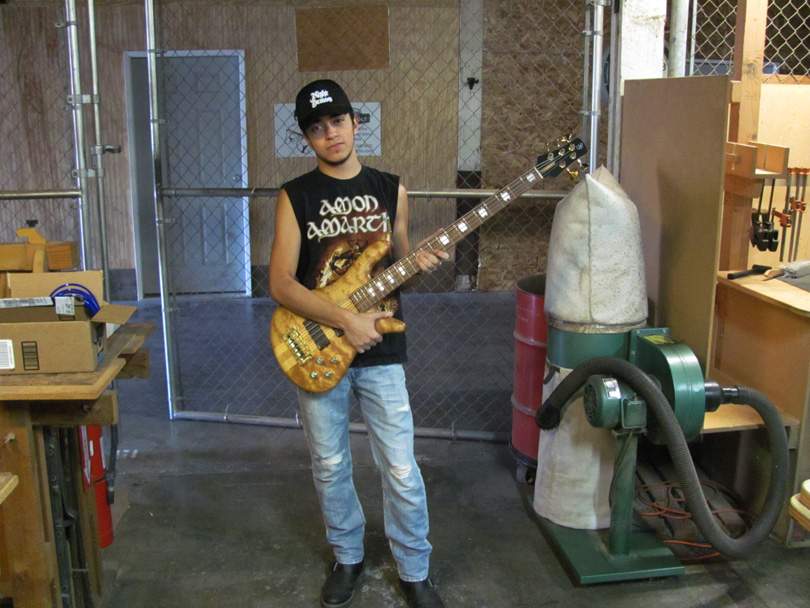
This time, Alex will be repairing two nice Pedullas, from two different owners. Both have broken truss rods. Both owners couldn't find any other Luthiers willing to do the repair, including contacting Mike Pedulla himself. Mike is semi-retired now. He does some service work on his instruments, but not heavy repair work like this.
Keith Horne and I will be helping Alex with these two repair jobs. Keith has more experience than I do in removing fingerboards like these. I'll help with any machine shop work needed to make the replacement truss rod parts. I'll also document it all on here.
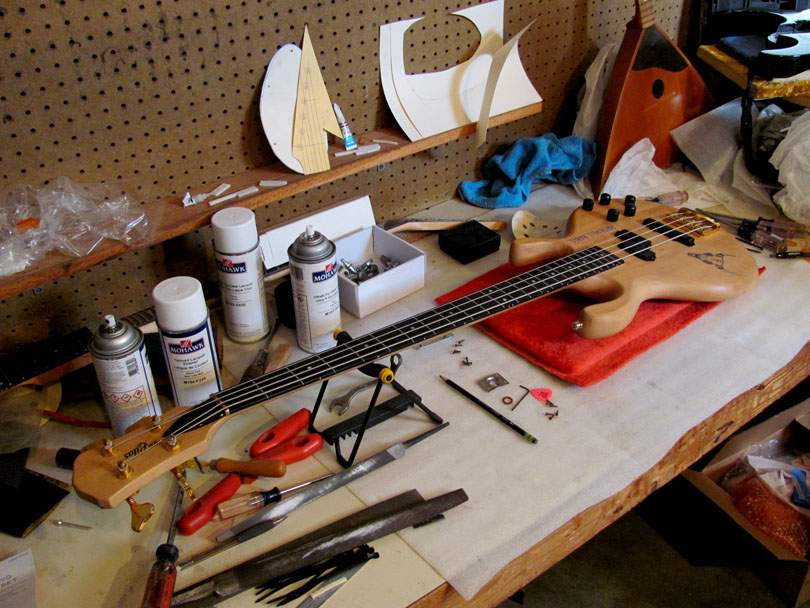
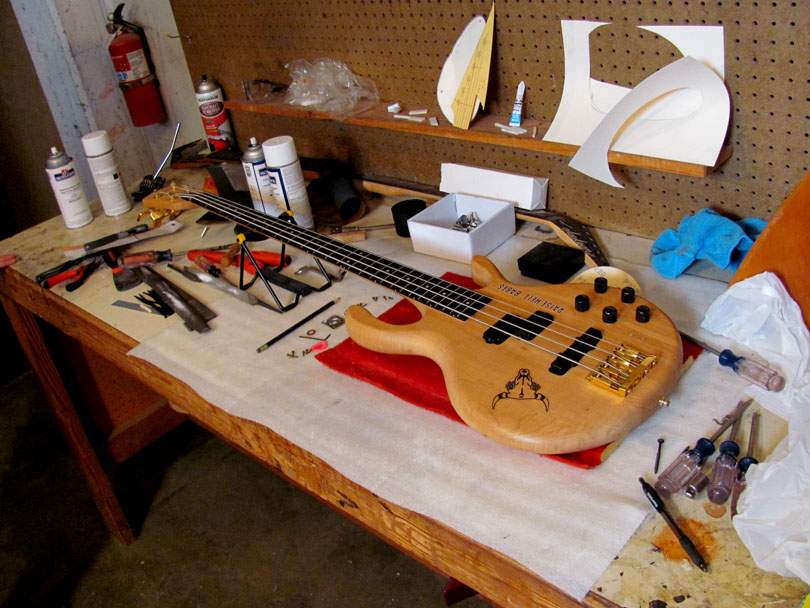
The first Pedulla belongs to Inara in Seattle. It's a mid-80's Buzz 4-string fretless. When she bought it, someone had already stripped/sanded it all down to the bare wood. She added a few of her own logos and a simple oil finish. It's a solid player. She admits that she accidentally broke the truss rod herself while working with the setup. Here it is on Alex's bench:
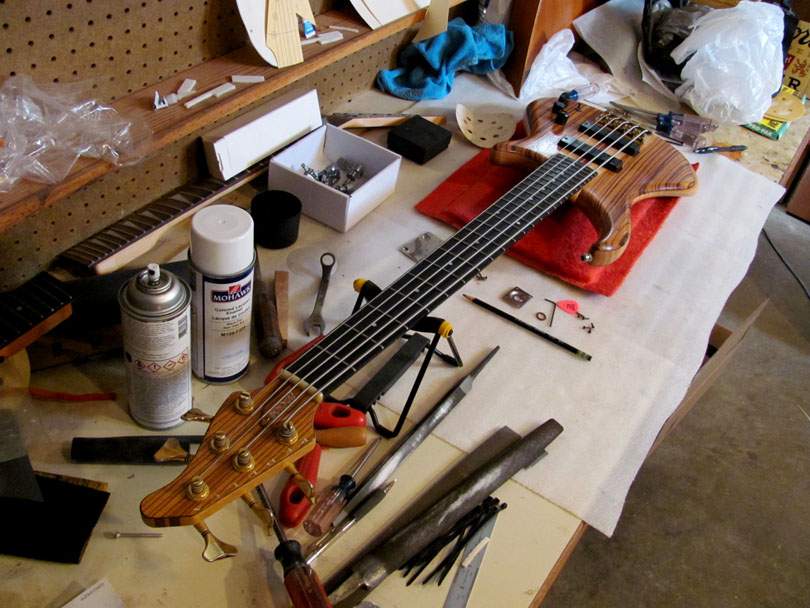
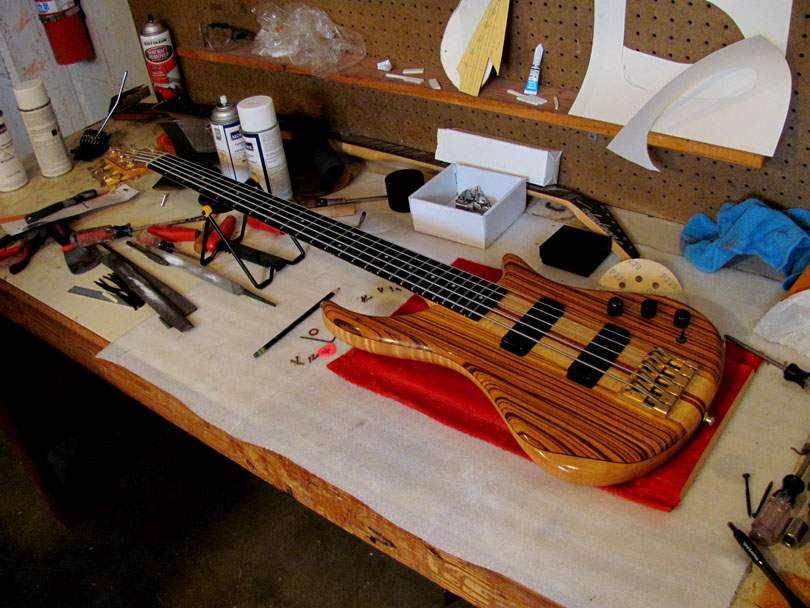
The second Pedulla is from Mike in New York. It's a 1996 ET-5 5-string Thunder Bass, fretted. Nice and clean, looks like a zebrawood top and headstock cap. Mike loves it and considers it his main player. But the truss rod got broken somehow.
I've never opened up a Pedulla's neck, but I understand that Mike made his own custom truss rods, his own design. And they turn in the opposite direction from most truss rods, which is part of the reason why they sometimes get broken. I'm curious to see what's inside. When we take a look, we'll decide whether to make up exact replica parts, or to improve on the design and make something stronger.
Before disassembling them, a quick inspection shows that both of these necks are actually in nice shape. Even with non-functioning truss rods, Inara's Thumb is almost dead flat, and Mike's ThunderBass has only a slight forward bow. Neither have any serious warpage problems. That's always a worry when I see a bass with a broken truss rod. Often the reason the truss rod got broken is because the neck is badly bowed. Not here. That makes the repair job a lot easier.
Also, these Pedullas both have ebony fingerboards, fairly thick. That's a good thing. To repair these two, Alex will be using gentle heat and patience to soften the glue and remove the fingerboards from the necks. That's the trickiest part of the job. If all goes well, the fingerboards will come off clean, and stay flat and straight.
After we figure out how to repair/replace the truss rod, the fingerboards will get cleaned up and carefully glued back on. Hopefully with minimal change to the fingerboard surface and frets. Just a light touchup and leveling.
But, sometimes when removing fingerboards like this, they can crack or break or curl up and twist. Then, you have to put on a put on a new fingerboard, recutting the radius, slotting, refretting, etc. A much more complicated job, especially on neck-through basses like these. This is mostly a problem when the fingerboard is cut real thin, or is made from a board with very weaving grain.
These two Pedullas have nice thick ebony boards, high quality wood. So, I'm confident that they will come apart easily. Alex is taking off the strings and nuts. He'll be starting the surgery in the next day or two.....
Most of the work on this job will be done by Alex. He joined us recently, and has set up a shop right down the hall from mine. We old grey-haired Luthiers have been teaching him the instrument repair business and helping him get going at it. You may have seen the thread where he repaired a sweet old Spector with a broken-off headstock. I guided him through the job, and documented it here:
Spector NS-5 USA Model w/ Broken Headstock Thoughts?
This time, Alex will be repairing two nice Pedullas, from two different owners. Both have broken truss rods. Both owners couldn't find any other Luthiers willing to do the repair, including contacting Mike Pedulla himself. Mike is semi-retired now. He does some service work on his instruments, but not heavy repair work like this.
Keith Horne and I will be helping Alex with these two repair jobs. Keith has more experience than I do in removing fingerboards like these. I'll help with any machine shop work needed to make the replacement truss rod parts. I'll also document it all on here.
The first Pedulla belongs to Inara in Seattle. It's a mid-80's Buzz 4-string fretless. When she bought it, someone had already stripped/sanded it all down to the bare wood. She added a few of her own logos and a simple oil finish. It's a solid player. She admits that she accidentally broke the truss rod herself while working with the setup. Here it is on Alex's bench:
The second Pedulla is from Mike in New York. It's a 1996 ET-5 5-string Thunder Bass, fretted. Nice and clean, looks like a zebrawood top and headstock cap. Mike loves it and considers it his main player. But the truss rod got broken somehow.
I've never opened up a Pedulla's neck, but I understand that Mike made his own custom truss rods, his own design. And they turn in the opposite direction from most truss rods, which is part of the reason why they sometimes get broken. I'm curious to see what's inside. When we take a look, we'll decide whether to make up exact replica parts, or to improve on the design and make something stronger.
Before disassembling them, a quick inspection shows that both of these necks are actually in nice shape. Even with non-functioning truss rods, Inara's Thumb is almost dead flat, and Mike's ThunderBass has only a slight forward bow. Neither have any serious warpage problems. That's always a worry when I see a bass with a broken truss rod. Often the reason the truss rod got broken is because the neck is badly bowed. Not here. That makes the repair job a lot easier.
Also, these Pedullas both have ebony fingerboards, fairly thick. That's a good thing. To repair these two, Alex will be using gentle heat and patience to soften the glue and remove the fingerboards from the necks. That's the trickiest part of the job. If all goes well, the fingerboards will come off clean, and stay flat and straight.
After we figure out how to repair/replace the truss rod, the fingerboards will get cleaned up and carefully glued back on. Hopefully with minimal change to the fingerboard surface and frets. Just a light touchup and leveling.
But, sometimes when removing fingerboards like this, they can crack or break or curl up and twist. Then, you have to put on a put on a new fingerboard, recutting the radius, slotting, refretting, etc. A much more complicated job, especially on neck-through basses like these. This is mostly a problem when the fingerboard is cut real thin, or is made from a board with very weaving grain.
These two Pedullas have nice thick ebony boards, high quality wood. So, I'm confident that they will come apart easily. Alex is taking off the strings and nuts. He'll be starting the surgery in the next day or two.....
Last edited: