
Enjoy the benefits of a premium membership!
Upgrade Account
-
TalkBass has been independent since 1998. Add your voice.
Create a free account to reply to discussions, view embedded media, and browse with fewer display ads.
Join free Log in
Want zero display ads or expanded classifieds tools? Compare plans.
You are using an out of date browser. It may not display this or other websites correctly.
You should upgrade or use an alternative browser.
You should upgrade or use an alternative browser.
Scary Repairs: Two Pedullas With Broken Truss Rods
- Thread starter Bruce Johnson
- Start date
More options
Who Replied?



Exactly the questions I was going to ask. Using LH threads seems like an open invitation to disaster.What is the reason Mike created his own unique type of TR, and why did he reverse to usual way of tightening/loosening it?

I never got around to completing this thread. Basically, I got personally interrupted by cancer and heart surgery that cost me nearly two years of shop life. But, I'm recovered and back. While I was doing that, I turned over these two Pedulla truss rod replacement jobs to my friend Randy Robinson. He completed them both and they are happily back with their owners.
Once we had routed the fingerboards off, we found that it was relatively simple to pull out the original Pedulla design truss rods and install modern aftermarket double-acting double-rod style truss rod assemblies. I think he used LMI brand. They were almost a perfect fit in the necks with minimal trimming of the internal wood.
And the new truss rods are working fine. The necks are strong and adjustable and back in service.
So, the conclusion is that repairing a broken truss rod in a Pedulla like these is not a big deal. Most of the work is in removing the fingerboard, then putting on a new one, and radiusing, slotting and fretting it. Yes, you have to remove the fingerboard. The Pedulla truss rod must be pulled from the top; it cannot be removed or repaired working from either end.
It may be possible to remove a Pedulla fingerboard by heat, but it's very difficult. We tried sincerely and failed. So we went with routing off the old fingerboards, using my big pin router.
Once we had routed the fingerboards off, we found that it was relatively simple to pull out the original Pedulla design truss rods and install modern aftermarket double-acting double-rod style truss rod assemblies. I think he used LMI brand. They were almost a perfect fit in the necks with minimal trimming of the internal wood.
And the new truss rods are working fine. The necks are strong and adjustable and back in service.
So, the conclusion is that repairing a broken truss rod in a Pedulla like these is not a big deal. Most of the work is in removing the fingerboard, then putting on a new one, and radiusing, slotting and fretting it. Yes, you have to remove the fingerboard. The Pedulla truss rod must be pulled from the top; it cannot be removed or repaired working from either end.
It may be possible to remove a Pedulla fingerboard by heat, but it's very difficult. We tried sincerely and failed. So we went with routing off the old fingerboards, using my big pin router.
Exactly the questions I was going to ask. Using LH threads seems like an open invitation to disaster.
Here's a post of mine on another thread about Pedulla truss rods, where I explain most of that:
Anyway, this spring I turned the Pedullas over to Randy Robinsen, another Luthier here in the same building as me. He got going on them, with some technical guidance from me. We routed off the fingerboards in my big green pin router.
Here's what we discovered about the truss rods:
Inara's 4-string, the earlier one, had a conventional Double-Acting Double-Rod truss rod, similar to the ones that everyone sells today. However, it was installed upside down. Normally, you install these truss rods with the rotating rod (which has the nut on it) on the bottom. In this Pedulla, it was on top, which made the operation reversed. You had to turn the nut counter clockwise to bend the neck backward. The nut is brazed to the rod and can't be removed. In Inara's bass, it got snapped off.
Mike's 5-string, a newer one, had a completely custom truss rod design. It's a single rod that's left-hand thread on one end and right-hand thread on the other. It threads into anchor blocks at both ends. Turning the rod CCW spreads the blocks apart, bending the neck back. The outward end of the rod is machined into a small square. You have to use a special wrench to turn it. This is the end that frequently gets rounded off, as it was on Mike's bass.
The good news for both of these basses is that there's plenty of room in the necks for a conventional modern aftermarket DADR truss rod. Hardly any trimming or filling needed. So, that's what Randy is doing. Both Pedullas are being fitted with standard DADR truss rods, which will rotate in the conventional direction. It turned out to be a simpler repair job than we expected.
So, to answer Stefanos question, your bass probably has the custom truss rod. You are seeing a threaded rod sticking out, which was square, but is now rounded off? Or are you seeing a steel cylinder which had a hex socket in it, but is now rounded out? Either way, it can't be fixed from the outside. The fingerboard has to come off, and the whole truss rod replaced. The good news is that you can use a commonly available aftermarket truss rod. I think Randy is using ones from LMII.
Warning: There may be two large 1/4" steel dowel pins in there, used to align the fingerboard to the body. They are directly under the first and last white dots. If you hit them with a router, things will go flying. We almost hit them when cutting the fingerboard off Mike's 5-string.
Here's that whole thread, if you want to know more:Here's what we discovered about the truss rods:
Inara's 4-string, the earlier one, had a conventional Double-Acting Double-Rod truss rod, similar to the ones that everyone sells today. However, it was installed upside down. Normally, you install these truss rods with the rotating rod (which has the nut on it) on the bottom. In this Pedulla, it was on top, which made the operation reversed. You had to turn the nut counter clockwise to bend the neck backward. The nut is brazed to the rod and can't be removed. In Inara's bass, it got snapped off.
Mike's 5-string, a newer one, had a completely custom truss rod design. It's a single rod that's left-hand thread on one end and right-hand thread on the other. It threads into anchor blocks at both ends. Turning the rod CCW spreads the blocks apart, bending the neck back. The outward end of the rod is machined into a small square. You have to use a special wrench to turn it. This is the end that frequently gets rounded off, as it was on Mike's bass.
The good news for both of these basses is that there's plenty of room in the necks for a conventional modern aftermarket DADR truss rod. Hardly any trimming or filling needed. So, that's what Randy is doing. Both Pedullas are being fitted with standard DADR truss rods, which will rotate in the conventional direction. It turned out to be a simpler repair job than we expected.
So, to answer Stefanos question, your bass probably has the custom truss rod. You are seeing a threaded rod sticking out, which was square, but is now rounded off? Or are you seeing a steel cylinder which had a hex socket in it, but is now rounded out? Either way, it can't be fixed from the outside. The fingerboard has to come off, and the whole truss rod replaced. The good news is that you can use a commonly available aftermarket truss rod. I think Randy is using ones from LMII.
Warning: There may be two large 1/4" steel dowel pins in there, used to align the fingerboard to the body. They are directly under the first and last white dots. If you hit them with a router, things will go flying. We almost hit them when cutting the fingerboard off Mike's 5-string.
Pedulla MVP worn truss rod nut

Here's that whole thread, if you want to know more:
Inara's 4-string, the earlier one, had a conventional Double-Acting Double-Rod truss rod, similar to the ones that everyone sells today. However, it was installed upside down. Normally, you install these truss rods with the rotating rod (which has the nut on it) on the bottom. In this Pedulla, it was on top, which made the operation reversed. You had to turn the nut counter clockwise to bend the neck backward. The nut is brazed to the rod and can't be removed. In Inara's bass, it got snapped off.
Mike's 5-string, a newer one, had a completely custom truss rod design. It's a single rod that's left-hand thread on one end and right-hand thread on the other. It threads into anchor blocks at both ends. Turning the rod CCW spreads the blocks apart, bending the neck back. The outward end of the rod is machined into a small square. You have to use a special wrench to turn it. This is the end that frequently gets rounded off, as it was on Mike's bass.
The good news for both of these basses is that there's plenty of room in the necks for a conventional modern aftermarket DADR truss rod. Hardly any trimming or filling needed. So, that's what Randy is doing. Both Pedullas are being fitted with standard DADR truss rods, which will rotate in the conventional direction. It turned out to be a simpler repair job than we expected.
So, to answer Stefanos question, your bass probably has the custom truss rod. You are seeing a threaded rod sticking out, which was square, but is now rounded off? Or are you seeing a steel cylinder which had a hex socket in it, but is now rounded out? Either way, it can't be fixed from the outside. The fingerboard has to come off, and the whole truss rod replaced. The good news is that you can use a commonly available aftermarket truss rod. I think Randy is using ones from LMII.
Warning: There may be two large 1/4" steel dowel pins in there, used to align the fingerboard to the body. They are directly under the first and last white dots. If you hit them with a router, things will go flying. We almost hit them when cutting the fingerboard off Mike's 5-string.
Pedulla MVP worn truss rod nut
Ran across this a couple of times, the most recent being a Maruszczyk Frog. I'm hard-pressed to define any mechanical benefits but it does allow easier access...a "straight shot"...with the nut positioned on top. Pure speculation on my part.
Riis

@Bruce Johnson Glad you're recovered and are back to living your life! Thanks for this followup, sharing valuable info, too.
The truss rod adjustment tab broke off my beloved PentaBuzz years ago, my sole fretless performance bass. The "maker" quoted me $2k to replace the rod with the same frail-tab type, with a limiting statement that the repair would be obvious in the finish blending, after repair.
I was also scolded for not returning the bass prior to the tab breaking off, as if I knew that was going to happen. I was pretty heartbroken and sick by all of it. I decided to cut my loss, selling the bass for $900 by eBay auction, supplying full condition disclosure in the listing title.
At that time there was no anecdotal evidence as you've presented in this thread. You've definitely answered important questions to help anyone performing a future repair of this type. Had I known that a standard rod would work, that minimal wood needed to be removed from the channel, that the fb needed to be milled off (vs heated), and that there are steel anchor pins at the inlays at the first and last positions, I could have found a luthier to help me with the repair.
Back when my truss rod broke, the standard response was, "Probably best to send it back to the maker, as the truss rod and construction are proprietary." Now that the said company is defunct, not even that option is available for anyone needing service/repair help. So, your info opens the door to extending the life of those otherwise great basses, with the assistance of a trusted, now-informed luthier. Thanks again : )
The truss rod adjustment tab broke off my beloved PentaBuzz years ago, my sole fretless performance bass. The "maker" quoted me $2k to replace the rod with the same frail-tab type, with a limiting statement that the repair would be obvious in the finish blending, after repair.
I was also scolded for not returning the bass prior to the tab breaking off, as if I knew that was going to happen. I was pretty heartbroken and sick by all of it. I decided to cut my loss, selling the bass for $900 by eBay auction, supplying full condition disclosure in the listing title.
At that time there was no anecdotal evidence as you've presented in this thread. You've definitely answered important questions to help anyone performing a future repair of this type. Had I known that a standard rod would work, that minimal wood needed to be removed from the channel, that the fb needed to be milled off (vs heated), and that there are steel anchor pins at the inlays at the first and last positions, I could have found a luthier to help me with the repair.
Back when my truss rod broke, the standard response was, "Probably best to send it back to the maker, as the truss rod and construction are proprietary." Now that the said company is defunct, not even that option is available for anyone needing service/repair help. So, your info opens the door to extending the life of those otherwise great basses, with the assistance of a trusted, now-informed luthier. Thanks again : )
Last edited:
It makes sense now. At the time I posted, I didn't realize it was double actingHere's a post of mine on another thread about Pedulla truss rods, where I explain most of that:
Anyway, this spring I turned the Pedullas over to Randy Robinsen, another Luthier here in the same building as me. He got going on them, with some technical guidance from me. We routed off the fingerboards in my big green pin router.Here's that whole thread, if you want to know more:
Here's what we discovered about the truss rods:
Inara's 4-string, the earlier one, had a conventional Double-Acting Double-Rod truss rod, similar to the ones that everyone sells today. However, it was installed upside down. Normally, you install these truss rods with the rotating rod (which has the nut on it) on the bottom. In this Pedulla, it was on top, which made the operation reversed. You had to turn the nut counter clockwise to bend the neck backward. The nut is brazed to the rod and can't be removed. In Inara's bass, it got snapped off.
Mike's 5-string, a newer one, had a completely custom truss rod design. It's a single rod that's left-hand thread on one end and right-hand thread on the other. It threads into anchor blocks at both ends. Turning the rod CCW spreads the blocks apart, bending the neck back. The outward end of the rod is machined into a small square. You have to use a special wrench to turn it. This is the end that frequently gets rounded off, as it was on Mike's bass.
The good news for both of these basses is that there's plenty of room in the necks for a conventional modern aftermarket DADR truss rod. Hardly any trimming or filling needed. So, that's what Randy is doing. Both Pedullas are being fitted with standard DADR truss rods, which will rotate in the conventional direction. It turned out to be a simpler repair job than we expected.
So, to answer Stefanos question, your bass probably has the custom truss rod. You are seeing a threaded rod sticking out, which was square, but is now rounded off? Or are you seeing a steel cylinder which had a hex socket in it, but is now rounded out? Either way, it can't be fixed from the outside. The fingerboard has to come off, and the whole truss rod replaced. The good news is that you can use a commonly available aftermarket truss rod. I think Randy is using ones from LMII.
Warning: There may be two large 1/4" steel dowel pins in there, used to align the fingerboard to the body. They are directly under the first and last white dots. If you hit them with a router, things will go flying. We almost hit them when cutting the fingerboard off Mike's 5-string.
Pedulla MVP worn truss rod nut

Happy to read you are all mended up, now, Bruce. Are you at 100%, now?
Thanks! I'm not at 100% of where I was 3 years ago. Maybe 80% in energy, strength and endurance. My rebuilt heart distinctly has a "governor" on it. Like a Big Block V-8 pickup with a 2 barrel carburetor. It runs smoothly carrying light loads, and can carry heavier loads for short bursts. But I can't carry a heavy load up a hill without having to stop and rest and catch my breath. No more full throttle low gear climbs for me.
But I'm back working full time in the shop, my usual crazy hours. I just take the muscular work at a slow steady pace, and take rest breaks when I feel like it. I'm thankful for that. I'm not an old man in a couch. I think I can go another 20-30 years of productive shop life building stuff.
@Bruce Johnson Glad you're recovered and are back to living your life! Thanks for this followup, sharing valuable info, too.
The truss rod adjustment tab broke off my beloved PentaBuzz years ago, my sole fretless performance bass. The "maker" quoted me $2k to replace the rod with the same frail-tab type, with a limiting statement that the repair would be obvious in the finish blending, after repair.
I was also scolded for not returning the bass prior to the tab breaking off, as if I knew that was going to happen. I was pretty heartbroken and sick by all of it. I decided to cut my loss, selling the bass for $900 by eBay auction, supplying full condition disclosure in the listing title.
At that time there was no anecdotal evidence as you've presented in this thread. You've definitely answered important questions to help anyone performing a future repair of this type. Had I known that a standard rod would work, that minimal wood needed to be removed from the channel, that the fb needed to be milled off (vs heated), and that there are steel anchor pins at the inlays at the first and last positions, I could have found a luthier to help me with the repair.
Back when my truss rod broke, the standard response was, "Probably best to send it back to the maker, as the truss rod and construction are proprietary." Now that the said company is defunct, not even that option is available for anyone needing service/repair help. So, your info opens the door to extending the life of those otherwise great basses, with the assistance of a trusted, now-informed luthier. Thanks again : )
The special truss rod is actually a nice mechanical design and was well made. Two problems: The CCW rotation to tighten was asking for trouble with owners who wouldn't read the directions. And they should have put some better head on the end of the rod. A hex nut or socket head nut brazed on.
It wouldn't be difficult to build a replacement Pedulla truss rod with those two changes. If I had finished up those two repair jobs, I probably would have done that. Just to show everyone how. But Randy went with common DADR rod assemblies to get the jobs done efficiently. And they work fine.
I never got around to completing this thread. Basically, I got personally interrupted by cancer and heart surgery that cost me nearly two years of shop life. But, I'm recovered and back. While I was doing that, I turned over these two Pedulla truss rod replacement jobs to my friend Randy Robinson. He completed them both and they are happily back with their owners.
Once we had routed the fingerboards off, we found that it was relatively simple to pull out the original Pedulla design truss rods and install modern aftermarket double-acting double-rod style truss rod assemblies. I think he used LMI brand. They were almost a perfect fit in the necks with minimal trimming of the internal wood.
And the new truss rods are working fine. The necks are strong and adjustable and back in service.
So, the conclusion is that repairing a broken truss rod in a Pedulla like these is not a big deal. Most of the work is in removing the fingerboard, then putting on a new one, and radiusing, slotting and fretting it. Yes, you have to remove the fingerboard. The Pedulla truss rod must be pulled from the top; it cannot be removed or repaired working from either end.
It may be possible to remove a Pedulla fingerboard by heat, but it's very difficult. We tried sincerely and failed. So we went with routing off the old fingerboards, using my big pin router.
Bruce, two things:
1. I'm extremely glad to hear that your health has improved.
2. Randy never returned my bass to me. The last email I received form him was in 2020, and he didn't respond to my latest request for an update. Could you let me know what he told you?
Last edited:
Bruce, two things:
1. I'm extremely glad to hear that your health has improved.
2. Randy never returned my bass to me. The last email I received form him was in 2020, and he didn't respond to my latest request for an update. Could you let me know what he told you?
Wow, I didn't know that. I thought it was long finished and returned to you. I'll call him tomorrow and find out what's going on. Randy has moved out of the shop down the hall from me, but we still stay in touch and do jobs back and forth regularly.
Wow, I didn't know that. I thought it was long finished and returned to you. I'll call him tomorrow and find out what's going on. Randy has moved out of the shop down the hall from me, but we still stay in touch and do jobs back and forth regularly.
Thanks Bruce -- I had sent him a couple emails and called a few times, but I assumed there was some health/facility challenges occurring and it seemed like he was doing you a favor, so I wanted to give you all as much space and time as you needed. My apologies if I backed off a bit too far and it fell through the cracks, but I'm always available and reachable. I had sent Randy my contact info a while back, and also emailed him last night after making this post. Let me know what I can do. Thanks!
Well, to anyone still subscribed to this thread, I figured I'd stop in and close the loop. I received my bass from Randy a couple weeks back, and it turned out great! I was afraid it would feel/play differently given the extent of the work that had to be done, but I was pleasantly surprised to find that it looks and plays exactly as I remembered. If it weren't for the fact that I saw progress pics and that the truss head is now obviously a stock model instead of the proprietary Pedulla it had before, I'd have even questioned that anything happened to it at all. Really impressive work! I've hardly been able to put it down since I got it back.
I want to thank you for coordinating this, Bruce. I've got to be honest (I hope understandably) that my feelings about your friend Randy are a bit... mixed... given that, despite the fact that the work had been done for some time, he didn't seem to have any intent to communicate with me or send my bass back at all until you followed up on my behalf. But, I know it's been a tough few years for many reasons and your intent was for this to go smoother than it did. Even though the uncertainty was stressful (I had emotionally accepted that I would never see my bass again until about December), if I'd somehow been able to know ahead of time that I'd need to send the bass away for a few years to get it fixed up like it has been, I probably would have signed up anyway.
So, all's well that ends well. I wish you the best, Bruce. Thanks again!
I want to thank you for coordinating this, Bruce. I've got to be honest (I hope understandably) that my feelings about your friend Randy are a bit... mixed... given that, despite the fact that the work had been done for some time, he didn't seem to have any intent to communicate with me or send my bass back at all until you followed up on my behalf. But, I know it's been a tough few years for many reasons and your intent was for this to go smoother than it did. Even though the uncertainty was stressful (I had emotionally accepted that I would never see my bass again until about December), if I'd somehow been able to know ahead of time that I'd need to send the bass away for a few years to get it fixed up like it has been, I probably would have signed up anyway.
So, all's well that ends well. I wish you the best, Bruce. Thanks again!
I hope that I never have to send my Pedulla away to be repaired. Mine is an early model with the "regular/conventional" truss rod, so hopefully it lasts forever.
Well, to anyone still subscribed to this thread, I figured I'd stop in and close the loop. I received my bass from Randy a couple weeks back, and it turned out great! I was afraid it would feel/play differently given the extent of the work that had to be done, but I was pleasantly surprised to find that it looks and plays exactly as I remembered. If it weren't for the fact that I saw progress pics and that the truss head is now obviously a stock model instead of the proprietary Pedulla it had before, I'd have even questioned that anything happened to it at all. Really impressive work! I've hardly been able to put it down since I got it back.
I want to thank you for coordinating this, Bruce. I've got to be honest (I hope understandably) that my feelings about your friend Randy are a bit... mixed... given that, despite the fact that the work had been done for some time, he didn't seem to have any intent to communicate with me or send my bass back at all until you followed up on my behalf. But, I know it's been a tough few years for many reasons and your intent was for this to go smoother than it did. Even though the uncertainty was stressful (I had emotionally accepted that I would never see my bass again until about December), if I'd somehow been able to know ahead of time that I'd need to send the bass away for a few years to get it fixed up like it has been, I probably would have signed up anyway.
So, all's well that ends well. I wish you the best, Bruce. Thanks again!
I'm very glad to hear that, Mike! I was concerned, too.
Randy moved out of his shop here in the Lab last September. He's now operating just out of his home shop in North Hollywood. I talk to him occasionally, but not as often as before. He's asked me specifically not to recommend any more major bass repair jobs to him. He's got all the work he can handle from local customers, doing setups and basic fretwork on mostly guitars. That's what he really likes doing. I tried to get him to get into heavier repairs, like truss rod replacements, but it's not his thing. He took a real long time finishing your bass (and another bass neck job that I sent to him), and wouldn't update you. That's not right. I think he got a little overwhelmed with it and just kept avoiding it. He eventually completed it well, but he doesn't want any more.
I've been trying to find and train someone else to do these neck rebuild/truss rod replacement jobs. Someone could make a decent living specializing in that if they want to. Mail order neck rebuilds. Particularly if they have some experience with "exotic" basses like Pedullas. I have two Wals here right now with...you guessed it...broken truss rods. These are $7K basses. The owners have been searching for years to find anyone who will repair them. I don't really have the time to repair them, but I agreed to out of sympathy.
I've been working with a young guy, Ellis, who is doing well as a guitar/bass tech. I've been teaching him the fine points of fretwork and small repairs. He's interested in learning neck repairs, but he has a ways to go.
If anyone reading this is interested, or knows of someone who is interested, in becoming a specialist in neck rebuilds, please contact me. I'll be glad to offer advise and guidance, and refer jobs.

Thanks for the update! Glad you’re back on your feet - you’re a badass, mind if I call you “Juice Bronson”? 
As the owner of 2 Raptures with healthy truss rods/nuts, and the former owner of a ThunderBolt 6 with a stripped truss nut (not disclosed by eBay jagoff seller!!) it’s great to see what’s involved with Pedulla truss rod replacement. Honestly the Raptures have the most “adjustable yet stable” necks I’ve seen in 38 years of playing.
As the owner of 2 Raptures with healthy truss rods/nuts, and the former owner of a ThunderBolt 6 with a stripped truss nut (not disclosed by eBay jagoff seller!!) it’s great to see what’s involved with Pedulla truss rod replacement. Honestly the Raptures have the most “adjustable yet stable” necks I’ve seen in 38 years of playing.

Great to hear health has improved and the bass was fixed up nicely.
My Thunderbass which has a chewed TR nut, has actually (thankfully) been super stable - the nut LOOKS nasty, but there is enough shoulder in there to grab whenever needed...I have had that confirmed by a few sets of eyes. The bass itself is far to good to give up on - I 'almost' turned it into a project and was going to start heating and stripping the FB...but felt i'd wait until I 'need' too - so far so good. All the best
My Thunderbass which has a chewed TR nut, has actually (thankfully) been super stable - the nut LOOKS nasty, but there is enough shoulder in there to grab whenever needed...I have had that confirmed by a few sets of eyes. The bass itself is far to good to give up on - I 'almost' turned it into a project and was going to start heating and stripping the FB...but felt i'd wait until I 'need' too - so far so good. All the best
A fresh chapter to an old thread:
We recently rebuilt another Pedulla neck that had.....yep, you guessed it....a broken truss rod. This was an older bolt-on model 5-string, with a bird's eye maple fingerboard and a bright red headstock. An unusual look for a Pedulla! Anyway, it had the old-style special Pedulla truss rod with the small square tip that requires the special key. And it turns the "wrong" direction. And, as is quite common, the little square end got sheared off.
The owner looked around for several years, trying to find anyone who would repair it. Then he found this thread and contacted me. I agreed to take it in and do the rebuild.
I'm still very, very busy with my Scroll Basses and other things. But these days, I have another Luthier who works here in my shop. Jeremy Kirsch, known as Freekmagnet here on TalkBass. You can see his threads and work over in the Luthier's Corner section. Jeremy is very good at building custom necks from scratch, as well as his own crazy design basses. He's not an employee of mine. He runs his own independent business, and rents time and use of machines in my shop. But we trade jobs back and forth, and help each other on projects.
I passed most of this job to Jeremy, and guided him through it. I made up the new truss rod, but he did everything else. He routed off the old fingerboard, extracted the old truss rod, fitted in the new one, put on a new fingerboard, radiused and slotted it, new dots, new stainless frets.
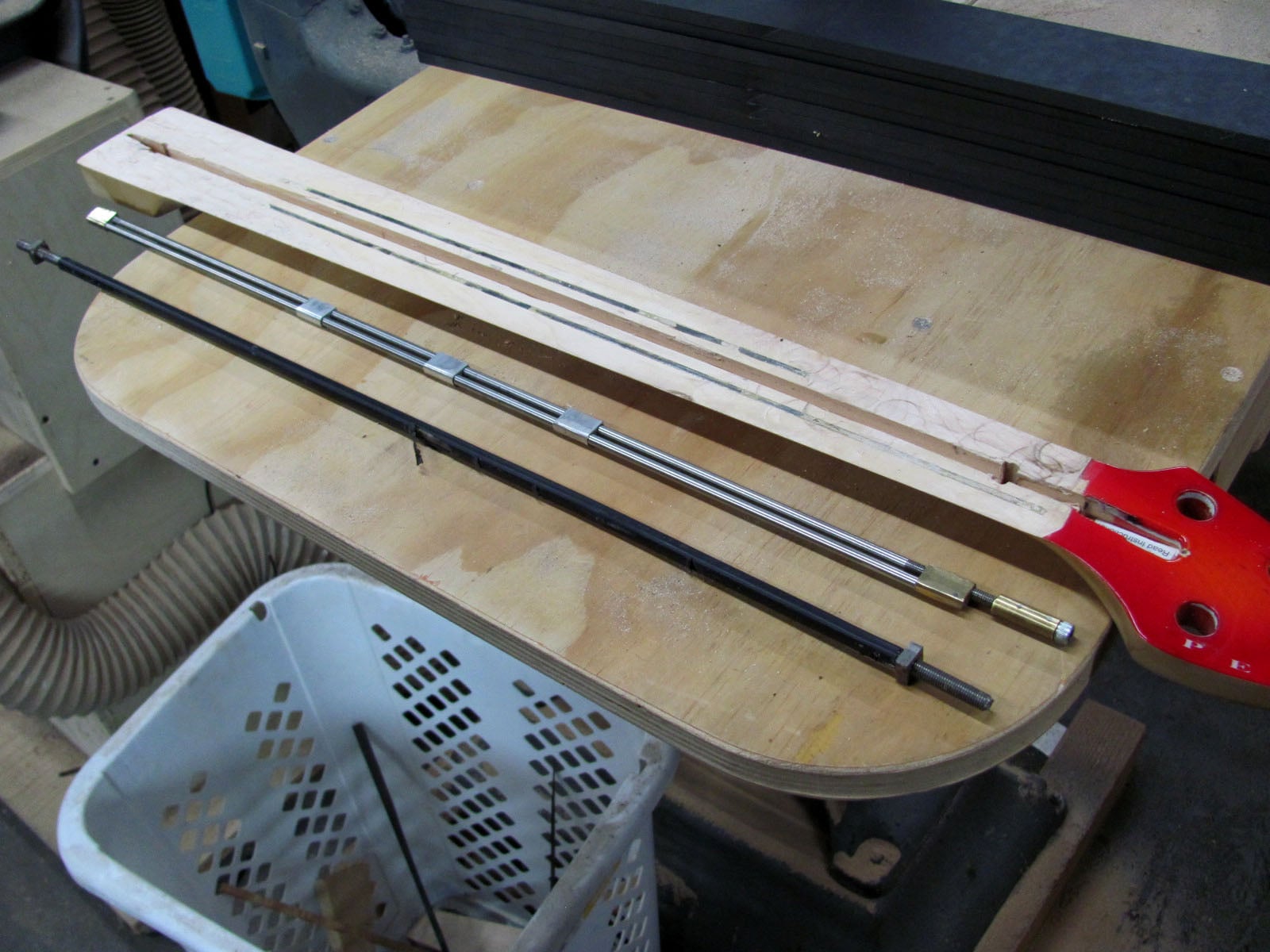
Here's the neck with the fingerboard routed off. That's the original Pedulla truss rod in the foreground. It popped out without any excessive violence. It's a single rod with left hand threads on one end and right hand threads on the other. It looks beefy, but it's a weak design. Poor mechanical ratio, not much neck-bending power. And the end of the rod was machined into a little square tip, which was easy to shear off.
This neck was fairly straight when it arrived here. No serious bowing problem. You can see that it has two steel reinforcing bars in it, and is quite stiff. The owner was trying to adjust the relief a little bit when the tip sheared off. The truss rod was underpowered for the job.
In the middle is the new truss rod that I made up. Over in Luthier's Corner, I have a thread going on where I'm showing everyone how to design and build their own truss rods for their own projects. This is the Double-Acting Double-Rod design that I'm working out. It's just right for this Pedulla neck, almost a drop-in fit. Jeremy only had to do a minor bit of trimming around the adjusting head to fit it in there. This rod is the 2nd prototype of that design, made to the correct length to fit in this neck.
This truss rod is much stronger and more powerful than the original rod. The adjusting head is stainless, taking a 5/32" Allen wrench. And it turns in the normal direction. Installed, it can easily bend the neck 0.100" back and 0.050" forward.
Jeremy machined the fingerboard to straight with the truss rod partially tightened. Good general practice.
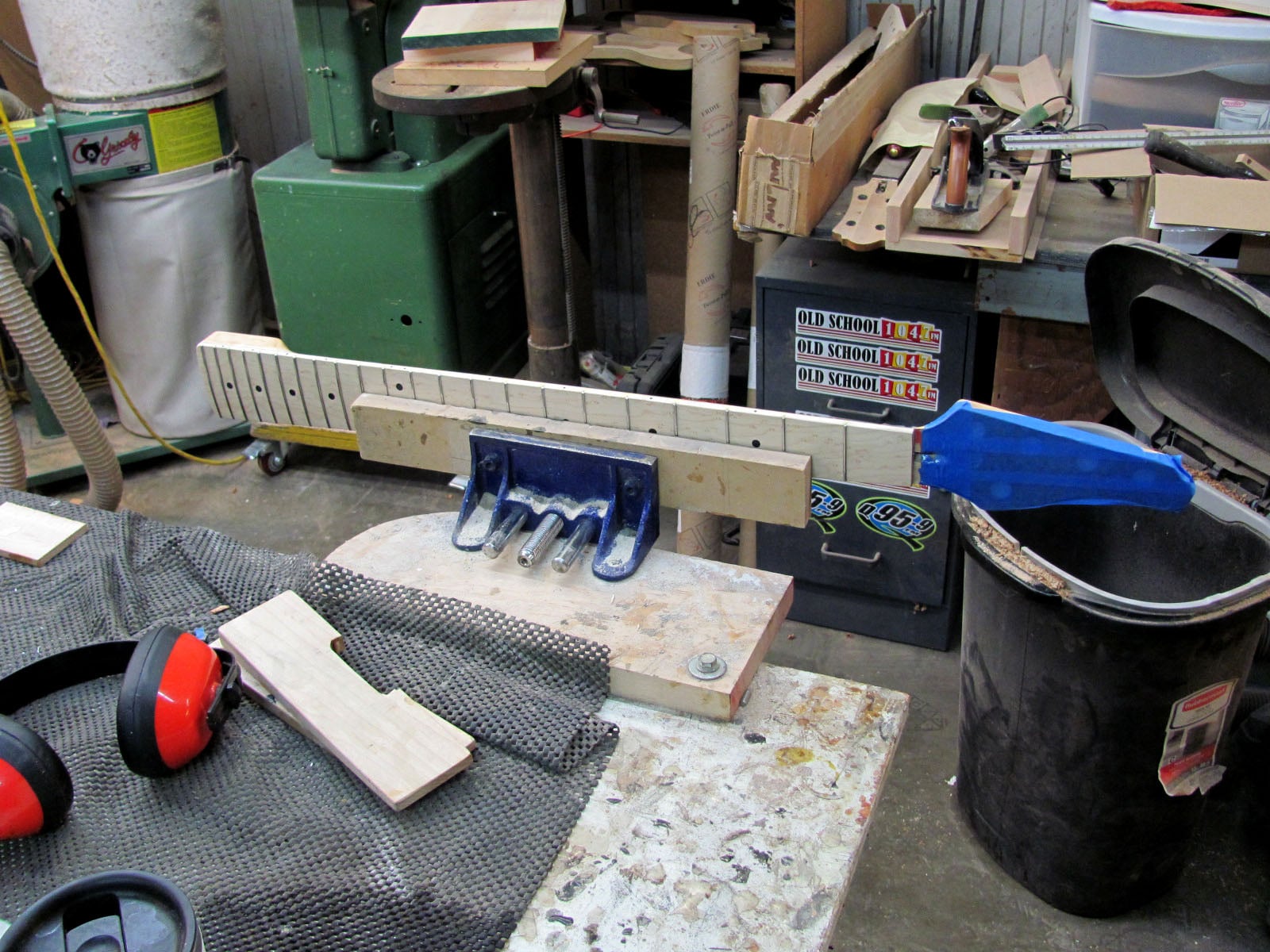
Putting in the side dots. He used black FRP plastic rod stock for the surface dots and the side dots.
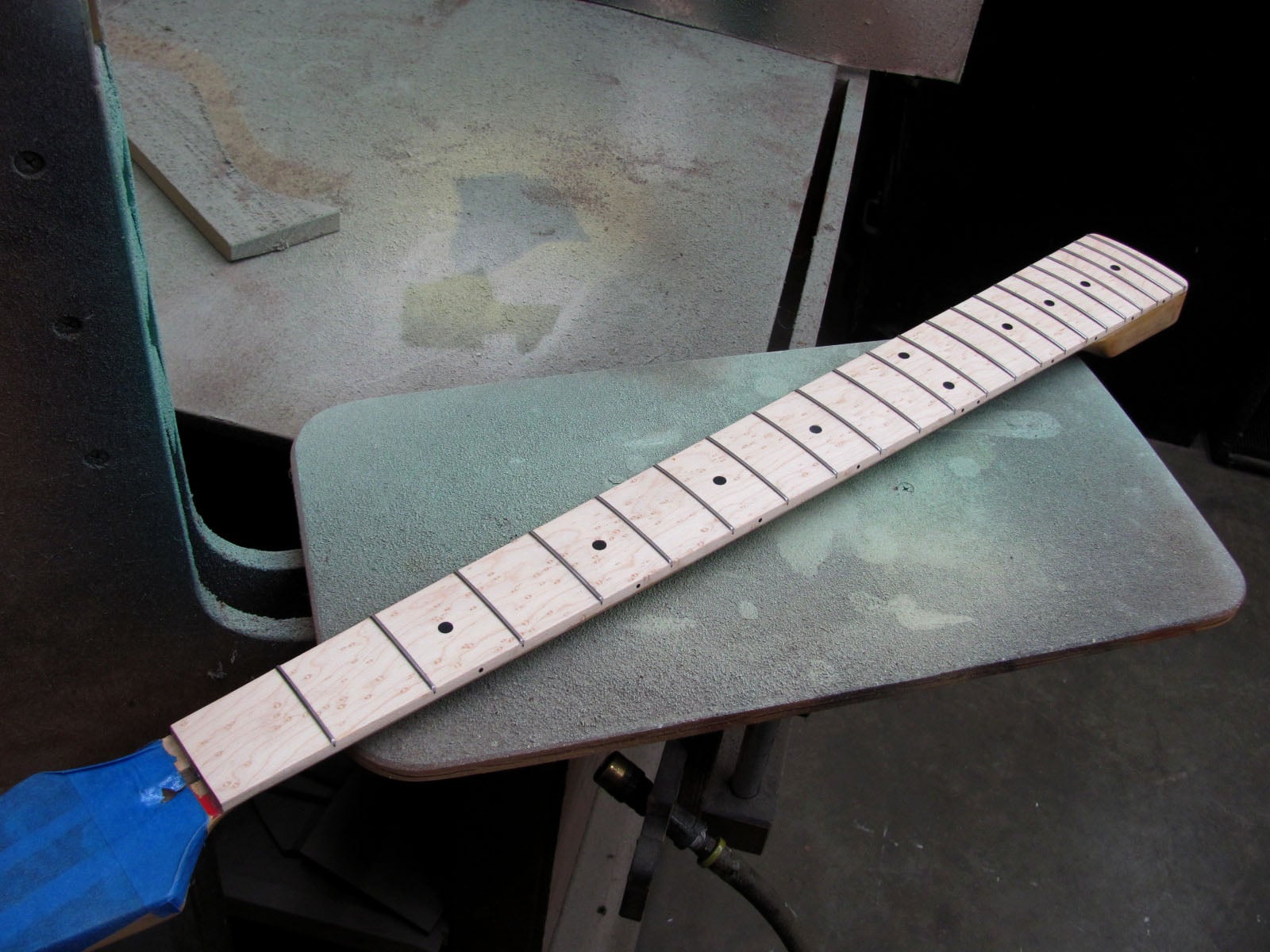
Jeremy sprayed 3 coats of clear polyurethane on the fingerboard before installing the frets and leveling them. Then one more coat after the frets were done, to get them all sealed up. Then buffed the finish off of the frets to their final polish. A maple fingerboard needs to be protected by a finish.
He found a really nice piece of bird's eye maple for the new fingerboard. It's a very close match to the original.
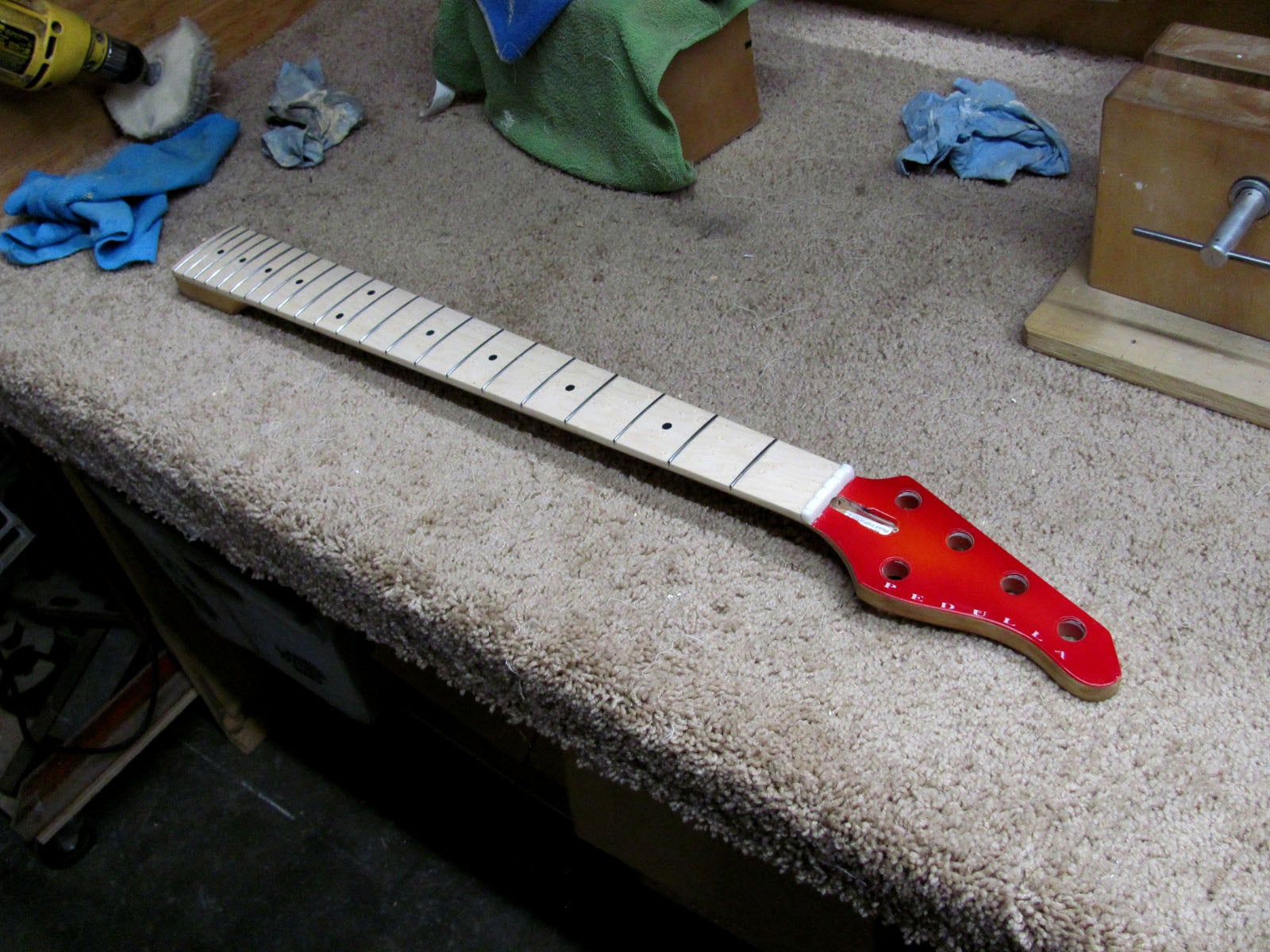
And here's the finished neck. It's on its way back to its owner now. It should be good for many decades of bass fun.
It's interesting seeing a Pedulla with a blonde fingerboard and a bright red headstock. Most Pedullas are dark and woody. Pedullas are fine basses, and I'm happy to help repair them when they have problems.
For your reference, the total bill was $680, including the return shipping.
As I've said throughout this thread, I'm documenting these Scary Neck Repairs jobs to encourage other Luthiers to do these repairs. And to encourage Pedulla owners to get their basses repaired. It's not that difficult.
We recently rebuilt another Pedulla neck that had.....yep, you guessed it....a broken truss rod. This was an older bolt-on model 5-string, with a bird's eye maple fingerboard and a bright red headstock. An unusual look for a Pedulla! Anyway, it had the old-style special Pedulla truss rod with the small square tip that requires the special key. And it turns the "wrong" direction. And, as is quite common, the little square end got sheared off.
The owner looked around for several years, trying to find anyone who would repair it. Then he found this thread and contacted me. I agreed to take it in and do the rebuild.
I'm still very, very busy with my Scroll Basses and other things. But these days, I have another Luthier who works here in my shop. Jeremy Kirsch, known as Freekmagnet here on TalkBass. You can see his threads and work over in the Luthier's Corner section. Jeremy is very good at building custom necks from scratch, as well as his own crazy design basses. He's not an employee of mine. He runs his own independent business, and rents time and use of machines in my shop. But we trade jobs back and forth, and help each other on projects.
I passed most of this job to Jeremy, and guided him through it. I made up the new truss rod, but he did everything else. He routed off the old fingerboard, extracted the old truss rod, fitted in the new one, put on a new fingerboard, radiused and slotted it, new dots, new stainless frets.
Here's the neck with the fingerboard routed off. That's the original Pedulla truss rod in the foreground. It popped out without any excessive violence. It's a single rod with left hand threads on one end and right hand threads on the other. It looks beefy, but it's a weak design. Poor mechanical ratio, not much neck-bending power. And the end of the rod was machined into a little square tip, which was easy to shear off.
This neck was fairly straight when it arrived here. No serious bowing problem. You can see that it has two steel reinforcing bars in it, and is quite stiff. The owner was trying to adjust the relief a little bit when the tip sheared off. The truss rod was underpowered for the job.
In the middle is the new truss rod that I made up. Over in Luthier's Corner, I have a thread going on where I'm showing everyone how to design and build their own truss rods for their own projects. This is the Double-Acting Double-Rod design that I'm working out. It's just right for this Pedulla neck, almost a drop-in fit. Jeremy only had to do a minor bit of trimming around the adjusting head to fit it in there. This rod is the 2nd prototype of that design, made to the correct length to fit in this neck.
This truss rod is much stronger and more powerful than the original rod. The adjusting head is stainless, taking a 5/32" Allen wrench. And it turns in the normal direction. Installed, it can easily bend the neck 0.100" back and 0.050" forward.
Jeremy machined the fingerboard to straight with the truss rod partially tightened. Good general practice.
Putting in the side dots. He used black FRP plastic rod stock for the surface dots and the side dots.
Jeremy sprayed 3 coats of clear polyurethane on the fingerboard before installing the frets and leveling them. Then one more coat after the frets were done, to get them all sealed up. Then buffed the finish off of the frets to their final polish. A maple fingerboard needs to be protected by a finish.
He found a really nice piece of bird's eye maple for the new fingerboard. It's a very close match to the original.
And here's the finished neck. It's on its way back to its owner now. It should be good for many decades of bass fun.
It's interesting seeing a Pedulla with a blonde fingerboard and a bright red headstock. Most Pedullas are dark and woody. Pedullas are fine basses, and I'm happy to help repair them when they have problems.
For your reference, the total bill was $680, including the return shipping.
As I've said throughout this thread, I'm documenting these Scary Neck Repairs jobs to encourage other Luthiers to do these repairs. And to encourage Pedulla owners to get their basses repaired. It's not that difficult.
Last edited:


