• TalkBass has been independent since 1998. Add your voice.
    Create a free account to reply to discussions, view embedded media, and browse with fewer display ads.
    Join freeLog in
    Want zero display ads or expanded classifieds tools? Compare plans.

Double Bass Screeching Notes & strings, rosin, technique

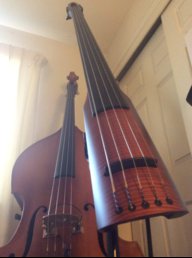
This is my current bass set up:

G, D string Spiro Stark, A, E Dominant
German bow, recently rehaired in black by Reid Hudson
Carlsson rosin
Busan copy 7/8th hand made carved

Tried Pops rosin today and, unless it's a placebo at work, a lot less of the dreaded screech notes. :)

I realize the strings I have on are tough for bowing. I tried a set of Bel Canto strings and it made my bass sound way too light, but easy to bow. At one point had a full set of starks which have a great piz sound but bowing was a bear.

I clean the bow and strings after every session.

This bass has had Spiro heavy, medium, Dominant, and Bel Canto strings. The current string set up is the best compromise for bowing and piz, for this bass.

So technique wise I suspect with the current strings bowing will always be a challenge. Any technique suggestions to follow? Exercises?
 
Last edited:
I'm no expert and hopefully someone more experienced will chime in, but at first thought, I'd suggest that you check your arm weight. If the screeches happen mostly when you change strings, I'd check your coordination as you prepare to leave the current string for the new string and decompose the motion. Sometimes I notice that in a fast passage as I change strings, particularly in TP, the string will jump and I fail to add more weight as I finger notes and change strings.

Hope that helps.
 
Last edited:
  • Like
Reactions: CaseyVancouver
Pops is good for your set up, fresh is best. Pops is made in Houston, Quantum bass there ships vacuum sealed Pops! Spiros have a lot of harmonic information, that is the screech sound. The first thing to do is study the screech sound - do not recoil from it. Learn to control and recreate it. Then you can just NOT do that!

Make sure the string is pushing the bow, do not push the bow, start the note and just follow it.
Weichs and solos are easier to get a clean sound from, plenty of great

A good exercise is to do a long tone, letting the string push the bow and slowly move bow from just below the fingerboard to the bridge - you sort of spiral up and down the string keeping a clean sound.
Each pitch will have sort of an ideal location between the bridge and fingerboard for the bow. It is good to find these places and work from there. I think of it as finding the place the "gives" us and "taking" the rest. Long tones on all the strings right on the bridge until you get a clean sound also helps.

I always say: treat sounds as facts, not right and wrong. Think, "this is what happens when _____".
 
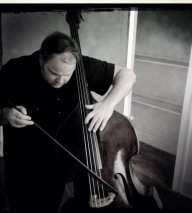
It is interesting Damon that in your picture, you have a bow that is almost at a 45 degree angle - to what extent does this matter, in relation to the question raised by the OP, if at all? Tip high or tip low will contribute to 'scratch', no?
OP- more here: The Annoying SCREECH
That is a special technique that shuts down the harmonics with light pressure, and activates more with more pressure. Not the way to get a clear sound! It gets a range of wispy and quacking sounds. Having studied this technique, I can now hear right away if someone bow is not straight, whether me or a student and correct it.
 
Andy, because (a) Damon's bass is leaning back , (b) the strings also add to the lean back as they go to the nut, and (c) the strings are curved by the arc of the bridge then I would expect the bow to actually be at 90 degrees to the G string even though it is pointing down towards the floor. Just as I would expect the bow hand to drop towards the floor when on the E string to maintain the 90 degrees. Only on the two middle strings will it look parallel to the floor.

Best arco sound and projection rely on more than the three main variables, Bow Weight, Bow Speed and Contact Point. The quality and characteristics of the bass, bow, strings and rosin all play a part. Not mentioned so far is the bow hair tension that is critical IMO. If too tight it will potentially skid, not able to control the string during a bow change. If too slack it will not produce a focused sound and good bow control of changes. With French bow I press the center of the hair down onto the D or A string and adjust the tension until I just play 3 strings at once when the hair touches the stick. This is with the contact point about 6 inches from the bridge. I try note starts on the A and D strings in each direction all over the hair length while adjusting the tension up or down in 1/4 turn steps until I get the grip and start that I want. There must be a similar way to adjust the German bow tension for best results. Depending on each individual stick's stiffness a 1/4 turn can make a lot of difference.

I am puzzled by Damon's idea that the string pushes the bow. I often use the analogy of the surf board rider. Damon is saying that the wave propels the rider (true fact!) however I liken drawing the bow to the rider driving the wave after the note is jump-started. The hair is gently bent over the string and is angled in slightly so that there is full hair contact but the upper side of the hair is more bent over than the lower side.

New hair takes a little time to take up rosin so I would suggest not being too worried about cleaning it. Carlsson rosin tends to powder and not build up. I worry that your cleaning the hair is actually polishing it. I am not a big fan of Pops and suggest using it very sparingly. My preference is Nymans. I have tried Carlsson and found it was a little too "dry", not gripping the strings enough and needing a lot of refreshing. The liquid Pops is too OTT for me, especially in a warm climate. But I am an orchestral player who needs to control note starts confidently for good timing using "arco" strings like D'Addario Helicore, Bel Canto and Pirastro Flexocor.
 
David Potts has great advice, as always. Because I play improvised music and "New Music" I am looking at a huge a range of sounds so "best" is not the way I think about it.
However, I have a very nice legit arco tone when I want - something I have worked on and I am proud of. I would not recommend that a more straight ahead player get side tracked working out every single sound the bass can make (As I do). To clarify, what I do recommend is that you study closely the "undesirable" sounds you end up making.

The pushing/surfing thing is probably the same idea. The vibration of the string will pull the bow across it, that speed makes a very good clean arco tone with the right pressure.
 
Spiros have a lot of harmonic information, that is the screech sound.

On my Spiro medium strings, I've struggled a lot with screeches, goose farts, duck quacks, etc. Now as my technique improves, I'm working on controlling unwanted harmonics. I agree that studying the unwanted sound to understand how it came to be is a good way to learn how to control it.

For me, a big step to a better sound was the switch to Oak medium soft rosin; but it could be that I was already on the plateau and ready to make the improvement anyway...
 
  • Like
Reactions: CaseyVancouver
It has been a few weeks of avoiding any screech or unwanted sounds with the bow :)
I am producing better results now.

To sum up here is what I have recently learned:
- Pops rosin works better than Carlsson, on my bass/strings/climate
- Less bow tension is responsive
- ok to clean off rosin from the bow hair only occasionally
- focused practise produces way better results
- 20 minutes on a topic (intonation, bow exercises etc) is long enough
- the spiro strings are great for jazz, but if I want to fit in a section bel canto may be a better choice

I have been working on getting to where I know I need to be to start lessons with a top symphony player.
Thanks for the suggestions and comments, it helped a lot!
 
Last edited:
I'm having a similar problem as the OP. I usually manage to avoid an outright screech, but I often have audible overtones in addition to the fundamental.

I perform in a mandolin orchestra, and the VAST majority of my parts are pizz. In one piece however, I start the piece, solo, with a sforzando arco note. Even when I feel that I have a clean attack, our conductor complains of a high harmonic.

I have tried different bow pressures and speeds and different amounts of rosin, but have not been able to consistently get a strong sound on my initial attack.

I have not practiced arco extensively, though I do try to work a little in often. One problem is the Shen hybrid bass I regularly practice with, including arco work, has gut strings. For this group, I use my carved Shen bass with Evah Pirazzi strings. I use French bow and oak rosin.

My Evah Pirazzi strings are very old: over ten years on the bass; for pizz, they still have consistent pitch and pleasing tone. Could this be contributing to my arco problems?

Any suggestions concerning technique or equipment are welcome. Thank you.
 
I'm a newbie learning on my own, and most of my bowing sounds like a screeching sick cow. My practice room sounds a bit like a slaughterhouse. I just assume that comes with the territory of being a beginner. With practice I'm seeing improvement. In the meantime I'm thankful my wife has not started divorce proceedings on the grounds of mental cruelty.
 
I had the same experience- very scratchy/twangy at first. But with more and more practice, I found that I was sounding better. Not conciously thinking about it but just by getting the feel of where to play to get the sound I wanted.

I just bought a new bow and was kind of surprised that I was getting the same scratchiness that I had in the beginning. I realized that the different bows have their own sensitivity and quirks. Once I got used to the new bow, I was able to produce a very nice sound with it.
 
Hi, Pete, which problem note are you starting on and on which string? Have you also explored different bow hair tensions and contact points. Also try the same note higher on the next thicker string, securing it firmly with fingers 1 and 2. These will all affect the harmonic mix. What we call harmonics are nodal points that can mathematically divide the stretched string into "bumps" (my term). If you choose to bow or pluck at one of these points that overtone will diminish or disappear from the mix. Almost instinctively you will have found the sound mix and string drive/flexibility that satisfy you most by choosing where to pizz.. It should be the same with the bow.

I think of pluck-starting notes with the bow. You cannot move the bow as fast as the string when it is deflected and released. Try deflecting the string, first with your fingers then with the bow (with carefully chosen contact point, hair tension and bow weight) before releasing it sideways.You will feel that the bow weight immediately wants to rise. We call this "release". If you do not control and release enough weight as you follow through the string vibrations will be crushed, not free to continue, and the bow might even stop. This moment can also be the source of your unwanted overtones. My follow through bow speed and reduced weight keep the hair bent more gently over the string, capping off some of the overtones while supporting the fundamental. I deliberately try for a more earthy tone because I want an orchestral,not solo, sound whereas Gary Karr might demand everything that his bass can give to cut through (which he does magnificently!!).

Plucking the string with the bow also gives you best control of note starts and timing (I am going to START) as well as degrees of accent.
 
  • Like
Reactions: CaseyVancouver
Thank you, David. The first note I'm playing is C, third semitone on A string, and my contact point is just below the end of the fingerboard. Since I wrote my first post, I've had a bit more success by using more rosin, though I still cannot guarantee a clean start every time. I've tried not to have a very tight hair tension.

I will work on releasing the bow weight as I continue the note; should this be gradual or quickly after I start?

Do you think that the extreme age of my strings could be contributing to the problem?

Thanks again.
 
Try the C at the bottom of the neck on the E string. The string is thicker, vibrating length is shorter, tone is thicker with less overtones and you only have one other (A) string to worry about not playing as well. This should give less overtones and more power (because the string is right over the foot of the bridge). Adjust your contact point accordingly but this might not be much closer to the bridge (to avoid the stiffness and inertia of the heavy string).The E string should still have plenty of life in it.

First, using the relaxed weight of your arm to rest the bow on the strings, adjust the hair tension up or down until you feel the bow catch note starts in each direction. Half a turn either way might make a sizeable difference. The bow hair at each end is too stiff to bend and grip for the first 1" so come out a little further, say 3" from the ferrule, and experiment. Think of matching your flexibility with those of the string and hair. Every bow stick and its optimum hair tension will be different. This may also call into question the quality of your bow.

For the note start I personally think of Grip - Pull on the down beat -almost immediately Release (the bow wants to rise but not allowed much if the sound is to remain level). For the accent I think Plonk (to grip) -Rip sideways (for the accent) - follow through with more immediate release of weight and decelerating speed. Listen to the start, resulting tone and projection and modify next time. You can work up a range (spectrum) of note starts from no accent with almost steady bow weight and speed through increasing degrees of stresses to sffz where the difference in speeds between punching sideways and releasing the follow through are much more dramatic. The most energy is concentrated in the deflected and loaded string jumping into life. You can't move the bow sideways that fast. The tone takes 10 full vibrations to reach its best according to Knut Guettler who researched this.

All this supposes that you only have the one note to play. It gets trickier if you then go on into more notes!!
 
Thanks again, David. It is not the only note; it's the first note of an arrangement of the fanfare -- the first 18 bars -- of "Also Sprach Zarathustra". Here is my part:

fanfare also sprach zarathustra -- double bass.png
 
I'm a newbie learning on my own, and most of my bowing sounds like a screeching sick cow. My practice room sounds a bit like a slaughterhouse. I just assume that comes with the territory of being a beginner. With practice I'm seeing improvement. In the meantime I'm thankful my wife has not started divorce proceedings on the grounds of mental cruelty.
Take lessons, you will not fix your bowarm via a forum.
Get Hal Robinson Strokin' and practise everything one the first five pages or so with a metronome 15-20 minutes a day. This will help a lot. If needed, just do one octave at first. Ideally, get some lessons specifically on that material.
 
  • Like
Reactions: damonsmith

Latest posts