• TalkBass has been independent since 1998. Add your voice.
    Create a free account to reply to discussions, view embedded media, and browse with fewer display ads.
    Join freeLog in
    Want zero display ads or expanded classifieds tools? Compare plans.
Double Bass Screeching Notes & strings, rosin, technique

image.jpeg

+1 on Pops, works for me. A teacher, if possible, is always the best thing ever. Join a community string orchestra if you can.

You might find if you are not able to practise regularly (like every day) you just do not progress. With every day practise the screeching goes away, miss a few days it comes back. Really focused practise time works best for bowing.

Perhaps the German bow and Bel Canto strings are best for screech free bowing but there are many players who play & sound great with French and spiro strings (of course!). I have both bows, multiple string brands, taken many lessons (years ago) and lots of time available to practise. Yep, bowing still challenges me. Maybe that's a good thing.

Have my Simandl books from 1971, useful, boring and I still use 'em today. I like to play tunes from the real book on bow. I have an early '77 version in treble clef (always good for a bass player to read treble) and a newer version with dif tunes in bass clef. If the piece is too easy I play it an octave higher. More fun than a scale book :)

Also have a huge library of cello music available, to keep from getting bored.

Jason Heath has some positive comments on strokin' and board walkin' & other methods:
Invalid Link Removed
 
Last edited:
  • Like
Reactions: gerry grable
It is stronger and grips better. Once you learn the right amount of rosin is it the same as white but lasts longer and grips better.

I just had my bow rehaired. It really needed it. Since I only have one bow, I had played it down to less than half the original hair. I was actually getting a pretty good sound out of it, but when I got my bow back two days later (!) with a new tub of Pop's it amazed me; it sang out. I wonder if the extra consentration I needed on getting a sound out of the sparse hair period actually helped my bow control?
By the way, I was going to get black hair but chickened out at the last moment. Maybe next time? I intend to get a German bow soon.
 
Before I made a decision on rosin I did a little 2 week test. One bow only got Carlsson, one only Pops.

I have two German bows (and a french which I did not include in the test) and sent them out to get rehaired. Reid Hudson, the great bowmaker, rehaired them and recommended black hair based on my symphony playing aspirations. One bow is a Horst Schicker, the other a student quality bow.

One bow (student) only got Carlsson rosin, one only Pops (Schicker). At the start of the day I would put fresh Carlsson on the student bow and play for a bit. I then changed bows but DID NOT put rosin on my second bow (Schicker). I'd play for a while then when needed put some Pops on.

I found the Carlsson, even just after putting it on, would tend to make the bow screeching thing a problem. The Pops bow, even without fresh rosin put on, played better (less screech) than the other bow with recent rosin. Pops for me now.
 
Last edited:
I do most of my practice, pizz and arco, on a gut strung bass, and I have been able to get a reasonable arco tone. When I had arco harmonic problems on my Evah Pirazzi strung bass, one of the solutions offered was to adjust the amount of rosin; I added more rosin, and this helped reduce the high harmonics that plagued my sound.

When I then tried to use the bow on my gut strung bass, the tone was very rough; I always had some success with light rosin when bowing gut, and the increased amount of rosin I needed for the EPs did not play nice with guts.

I have a second bow that I use as a backup. Would I be better off dedicating each bow to a specific bass, using the appropriate amount of rosin, instead of adjusting the amount of rosin on my main bow when I switch basses? Are there any of you who use both gut and steel strung basses? What is your approach to their arco requirements? Thanks.
 
I tried three different sorts of cleaners before I was able to remove the Pops buildup from a bass that I loaned to a student. The rosin globules felt like sandpaper. At Least Nymans and Carlsson's fall as dust that can be wiped off with a soft rag. The best I found was Kolstein's cleaner but this only comes in small bottles here, and very expensive too. Does any one have a magic formula?
 
Heavy build-ups are a nightmare. Kolstein's cleaner is about the best I've used. I wipe the table after every time I play, and I occasionally use medical swabs too, which I also use on strings. Serious deep cleaning is best left to a trusted luthier in my opinion, especially on old basses.
 
I tried three different sorts of cleaners before I was able to remove the Pops buildup from a bass that I loaned to a student. The rosin globules felt like sandpaper. At Least Nymans and Carlsson's fall as dust that can be wiped off with a soft rag. The best I found was Kolstein's cleaner but this only comes in small bottles here, and very expensive too. Does any one have a magic formula?

Something i've noticed immediately after deciding to give Nymans a try after only ever using Pops. Gunk factor drastically reduced, and i am liking the tone more. Seems to grip quite well. Loving the Nymans!
 
Hi, Pete, which problem note are you starting on and on which string? Have you also explored different bow hair tensions and contact points. Also try the same note higher on the next thicker string, securing it firmly with fingers 1 and 2. These will all affect the harmonic mix. What we call harmonics are nodal points that can mathematically divide the stretched string into "bumps" (my term). If you choose to bow or pluck at one of these points that overtone will diminish or disappear from the mix. Almost instinctively you will have found the sound mix and string drive/flexibility that satisfy you most by choosing where to pizz.. It should be the same with the bow.

I think of pluck-starting notes with the bow. You cannot move the bow as fast as the string when it is deflected and released. Try deflecting the string, first with your fingers then with the bow (with carefully chosen contact point, hair tension and bow weight) before releasing it sideways.You will feel that the bow weight immediately wants to rise. We call this "release". If you do not control and release enough weight as you follow through the string vibrations will be crushed, not free to continue, and the bow might even stop. This moment can also be the source of your unwanted overtones. My follow through bow speed and reduced weight keep the hair bent more gently over the string, capping off some of the overtones while supporting the fundamental. I deliberately try for a more earthy tone because I want an orchestral,not solo, sound whereas Gary Karr might demand everything that his bass can give to cut through (which he does magnificently!!).

Plucking the string with the bow also gives you best control of note starts and timing (I am going to START) as well as degrees of accent.
Thanks again David for your advice. Often I look back and reread your comments picking up new observations. I'm sure others do too.
 
I'm not sure about the "let the string move the bow" concept. The function of the bow is to put energy INTO the string, not take it out. This has to be done in a sympathetic way, yes, with sensitivity to how the string reacts, but the bow moves the string, and the fingers move the bow. I understand what you're trying to say, you need to be sensitive to the feedback from the string, but it does matter how you think about it
 
image.jpeg


So I was working on some standard bass material, and getting a few squeeky notes here and there. A professor of bass (not Moore by the way) happens to have the same material on cd and is available for sale to the public. Thinking ok, I have a copy, let's listen closely with headphones and hear how he does. Yep, he gets a few squeekers here and there too, buried in long runs. Hmmmm.

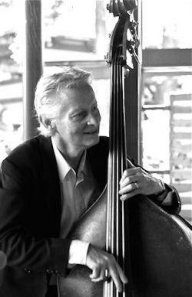
Here is David Moore, shown above, giving a lesson on clear sound and articulation. David plays a Boris Fritsch hybrid bow, a bit bigger than French and smaller than German frog. He holds it German. As you can see in the video his bow hair is not very tight, he gets a wonderful tone, and no squeekers in the fast bits.

I wonder what strings he uses, and what his comments would be on this thread. Maybe at his level the type of strings do not matter ...?

Link Removed

Edit
David Moore kindly answered my question on strings:

'As I'm sure you know, there is no easy answer to this. I use D'Addario Kaplan heavys on my Orchestral basses. Technique definitely matters, but some strings can be more forgiving to the bow and less prone to unmusical noises. For example, someone with very refined bow technique can make Spirocores sound good, but this may be a challenge for a predominantly pizzicato player. Finding a hybrid is always a tricky task as you usually end up with something that is equally mediocre at arco and pizz. John Clayton used to use Thomastik Superflexibles, but I think he uses light gauge Evah Pirazzis now. Finding the right string can be a frustrating and expensive process.'
 
Last edited:
I've been working with a student on this exact issue and I've come up with more insight. There are several things going on.
The main issue is bow changes. Work on long tones and and quick hand movement to re-direct the same energy/vibration that the string already has.
Where it can be an issue is that the quick hand movement is not always in rhythm with what is being played. The Arm will keep rhythm, the hand will re-direct the energy. Once the bow change happens let the string pull/push the bow. Only apply pressure.

When you do not redirect the energy the string already has you basically shut it down and restart. The grinding to a halt is where the noises happen. The whole process is a lot like grind gears in a standard transmission.

Even when crossing to other strings you are still trying to keep the same vibration/energy the bass already has in the body.
 
(Most, but not all, of this is specific to the German Bow Hold.)
IMO...
1. Most beginning players use "too little", (as opposed to "too much"), rosin, or are using dried-out, ineffective rosin that can't be applied substantially to the hair. There should be visible "tracks" where the hair has taken rosin off of the cake.
It is also a good idea to apply rosin from the Frog toward the Tip, AND, from the Tip toward the Frog. This ensures a more even and consistent application along the full length of the hair.

2. The bow and hair should be able to "grab" any string at any point between the Tip and Frog - you should be able to pull (and push) the string slightly WITHOUT making a sound, that is, not "releasing" the string. This was first demonstrated to me at my one lesson with Anthony Bianco, (Pittsburgh Sym., my Teacher's Teacher), who used the analogy of pulling on a rope attached to a wagon: the slack in the rope is first removed/pulled taut - then more "pull" is exerted until the wagon begins to roll.
This same model applies to the Bow Arm System beginning with the fingers/hand/wrist/arm/elbow/shoulder/upper back - all slack is removed, with (static) weight being applied to the string, and then the fingers initiate a small pull or push which releases the string and sound is produced, followed by the immediate engagement and partcipation of the Bow Arm System. This (finger motion) should be isolated and practiced with ONLY the fingers pushing and/or pulling and listening for the instant, clean start of a note. The German Bow hold is not as rigid and "easy" as some people describe. It should not be a static "grip" of the frog, but rather, an active and dynamic system beginning with the fingers/(especially)/hand/wrist/...etc.

3. Change of Bow Direction - This is almost impossible to describe using only words without images, but I'll use the analogy that my first Teacher (Roger Machiarolli - Buffalo Phi.) used - He spoke (at LENGTH!!) of a painter using a paint brush:
The long brush stroke moves from Left to Right (as in a DownBow), and as it approaches the end of the stroke, (AKA the "Turn"), the handle of the brush anticipates the change and begins moving Right to Left, (as in an UpBow) as the bristles continue (L - R) to the end of the stroke, and for a split-second, are "stopped", moving neither L -R or R - L... until the bristles "flip" and begin moving R - L, following the handle. (Try this with your Bow Arm with your fingers being the bristles - this is a good visual representation of the mechanics of the "Turn".)
This movement is felt in the Change of Bow Direction, as the wrist is the handle of the paintbrush, and the hand/fingers are the bristles. His mantra was - "The Wrist Leads". It applies to an UpBow changing to a DownBow as well.

4. Beginning players often accelerate (unnecessarily) at the moment of the "Turn", which can cause the hair and weight to momentarily decouple from the string, and the subsequent (unnecessary) acceleration can cause the dreaded "Screech" or "Gasp/Gap" of interrupted sound due to "skidding" of the hair.
The goal is to maintain consistent contact, weight, and bow speed throughout the "Turn". It helps to think of this as being a slow, consistent, controlled motion, not a "fast" (binary?) instant change of direction.

5. The "Wrist Leads" concept leads to a discussion of the overall motion of the Right Arm - again difficult to describe with only words, but here is a good analogy: If a tiny lightbulb were placed on the Bow Arm Wrist (in a dark room), and Long, Legato strokes were played, the resulting lines would NOT be 2 straight/parallel lines for both the DownBow and UpBow. Rather, there would be a long, flattened circle or ellipse, as the bow arm cycles through the bow strokes. The fluid motion of the Bow Arm System causes this elliptical shape, as the "Turn" is facilitated by this 3-dimensional motion as the Wrist anticipates the change of direction, while maintaining full contact with the string throughout the "Turn".
Roger M. used to say that a DownBow should "feel" like your Wrist is heading toward the Floor! He had a wonderful ability to verbally describe very subtle and complex motions as he demonstrated the motions. (The UpBow motion is similar, and even more complex and difficult for me to describe here.)

6. The Myth of Perpendicularity - It is more useful to be concerned with the Contact Point of the hair throughout the stroke, as the Myth of Perpendicularity can often encourage a stiff or locked Right Hand/Wrist. (Yes - the Contact Point may move as the string length changes with the register change.) Slight variations in Perpendicularity are inaudible. Contact Point slippage/sloppage WILL affect the sound quality.

Just wondering if other German Bowists have had similar or different experiences.
Thanks.
 
Good stuff, Don. My comments as a Frenchie, point by point, are -

(1) My concern about lots of rosin, especially Pops, is that it imposes too much control over your range and nuance of expression. Some players advocate using little or no rosin, or a hard powdering rosin (eg violin or cello rosin) or Carlsson/Nymans (which I prefer) so that the sound is theirs, not Pop's.
(2) I agree with almost all you say except we perhaps differ when it comes to how we see the moment of starting the note. I am aware of the small finger stroke idea but instead allow the deflected and loaded string to release itself, as by pizzicato. The French bow allows me to employ the flexing elbow with twitch muscles (biceps and triceps) to "pluck" the string and control the follow through.
(3) I agree totally with the paint brush analogy.
(4) I agree. There has to be a tiny moment of disruption as the bow "turns the corner" however the body of the bass is still vibrating from the previous note and tends to help smooth over this break. Much depends how you have balanced the main variables of weight, speed, length and contact point. Bow quality and its hair tension also play a part. Big flourishing movements of the wrist and fingers are generally less successful that relaxed minimal flexes that match the flexibility of strings, stick and hair. I guess I make a big deal about this moment when the string changes direction because this is when I control timing and clarity of articulation.
(5) I agree with the idea that the fingers and stick follow through and are the last in the chain of movements to change direction, and that the wrist can "turn the corner" slightly earlier (a controlled version of your "paint brush" analogy above) however I wish to be in control of the moment the bow grabs the string in the new direction.
(6) It is possibly easier to draw the "overhand" French bow at close to 90 degrees if care is taken with the arm and bow hold are set up and movements are blended. My analogy is to stand in front of a table or bench and simulate the bow stroke backwards and forwards by drawing my fingertips along the straight edge and observing how the upper and lower arm movements blend together naturally. It also makes sense of the "paint brush" analogy as you see that the fingertips are the last to change direction if your wrist is relaxed but flexible. The bow strokes can't be drawn too far from perpendicular before distortion of tone quality happens. There is however a trick here. The bow can be angled more to the string so long as the energy of the stroke is at 90 degrees. In other words you can change the contact point as you draw the bow and keep the sound free from distortion while you change positions, up or down. When you arrive at the new position you simply resume stroking at 90 degrees (once shown to me by Tom Martin).

None of the above is trying to say that one style of bow or approach is better than the other, just perhaps different with the same ends in mind.
 
Last edited:
Carlsson/Nymans (which I prefer) so that the sound is theirs, not Pop's.
Hi David.
1.) I've recently been using and liking a DIY hybrid blend of Pops/Nymans - 50/50. The Pops seems to help the Nyman's with ease and evenness of application, IMO.

I've never tried French bow, as my generation seemed to be encouraged to choose one over the other. I know of only a few of my classmates (mostly very serious Orchestral Bassists) that eventually learned both. Nowadays, studying both seems to be more common. (That's a good thing. IMO.)
"Old Dog...New Tricks".
Thanks for your time, interest and expertise.
 
  • Like
Reactions: Tom Lane