• TalkBass has been independent since 1998. Add your voice.
    Create a free account to reply to discussions, view embedded media, and browse with fewer display ads.
    Join freeLog in
    Want zero display ads or expanded classifieds tools? Compare plans.

screw-on (bolt-on) neck vs. neck-through, can you hear the difference?

can you hear the difference?

  • absolutely

  • not at all

  • sometimes

  • undecided, carrot-thru for me, thanks!


Results are only viewable after voting.

Killed_by_Death

Snaggletooth
Inactive
Jan 2, 2015
24,890
61,257
14 Megameters from Groong Tehp
First of all, they're screwed on, not bolted :smug:
Yes, there is a difference.

Secondly, can you hear the difference?

A while back I was comparing two very similar basses & the thought never occurred to me, at the time, that part of their difference in timbre was due to the neck-through vs. screw-on designs.

Now I'm rethinking every time I tried a neck-through Ibanez BTB & wish I'd taken that into account.
I'm also wishing I could get a SR505E (screw-on) & BTB740 (neck-through), both with Bartolini BH2 pickups, side-by-side for a comparison.

Yes, I know there's been much discussion in the past, I'm reading those threads now.
However, I don't think there was a poll.
 
Secondly, can you hear the difference?

I have no idea, as I've never encountered otherwise identical instruments in the same place at the same time. But I consider bolt-on construction (sorry, it's accepted usage and I have more compelling windmills beckoning) to generally be pretty unappealing aesthetically, although my current favorite bass is a bolt-on type.
 
In my experience, it's there, but depending on the bass, the amount of difference varies somewhat.

The neckthrus tend to carry through to the amp (or put another way, not lose them) the first several harmonics. But that's very dependent on the woods in the laminate and the fingerboard, harder woods being better for this to happen. One of my Alembic fives was rock maple/walnut with their standard 1/4" ebony fingerboard. Hit a low C, and you could hear those first several harmonics almost like a beat or a grinding timbre within the note you'd hear. The BB5000's would do this, but you really had to listen close, it wasn't as in your face as that one particular bass.

Basses with 'separate' necks (screw-on or the rare glue joint instrument) tend to 'interrupt' this process, and I tend to attribute this to the neck joint. Obviously still 'bassy', but more in that 150-300hz range (which is the freq range most of us hear as bass anyway). That those small handful of deep harmonics is possibly missing is no big deal for most, and is so amp- and axe-driven as to be overlooked and not missed in the real world anyway.

Usually the 'sustain is better' idea gets trotted out, and if it's true, I'd think it would show in recording far more than playing on stage. Most loud stages, a $100 flea market find is going to sustain, so for me this was always a non-starter in the real world.

Something to me that gets overlooked in this is wood recipe. When this question comes up, it tends to imply 'Is X-neckthru going to sound different/sustain better/etc., than a Fender?' The neckthrus tend to be more complex wood-wise than the usual alder/maple Fender, and I think there's something to that: Aside from Spectors, there are very few neckthrus that use the 'white' woods, and Spectors still have 'dark' fingerboards like some Fenders, and yet . . . . . most would not think a 4-string NS with a P/J layout sounds like a similarly-equipped Fender.

After all these years, to me the real advantage of neckthrus is that they're 24 frets and IF you want to play up the neck, it's far easier, aided by not having that block at the heel for the neck screws. There's just something 2 cool about that deep cutaway and the extra high notes / room at the end of the fingerboard.

After all three BB5000's and two Alembics, this is my experience with neckthrus. Your results . . . . may vary.
 
When I compare two identical basses (like 2 Fender Am Std J basses), I usually never find two that are identical in sound and feel. The problem is that the feel affects the sound since the sound is in the fingers, as we all know.
So when two instruments that are supposed to be identical have different characteristics, how is one supposed to compare two instruments that have a different construction and distinguish between differences that come from the 'no two basses are ever alike' thing and the differences that come from different construction methods ?
I usually end up with neck through basses, because I like the feel of the section where the neck meets the body more on them.
 
Yes, having owned several Ken Smith & Status graphite bolt- on’s & neck throughs, I prefer the punch of a bolt on over a neck through. I hear the differences, & bolt ons just sound better to me. More “alive”, punchier.. Ask Sadowsky, Lull, Fodera, Tobias, & they will tell you the specifics on why that is. Billy Sheehan has stated in an interview that he prefers the “bolt on” sound. Another advantage is you can change necks with a bolt on, if necessary. Neck throughs are fine for many folks, but just not my thing.
 
I was skeptical about the difference, but the kicker for me was my first Ken Smith. I could definitely tell the difference with that particular bass. I don't claim to be able to hear the difference on a recording, but neck-through basses can sound different than bolt-ons because of the neck attachment. I think you could build a neck-through that sounds like a bolt-on, but I don't think you could build a bolt-on that sounds and plays like that Ken Smith with all of the laminates.
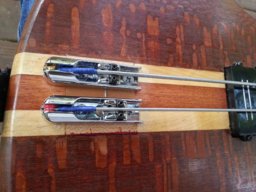
smith_bsr6tn_back-jpg.1169091
 
I don't know or care whether each particular neck construction has guaranteed, quantifiable impact on an instrument's sound with every other factor being equal... but I can say that I have owned a roughly equal amount of bolt-on and non-bolt-on instruments, and I have clearly preferred the tone of non-bolt-ons on average, and my absolute favorite bass and electric guitar (from the perspective of tone only) are a neck-through and set-neck, respectively. However, I barely play that electric guitar anymore because I have a bolt-on that is lighter and easier to play, so obviously the difference isn't anything earth-shattering.
 
  • Like
Reactions: Eidolon0274

Latest posts