My god, Flux. I had no idea. My head is exploding right now. i also feel a little bit better about my own goofy "ideal" setup.
Hahaha!

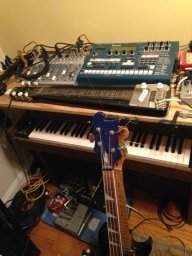
Yea, quite a rig, que no?
I've been through the whole ~buy this amp, that cab, and then spend dollars trying to fill in the weak spots. Then when that doesn't work out, buy another amp, another cab, and more stuff to fill in the new weak spots~ trip too many times.
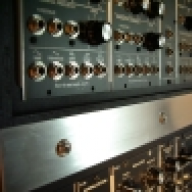
So I decided that I was going to build an amplification system that is totally compartmentalized. Totally modular. Each single stage of the system a separate and independent module that may be replaced or easily modified. No matter which design family it belongs too, digital, analog/solid state, or tube. So if it turns out that my input gain stage is a tube driven unit, and the compression stage is solid state, and then the bass stage of the EQ stack is digital, then the midrange stack is solid state, and the treble stack is tube, and finally the power stage is solid state ... I don't care. The focus is on function and flexibility.
As it stands currently....
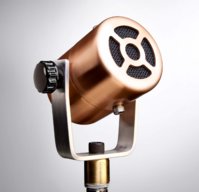
INPUT STAGE: twin tube-driven mic preamps that receive the independent pickup signals (the bass itself is modified so that it has separate outputs for each pickup).
PRIMARY COMPRESSION STAGE: solid state. Twin compressors that are set to optimize each pickup's dynamics.
PICKUP SIGNAL BLEND/MIXER: A foot controlled mixer that uses a momentary footswitch to bypass/engage the bridge pickup.
EQ STAGE-BASS: a combination of a solid state aural exciter, a digital modeler, and a graphic EQ to boost the bottom end.
EQ STAGE-MIDRANGE: a combination of a parked wah, a digital modeler, and an aural exciter.
EQ STAGE-TREBLE: Digital modeler and some solid state graphic EQ.
SIGNAL SPLITTER: Signal is split after the EQ stage to two independent signals,
SECONDARY PROCESSOR: One of the signals is sent to a sophisticated channel strip, (ART Pro Channel II) which has it's own optical compression, four stage EQ, and output stage. This signal is sent to the "bass" cab.
2-CHANNEL AMPLIFICATION: The two output signals are sent to separate amp channels of a solid state 1400 watt PA amp. Channel "A" is sent out to a 2x10 front ported cab, Channel "B" is a 4x10 sealed cab. I am able to easily select a mix of the two cabs, to fine tune the sound. The ported 2x10 has far more low end than the sealed 4x10. So if I need more room filling lows, I balance the signal in favor of the 2x10, if I need more defined mids I make the 4x10 louder.
Essentially it's a simple 2 - into 1 - into 2 setup. Start with 2 separate signals blended into one, then resplit into two. This way I can address all of my complaints with bass systems that I have no matter which off the shelf amp or bass guitar I've ever owned. And, between each single stage, there is total access to that connection as an "insert" where any type of processing can be inserted. Distortion, FX, EQ, whatever.
It's just like having a set of Send/Return jacks placed between each single knob of your bass amp.
It sounds horribly complex, but it isn't. The nice thing about it is that no matter which bass guitar I may end up using, or how my tastes may change, or what type of music I end up playing, this rig is easily reconfigurable. And, if one stage breaks down or fails, I simply remove/replace/repair just that one stage, instead of being without my entire bass amp unitl repairs are completed.
I'm still configuring it, but I get closer to being ~done~ every week. (Stuff like this is never truly "done" though).