
Enjoy the benefits of a premium membership!
Upgrade Account
-
TalkBass has been independent since 1998. Add your voice.
Create a free account to reply to discussions, view embedded media, and browse with fewer display ads.
Join free Log in
Want zero display ads or expanded classifieds tools? Compare plans.
You are using an out of date browser. It may not display this or other websites correctly.
You should upgrade or use an alternative browser.
You should upgrade or use an alternative browser.
Second bass build - Effortless playability
- Thread starter JLW
- Start date
-
- Tags
- bass build build future
More options
Who Replied?

I like the idea of maintaining aesthetics and design familiarity.
Regarding the upper horn modification, I'll try to explain more clearly, then maybe I can get an image posted later this weekend...
In my current playing position, the precision upper horn rests lightly on my chest just left of center. An ideal design for my body might be one that would allow me to maintain an identical neck and hand position, though with the horn resting 2.5 inches or so above the lower point of my sternum. This would center the horn contact area vertically and horizontally on my chest. If the basic precision horn shape and dimensions are preserved, though with an expanded inside radius of curvature at the base of the horn, the angle described by center line of horn and neck would increase slightly and result in such a fit for me. It seems that flattening and contouring the back side of that horn to increase the resting surface area would further improve comfort and stability.
Sitting with a glossy precision in this seated playing position, it becomes clear that the typical forearm cut serves little function. My forearm catches the foreward elbow of the cut even with efforts to project my upper arm outward a bit and play with a straightened wrist. Thus the need to adjust forearm cut placement or carry the contour further forward on the body.
Mine is not an elegant solution, but I use black cotton hockey tape on black bass to improve the friction of the contact areas for chest and both legs. It is basically undetectable from 5 ft away, and seems to have zero effect on audible tone. One might imagine using clear grip tape or a finish additive at those points for a more polished solution.
Your sketches look great. The final two at the bottom show a slight concave in the area below and to the left of the bridge. It is in this area, and to about that degree, that I may do the same on a precision instrument.
Regarding the upper horn modification, I'll try to explain more clearly, then maybe I can get an image posted later this weekend...
In my current playing position, the precision upper horn rests lightly on my chest just left of center. An ideal design for my body might be one that would allow me to maintain an identical neck and hand position, though with the horn resting 2.5 inches or so above the lower point of my sternum. This would center the horn contact area vertically and horizontally on my chest. If the basic precision horn shape and dimensions are preserved, though with an expanded inside radius of curvature at the base of the horn, the angle described by center line of horn and neck would increase slightly and result in such a fit for me. It seems that flattening and contouring the back side of that horn to increase the resting surface area would further improve comfort and stability.
Sitting with a glossy precision in this seated playing position, it becomes clear that the typical forearm cut serves little function. My forearm catches the foreward elbow of the cut even with efforts to project my upper arm outward a bit and play with a straightened wrist. Thus the need to adjust forearm cut placement or carry the contour further forward on the body.
Mine is not an elegant solution, but I use black cotton hockey tape on black bass to improve the friction of the contact areas for chest and both legs. It is basically undetectable from 5 ft away, and seems to have zero effect on audible tone. One might imagine using clear grip tape or a finish additive at those points for a more polished solution.
Your sketches look great. The final two at the bottom show a slight concave in the area below and to the left of the bridge. It is in this area, and to about that degree, that I may do the same on a precision instrument.
I love the idea. I love how your approach is to build a bass with the least amount of resistance possible. I can't wait to see what you'll come up with.
For expanding foam, there are spray cans of it (example: Great Stuff, at hardware stores in the US). It will definitely be very sticky until it hardens/cures, and the garbage bag will be attached. I don't know how difficult it would be to separate the garbage bag from the foam after curing. Spraying the insides of the garbage bag with a lubricant, like non-stick cooking spray might help (but it also might make a mess).
Also, here is a photo of my Les Paul (Epiphone). You might want to try what I did, to see if you find it comfortable. In stock form, LP guitar was the most uncomfortable instrument I have ever played. It dug into my ribs, causing discomfort within a few minutes (and the body would fall off my lap to the right). You can see where I added wood where the guitar hit me in the ribs. I carved it like a Strat, both in the back (shown) and on the front (for the right arm). Now it comfortably rests on my chest muscle (right pectoral)...a huge improvement. An easy way to test and refine this is to use some inexpensive pine (like a 2x4 or 2x6 piece of lumber) and shape it, then tape it to the guitar or bass body. I played this guitar for months with the taped on pine, and refined it until I was confident that this was how I wanted the finished guitar.
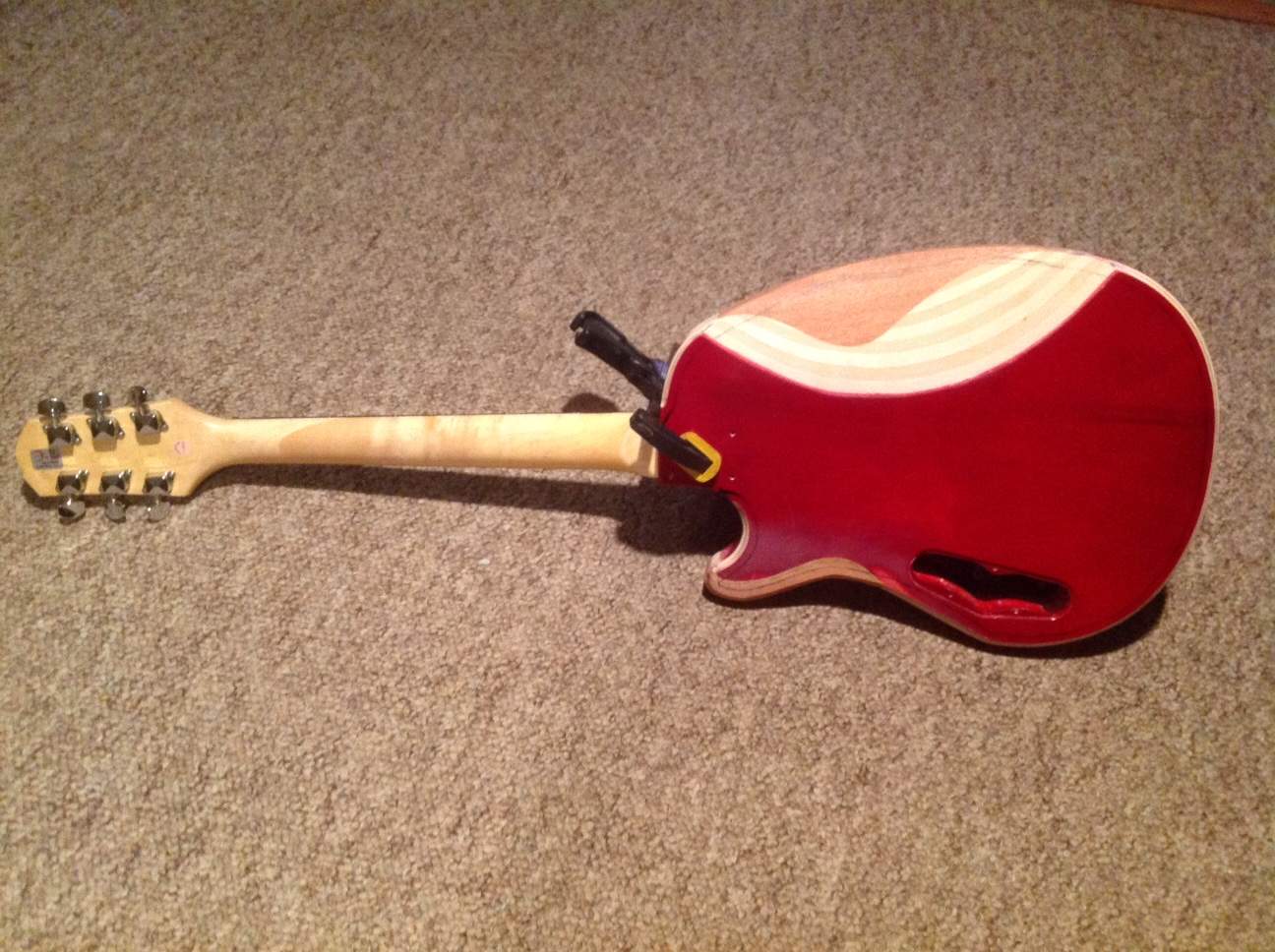
Also, here is a photo of my Les Paul (Epiphone). You might want to try what I did, to see if you find it comfortable. In stock form, LP guitar was the most uncomfortable instrument I have ever played. It dug into my ribs, causing discomfort within a few minutes (and the body would fall off my lap to the right). You can see where I added wood where the guitar hit me in the ribs. I carved it like a Strat, both in the back (shown) and on the front (for the right arm). Now it comfortably rests on my chest muscle (right pectoral)...a huge improvement. An easy way to test and refine this is to use some inexpensive pine (like a 2x4 or 2x6 piece of lumber) and shape it, then tape it to the guitar or bass body. I played this guitar for months with the taped on pine, and refined it until I was confident that this was how I wanted the finished guitar.

Its suprisingly stable, no tuning issues. Just three exceptional pieces of maple. Handles most 45-105 strings with the truss rod nut 1/4 turn from completely off. Now it has la Bella copper whites with the truss rod at only 1/8 turn. The relief is mostly in the frets. The final dimensions; 17mm at 1st fret. The asymmetric offset is .3mm graduating to 2.2mm. If I pick it up and hold it by the neck parallel to the floor the strings almost bottom out so I always support the weight (8.2lbs).
Their where no reinforcements, it's a 92' sr800.
I listen very carefully as I sand in a quiet room. The first time I ever did this the spot behind the truss rod became soft and I could hear the wood getting louder and higher as I sanded. That strat is still going 17years later but you can hear your thumb rubbing over the truss rod. These days, as I hear the wood start to get thin I stop. I think that's about 2.2mm-1.5mm range. I'd guess this example has about 2- 1.5mm behind the truss rod. I've been charging $100 for this service. Early 2000's wicks are excellent candidates.
Their where no reinforcements, it's a 92' sr800.
I listen very carefully as I sand in a quiet room. The first time I ever did this the spot behind the truss rod became soft and I could hear the wood getting louder and higher as I sanded. That strat is still going 17years later but you can hear your thumb rubbing over the truss rod. These days, as I hear the wood start to get thin I stop. I think that's about 2.2mm-1.5mm range. I'd guess this example has about 2- 1.5mm behind the truss rod. I've been charging $100 for this service. Early 2000's wicks are excellent candidates.
Last edited:


- Jan 28, 2009
- 2,929
- 4,152
- Disclosures
- Owner: Moonshine Custom Guitars
Building a jig to accurately create that neck in the home shop would be an interesting challenge. I'm guessing there's some CNC work being done to build these commercially.
In the early 2000's I worked for a small guitar company in Nashville; we built high end acoustic instruments (guitars, mandolins, banjos and resonator instruments). There was also an electric guitar project that had started before I joined in which the company was working with a well known pickup builder from California who had designed an ergonomic guitar with a twisted neck; the company I was involved was hired to build the prototypes (and supposedly production...).
One of the builders designed and built the jig to cut and shape the "twisted" necks, it was a brilliant design and all done in his head. No CNC (the company did own one for cutting out fingerboards and inlays) was involved.
I joined this company without the knowledge that it was going through some major (as in BAD) management changes; the builders there were not happy and the original people were either leaving or being fired. The replacements were nowhere near as knowledgeable as the previous crew and things started going downhill fast. The ergonomic guitar project went to crap first. I believe only two guitars were delivered and to be honest they were most likely unplayable; oddly enough, the only thing right about them was the twist design (they played pretty good)... the overall construction was horrible with covered in bondo and a good paint job to cover the mess. I'm sure there lawsuits threatened over it.
About the whole ergonomic thing... I remember one of the salesmen trying to convince me the twisted design was easier to play "See when you play up the neck your arm naturally twists"... In my case I just don't see it. I do like unconventional instruments but I feel too many players are fairly set in their ways when it comes to instrument design. That's not to say that there isn't a market for ergonomic instruments, just not sure how big it is.
You are definitely talented, good luck with your project.
Moonshine


very cool! I wonder how he got the instrument to balance with such a lightweight body?? It looks like he put the strap pins in very specific spots...maybe that's how? Have you ever played one?
Built one. Very nice balance sitting and standing, and it falls into an easy 45deg kind of posture (that I very much like). Basically, it just works. Then, there are lots of options that can also work. I have a Ibanez GL-104 that also does the same and looks quite different. Again, another very comfortable, well-balanced, ergonomic bass.
Here is a pic of the one I built
Very nice build! I like the dark/light wood combination. I wonder if the tiny headstock has anything to do with it balancing so well.
About the whole ergonomic thing... I remember one of the salesmen trying to convince me the twisted design was easier to play "See when you play up the neck your arm naturally twists"... In my case I just don't see it. I do like unconventional instruments but I feel too many players are fairly set in their ways when it comes to instrument design. That's not to say that there isn't a market for ergonomic instruments, just not sure how big it is.
You are definitely talented, good luck with your project.
Moonshine
Hey Moonshine, thanks for the kind words. I just think that bass guitar construction and design has completely
stagnated. For that reason alone I feel I have to at least try to innovate in spite of 90% of people just wanting uncomfortable Fender clones.
These are once again older sketches but I figure I might as well post them up here if only for the purpose of documenting all of my work.

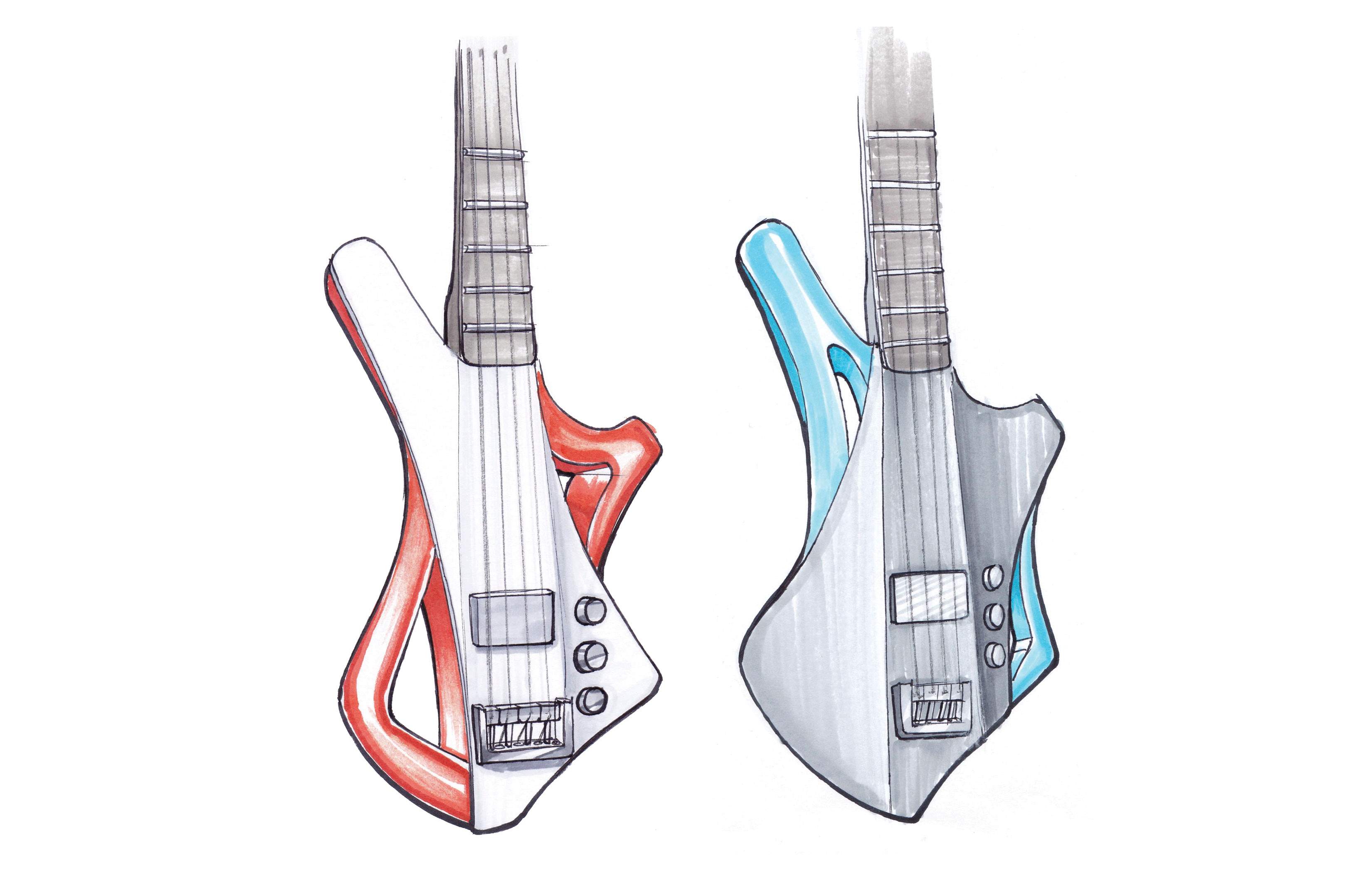
I made another foam model based on some of your feedback and it is much more comfortable when rested on the right leg when compared to something like a Fender P Bass or a Musicman Stingray. It still retains a super high level of comfort when played in classical position as well. No need to raise the left leg or anything. You can literally sit down in a neutral position and then place the bass on your lap and it just fits. So we're onto something. Right now it's a matter of getting all of the controls to fit properly, and then prototyping some of this stuff. Another big thing will be properly balancing the instrument. If the body is too light in comparison to the neck, we all know what will happen
I made another foam model based on some of your feedback and it is much more comfortable when rested on the right leg when compared to something like a Fender P Bass or a Musicman Stingray. It still retains a super high level of comfort when played in classical position as well. No need to raise the left leg or anything. You can literally sit down in a neutral position and then place the bass on your lap and it just fits. So we're onto something. Right now it's a matter of getting all of the controls to fit properly, and then prototyping some of this stuff. Another big thing will be properly balancing the instrument. If the body is too light in comparison to the neck, we all know what will happen

i like your stuff so far -keep it up!
fwiw, i am building instruments for a player of both acoustic guitars and basses, that has an old fretting hand shoulder injury. one of the concepts we've been working on are basses with a neck that is set farther into the body and is of a short scale (30"). On acoustics her preferred scale is 24" with a pretty small body, generally around a Martin size 2-1/2 or smaller.
interesting thing to note is that her fretting hand is used in what i call the "cradle postion". ime there are generally three hand postures that players use: cowboy (thumb over the top of the neck), "classical" (thumb planted in the center of the back of the neck) and "cradle" (thumb not on the back of the neck at all). she playes very well this way, but the problem is the torn rotator cuff issue that makes it real hard to support a diving neck or one that sticks out too far.
there are also some right hand issues as well in terms of a comfortable approach angle to the strings -she generally prefers very little wood in this area or at least a pretty big radius so that the right wrist doesn't go numb due to sharp edges.
she is also sensitive to what i call "neck fill" which is basically the amout of material on the back of the neck that contacts her hand. generally on her necks the change in thickness is only on the order of .100 or so and we usually go with a "truncated C" shape. neck taper is pretty normal.
fwiw, i am building instruments for a player of both acoustic guitars and basses, that has an old fretting hand shoulder injury. one of the concepts we've been working on are basses with a neck that is set farther into the body and is of a short scale (30"). On acoustics her preferred scale is 24" with a pretty small body, generally around a Martin size 2-1/2 or smaller.
interesting thing to note is that her fretting hand is used in what i call the "cradle postion". ime there are generally three hand postures that players use: cowboy (thumb over the top of the neck), "classical" (thumb planted in the center of the back of the neck) and "cradle" (thumb not on the back of the neck at all). she playes very well this way, but the problem is the torn rotator cuff issue that makes it real hard to support a diving neck or one that sticks out too far.
there are also some right hand issues as well in terms of a comfortable approach angle to the strings -she generally prefers very little wood in this area or at least a pretty big radius so that the right wrist doesn't go numb due to sharp edges.
she is also sensitive to what i call "neck fill" which is basically the amout of material on the back of the neck that contacts her hand. generally on her necks the change in thickness is only on the order of .100 or so and we usually go with a "truncated C" shape. neck taper is pretty normal.
Last edited:
@Arie X very interesting. With the neck fill, are you adding 0.1 inches of material to the neck or taking it away for her? And when you say truncated C, which part of the C is truncated, the part where the bass strings are or the part where the higher strings are?
Very nice build! I like the dark/light wood combination. I wonder if the tiny headstock has anything to do with it balancing so well.
Thanks. And, yes, the small headstock and light-ish tuners (Gotoh 707) help. But that is simple physics: you don't want a lot of mass at the end of a long stick if your going for balance. So in-a-line with big heavy tuners (the Fender model, IMO) make it hard to get any sort of mass centralization going on. So it will factor into any design.
So headless is another option, but you have to attempt to balance the aesthetics of the look with the ergo thing. Your mileage is going to vary. As you mentioned, if you are after a Fender look, then headless is just not going to cut it and you're going to have to find some way to deal with the dive.

I really respect your job and your efforts to help Bass players. But I'm playing for almost two years now and what you are trying to fix is all about right posture and technique and not about Bass ergonomic. I practice +5 hours a day and not noodling and with right posture and technique there is nothing to stop me. I think the most important thing is neck dive and i think it's not only about of weight of head and neck. Good designing of body shape is the key.

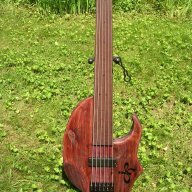
not an ergo-bass but you can take ideas from the body shape.
This pic is taken today,the build started back in the 26/8/2016.
If you really interesting about ergo,then 30"scale is the way to go.Shorter scale is easier to play and it weights less
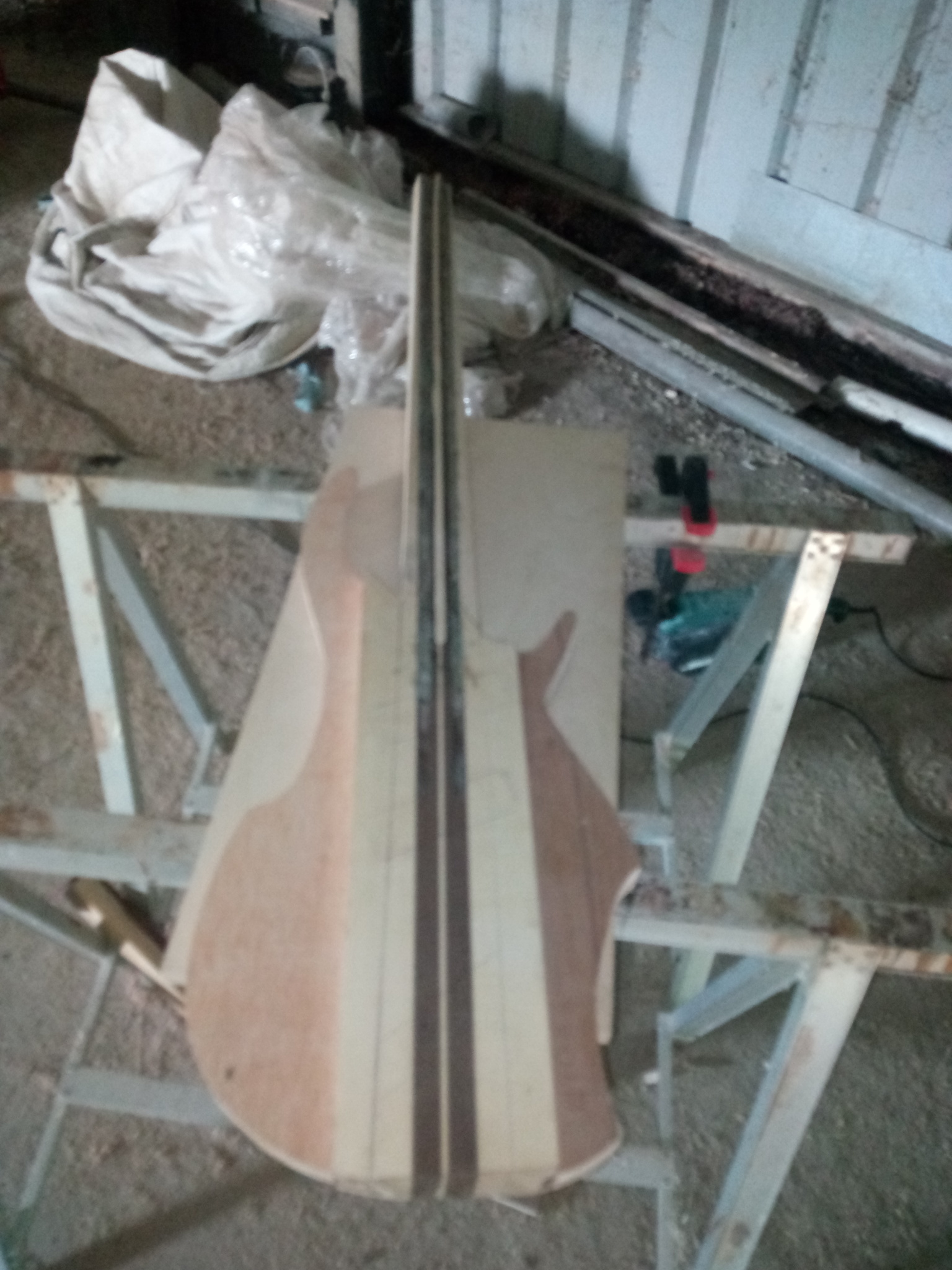
This pic is taken today,the build started back in the 26/8/2016.
If you really interesting about ergo,then 30"scale is the way to go.Shorter scale is easier to play and it weights less
I really respect your job and your efforts to help Bass players. But I'm playing for almost two years now and what you are trying to fix is all about right posture and technique and not about Bass ergonomic. I practice +5 hours a day and not noodling and with right posture and technique there is nothing to stop me. I think the most important thing is neck dive and i think it's not only about of weight of head and neck. Good designing of body shape is the key.
Hi Mili, you are right. It's all about good posture and technique. I think that most basses today make it hard for players to have good posture and technique. I understand that several players like their "normal" instruments just fine, and I won't target those people. If you read some of these other posts here, there are some people who cannot physically play regular basses because of injuries. That is who I am trying to help.
@Arie X very interesting. With the neck fill, are you adding 0.1 inches of material to the neck or taking it away for her? And when you say truncated C, which part of the C is truncated, the part where the bass strings are or the part where the higher strings are?
most instrument necks are tapered in width and in depth. the necks we are working on get thicker towards the heel. this isn't unusual as some taper much more. basically a straighter then usual neck.
the "C" profile is chopped off equidistant on both bass and treble sides.
in reality there isn't really a one size fits all type of neck profile. people with specific needs go custom for a reason.
Last edited:
most instrument necks are tapered in width and in depth. the necks we are working on get thicker towards the heel. this isn't unusual as some taper much more. basically a straighter then usual neck.
the "C" profile is chopped off equidistant on both bass and treble sides.
in reality there isn't really a one size fits all type of neck profile. people with specific needs go custom for a reason.
Okay I think I got it. I was just asking for clarity. Thank you!
I wish you luck.there are some people who cannot physically play regular basses because of injuries. That is who I am trying to help.

I'm very interested in ergonomic guitar design and it's good to see you doing this.
I want to encourage you to not worry at all about making your designs look somewhat 'normal', because the conventional modernised P-bass design is so old and so bad you will never make any significant progress.
Many players have very conservative taste and won't accept anything even slightly modern or ergonomic so it's best to give up on most players. There are still many players like me who are looking for something new and different. Consider the success and surprising popularity of what Steinberger did with an extremely alien design as far back as the start of the 1980's.
So i wouldn't worry about making it headless, which itself helps in many ways.
Related to that i feel your designs are too normal, like you are restricting yourself, or working from a false assumption of what a bass 'should look like', or are tweaking a P-bass.
The approach to ergonomic design i would take is to forget everything and work from first principles:
1. Start by considering the player and the strings only, floating in space. Consider what is the ideal orientation of the strings to the player in terms of posture health and visibility of the fretboard: Overall vertical position, overall left-right shift, and the 3 rotations: Headstock-up angle, forward angle of neck when seen from above, angle of tilt around the neck axis.
2. Next start to add the pieces that connect the player to the strings. Consider what contact points with the player and with a strap, and what critical aspects, are necessary to acheive point 1 with perfect balance and stability when standing or sitting with perfect posture.
Perfect posture being: Sitting: thighs level, back and shoulders not twisted to the side. Sitting and standing: Head not turned much even when looking at the end of the fretboard. Not much wrist bending. Upper arms not raised up too high. Shoulders not hunched etc.
Make this happen even if the hands are not touching the instrument, so that the hands are not working to suport the instrument.
3. Experiment with prototypes without worrying about what is in the gaps between the critical aspects/contact points or worrying about how it looks.
4. The last step is to fill in the non-critical gaps in the design in an artistic way to make it look good. So that you start with uncompromising ergonomics and make it look good, instead of how it looks compromising ergonomics from the start.
Remember 'form follows function' can be, and is, beautiful, for example nature.
I want to encourage you to not worry at all about making your designs look somewhat 'normal', because the conventional modernised P-bass design is so old and so bad you will never make any significant progress.
Many players have very conservative taste and won't accept anything even slightly modern or ergonomic so it's best to give up on most players. There are still many players like me who are looking for something new and different. Consider the success and surprising popularity of what Steinberger did with an extremely alien design as far back as the start of the 1980's.
So i wouldn't worry about making it headless, which itself helps in many ways.
Related to that i feel your designs are too normal, like you are restricting yourself, or working from a false assumption of what a bass 'should look like', or are tweaking a P-bass.
The approach to ergonomic design i would take is to forget everything and work from first principles:
1. Start by considering the player and the strings only, floating in space. Consider what is the ideal orientation of the strings to the player in terms of posture health and visibility of the fretboard: Overall vertical position, overall left-right shift, and the 3 rotations: Headstock-up angle, forward angle of neck when seen from above, angle of tilt around the neck axis.
2. Next start to add the pieces that connect the player to the strings. Consider what contact points with the player and with a strap, and what critical aspects, are necessary to acheive point 1 with perfect balance and stability when standing or sitting with perfect posture.
Perfect posture being: Sitting: thighs level, back and shoulders not twisted to the side. Sitting and standing: Head not turned much even when looking at the end of the fretboard. Not much wrist bending. Upper arms not raised up too high. Shoulders not hunched etc.
Make this happen even if the hands are not touching the instrument, so that the hands are not working to suport the instrument.
3. Experiment with prototypes without worrying about what is in the gaps between the critical aspects/contact points or worrying about how it looks.
4. The last step is to fill in the non-critical gaps in the design in an artistic way to make it look good. So that you start with uncompromising ergonomics and make it look good, instead of how it looks compromising ergonomics from the start.
Remember 'form follows function' can be, and is, beautiful, for example nature.
Last edited:


