• TalkBass has been independent since 1998. Add your voice.
    Create a free account to reply to discussions, view embedded media, and browse with fewer display ads.
    Join freeLog in
    Want zero display ads or expanded classifieds tools? Compare plans.

Second-ever bass build (9-strings!)

evanatch

Guest
Jun 19, 2011
203
1
Hello TalkBass Luthiers, my name is Evan Atchison. I'm 16 years old and a junior in high school. This thread will be a documentation of my second ever bass build in my Construction class.

My first build was a four-string fretless. I've run into some problems trying to finish it, and will probably be trying to get paint on it at the same time I'm doing the woodwork for this build.

This build will be a fretted, 9-string, neck-through bass. This should be more challenging than my first build, but I think I'm up to the task. Plus, this time around I will have this forum as a resource (I'll be counting on you guys for help very often).

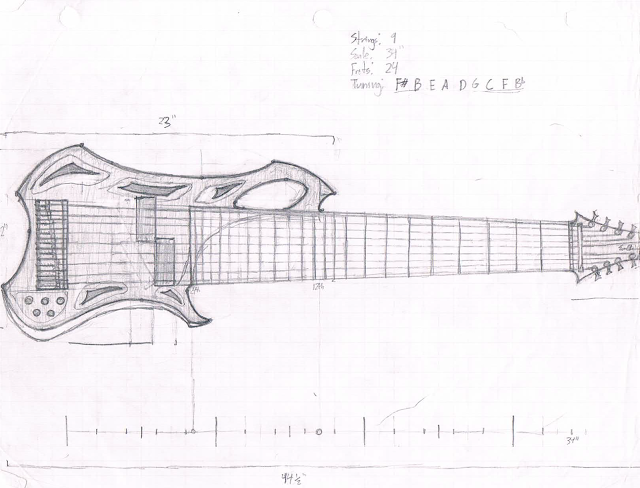
Here's a scaled drawing of my design:
BassDrawing.png

The actual construction will be slightly different. The body needs to be slightly enlarged, and will not be chambered. I hope to use a "swirl" type finish for the body and headstock.

I have applied for a guitar building scholarship from LMII to help gather the necessary materials for this build. Hopefully they will send me parts soon. If I don't get the scholarship, I'm not sure I'll be able to continue this build - I don't think I can afford it.

Finally, I have a few questions to start off with:
- For those of you who have build extended-range basses, how thick did you make the neck? Is it thinner than a standard neck?
- Is there any detailed guide on how to connect a neck-through singlecut's upper wing to the neck? I've seen some pictures, but I have no idea how to go about doing it.

Thanks for reading my thread, I will try to post regular updates as often as interesting things happen!:bassist:
 
Anyone have a guide on connecting a singlecut upper wing to the neck? Any help would be appreciated with this.

I have never done it, but I have seen it done on here. The neck pocket extends into the upper horn, and the neck is carved to the shape of the neck pocket. It bolts on like a double cut.
 
Since you're building a Neck through, which the other guys didn't seem to catch, you can either do some rough contouring of the neck before you attach the sides (leaving enough flat area on the bass side of the neck to attach your wing), or do all the carving post-wing attachment.

Are you planning on having the pickup that close to the neck? I might shift it back to the same location as a P bass, just to tighten up the tone on the low strings and give you bit more versatility.

Are you going to use a pair of soap bars to form a massive P pickup? Maybe find a matching pair of dual coil soap bars, so you can switch between humbucker or single coil per side, and then wire it up with two jacks (bass and treble), since I'm guessing some tapping is gonna happen, then you can run the highs into a guitar amp with different tone and effects than the bottom strings.

Passive or active?

You'd be surprised at how cheaply you could build something by going with budget parts that you can parade in the future. Pickups, single string bridgs, and tuners can be had pretty cheap on eBay. Make it simple and passive to start; volume and tone, but make a big enough control cavity to add a preamp or other features later if you want.

Use pickups that are a 'standard size'... Lots of soapbars are 4.5" x 1.5", and cheapo's that sound alright are available online.

Make the body out of something like pine, agathis, or basswood (won't matter much what it looks like since it'll be painted, and are easy to cut/sand/shape). Maple neck and fingerboard can be cost effective and are pretty standard. Don't radius the fingerboard, lots of ERB guys prefer a flat board, and it also saves time/money on making a jig or radiused sanding block to radius your FB.

You could even save a few dollars by using bass tuners on the low strings F#-A and the guitar tuners D-Bb. Again, buy some cheaper ones and if the bass actually ends up being wort it, upgrade to Hipshots or something down the line.
 
  • Like
Reactions: Why Nautilus‽
TheEmptyCell said:
Since you're building a Neck through, which the other guys didn't seem to catch, you can either do some rough contouring of the neck before you attach the sides (leaving enough flat area on the bass side of the neck to attach your wing), or do all the carving post-wing attachment.

Are you planning on having the pickup that close to the neck? I might shift it back to the same location as a P bass, just to tighten up the tone on the low strings and give you bit more versatility.

Are you going to use a pair of soap bars to form a massive P pickup? Maybe find a matching pair of dual coil soap bars, so you can switch between humbucker or single coil per side, and then wire it up with two jacks (bass and treble), since I'm guessing some tapping is gonna happen, then you can run the highs into a guitar amp with different tone and effects than the bottom strings.

Passive or active?

You'd be surprised at how cheaply you could build something by going with budget parts that you can parade in the future. Pickups, single string bridgs, and tuners can be had pretty cheap on eBay. Make it simple and passive to start; volume and tone, but make a big enough control cavity to add a preamp or other features later if you want.

Use pickups that are a 'standard size'... Lots of soapbars are 4.5" x 1.5", and cheapo's that sound alright are available online.

Make the body out of something like pine, agathis, or basswood (won't matter much what it looks like since it'll be painted, and are easy to cut/sand/shape). Maple neck and fingerboard can be cost effective and are pretty standard. Don't radius the fingerboard, lots of ERB guys prefer a flat board, and it also saves time/money on making a jig or radiused sanding block to radius your FB.

You could even save a few dollars by using bass tuners on the low strings F#-A and the guitar tuners D-Bb. Again, buy some cheaper ones and if the bass actually ends up being wort it, upgrade to Hipshots or something down the line.

This.

I think the headstock would look odd though with a mix of bass and guitar tuners though ;) if it were me id get no name basic tuners of the fleabay and roll with those
 
Since you're building a Neck through, which the other guys didn't seem to catch, you can either do some rough contouring of the neck before you attach the sides (leaving enough flat area on the bass side of the neck to attach your wing), or do all the carving post-wing attachment.

Are you planning on having the pickup that close to the neck? I might shift it back to the same location as a P bass, just to tighten up the tone on the low strings and give you bit more versatility.

Are you going to use a pair of soap bars to form a massive P pickup? Maybe find a matching pair of dual coil soap bars, so you can switch between humbucker or single coil per side, and then wire it up with two jacks (bass and treble), since I'm guessing some tapping is gonna happen, then you can run the highs into a guitar amp with different tone and effects than the bottom strings.

Passive or active?

You'd be surprised at how cheaply you could build something by going with budget parts that you can parade in the future. Pickups, single string bridgs, and tuners can be had pretty cheap on eBay. Make it simple and passive to start; volume and tone, but make a big enough control cavity to add a preamp or other features later if you want.

Use pickups that are a 'standard size'... Lots of soapbars are 4.5" x 1.5", and cheapo's that sound alright are available online.

Make the body out of something like pine, agathis, or basswood (won't matter much what it looks like since it'll be painted, and are easy to cut/sand/shape). Maple neck and fingerboard can be cost effective and are pretty standard. Don't radius the fingerboard, lots of ERB guys prefer a flat board, and it also saves time/money on making a jig or radiused sanding block to radius your FB.

You could even save a few dollars by using bass tuners on the low strings F#-A and the guitar tuners D-Bb. Again, buy some cheaper ones and if the bass actually ends up being wort it, upgrade to Hipshots or something down the line.

Wow, thanks for all the advice! I really appreciate it.

I definitely am planning to move the pickup to the P-Bass position, the pickup placement on the drawing was a result of some bad math. The pickup will be two humbuckers wired like a P-Bass pickup. I'm hoping to use EMGs, but I need to find out what my budget is first. I will probably take on advice on not using a preamp at first. Ideally I'd like to use an Audere Classic 4-Band, but realistically passive is probably the way to go for now.

As far as the rest of the materials go, I need to see what the scholarship I applied for will provide or won't provide. It's through LMII, here's the information for it: http://www.lmii.com/CartTwo/Scholarship.asp. I'll have to see what comes of that and then decide what to do then
 
Seriously ambitious, but hopefully this forum will be of assistance. :) I second the guitar tuners and I'd also suggest going inexpensive, as you can always upgrade later. I'd also suggest doing a full scale 1:1 drawing of the bass, as that drawing and tracings can then become your templates for building.

For a neck through that large (which I have never done!), I would probably make a tapered neck blank that matches the overall fingerboard shape and then attach the sides to that blank. I'd then shape the heel afterwards to make it work. I think I'd go with a full thickness neck through section and full thickness wings just to simplify - but that's just me.

I would probably use two trussrods and maybe three stiffeners, but it would depend on the neck construction - your nut will have to be quite custom too...

Single string bridges will be your simplest option, but mating two or more bridges might be cheaper - worth exploring I think.

I would also suggest you go with EMGs, as for the price, they are probably the best you can come by. Even the cheap crap on allparts is nearly the same price as EMGs and with EMGs you get the electronics included.

Lastly, I don't know what your parents are like but if my son had come to me with a project like this when he was in high school, I'd have probably tried to come through with a thousand bucks to help him see it through! :) I'd try raising some cash locally if possible, you never know who might help you out, and you probably only need around $400 to get you on your way - any chance they'd be willing to help you through? You've got a great community of support here...
 
Sorry it's been so long since I last posted on this thread, I haven't made very much progress recently. Things should picking up soon, however.

After getting in contact with LMI, they have agreed to send me some of the materials for the bass, even though they no longer offer the scholarship I applied for. This was definitely a cool thing for them to do and is much appreciated. :bassist: The materials were scheduled to arrive at the school today. I ordered the hardware recently as well, I found some cheap Chinese parts on eBay that should be functional. Not perfect, but for $70 for bridge + tuners I'm pretty happy. Still looking for a good deal on some used EMGs.

In the meantime, I built a full-size rough plan for the bass out of some spare MDF to get a good idea of how big this thing will be. The neck is pretty enormous, but I think I'll be able to manage it. This is far from perfect and still needs to be tweaked for the final design a bit, but here it is:
CAM00009.jpg

CAM00010.jpg

I'm very excited to be able to get this build underway soon, and hopefully I'll be able to post more regular updates. Thank you all for your advice so far, it's really appreciated! :bassist:
 
Definitely going to want the treble side wider, so your pickup isn't so close to the edge. Also so that you have room for a control cavity. Looks good so far, and congrats on getting the scholarship.
 
Widening the treble side is definitely something I'm planning on doing on the final design. Also, I should be able to get a four and a five string pickup to use, instead of trying to make two five string pickups work (which is how the pickups on the model are drawn).
 
I don't see why a 4-string humbucker and a 5-string humbucker wouldn't work.

Something like an EMG 40HZ and an EMG 35HZ would probably work fine in a massive P configuration. It'd give you a maximum string spread of 146mm, which is enough for up to 18mm string spacing, which I think would make a 9-string bass difficult to manage.
 
Ahh, sorry, I was reading fast, I thought OP said just one pickup! Yeah, 4+5 string should work A-OK. Depending on whether the bass will be played mostly fingerstyle or touch style, 18mm might be feasible. I'd shoot for 17 or 17.5 for a good in between. Anything less just feels bad to me (my favorite guitar necks are classical).
 
Thanks for advice and positive comments guys! It will definitely be a difficult process, but hopefully with the advice of TB Luthiers this will be turned into an awesome instrument.

I'm thinking I'll go with a 16.5mm string spacing for this. My current main bass (Spector Rex Pro 5) has a .66" = 16.764mm string spacing and I'm pretty comfortable playing fingerstyle, tapping, or slapping on it. A smaller string spacing will also help keep the neck width down. I'll try to make a list of all the specs this weekend and add it to the OP.