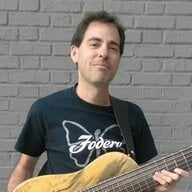
A few minutes ago I received the best bass instruction book I have ever seen: "Serious Electric Bass: The Bass Player's Complete Guide to Scales and Chords," by the late Joel Di Bartolo. I was sad to learn that Maestro Di Bartolo recently passed away, but I am happy to dedicate my first Talk Bass thread to him.
I have only been playing bass for a few months, but have been a musician for 40 years -- classical guitar for 25+ and electric guitar ten years before that, trumpet and clarinet during my youth (among experimentation several other wind/brass instruments), piano classes during my undergraduate studies, and I have been playing Brazilian percussion for about a decade. However, I have fallen in love with the electric bass, and have begun (hopefully) a very long love affair.
Since I am once again a broke graduate student (this time science), I have to rely on my past skills and new instruction books (nothing replaces a real teacher, IMHO). So, I began a long, in-depth search for suitable bass methods, and luckily I found Talk Bass because there is so much great advice in every regard to the bass-playing world.
After reading several threads on Talk Bass and elsewhere about the bass instruction books available (and out of print), I developed criteria for selecting bass instruction books:
1. NO TAB notation!!!
2. Logical pedagogical routines that foster sight reading in bass clef, and hand position/movement studies
3. Scales, chords, and a variety patterns
4. The above must be usable for improvisation
5. The information and exercise routines must be presented and related to music theory
6. The information and exercise routines must be at a level that makes me think very hard
7. Information and exercise routines must have a universal quality, in that they not only work for the electric bass, but other bass clef instruments (to some degree)
8. NO TAB NOTATION!!!!
Okay, it may appear that I do not like tab notation -- Yes and no. I spent several years studying lute and vihuela tablature, and even did a little research on Spanish and German keyboard tablature. However, I view modern guitar tab notation to be a hinderance to musical literacy. I am not saying it does not have its place, nor am I criticizing its useful and practical aspects, especially if it leads to mastery of instrumental technique, and hopefully inspires a desire to learn standard notation. Lastly, if one enjoys reading tab notation, then please disregard my personal pet peeve.
My point is that the use of tab notation has grown to an absurd proportion in the printed literature in the past two decades, so much to the point (I believe) it fosters illiteracy (I am sure many here will find exceptions). In addition, since I have studied and played other instruments that required me to read standard notation, as well as understand and properly perform rhythm, I have been able to compare the results to my guitar playing, which I initially learned by ear and did not read (I learned tab on the guitar before reading music notation).
I can say from personal experience and countless observations, the majority of guitar players I have ever heard CANNOT play with good rhythm. Several years ago I concluded this after learning classical guitar and piano, and Brazilian percussion, the latter of which I initially learned by ear.
The tab vs. music notation debate, I believe, has already taken place in countless other threads, and I apologize for such a long explanation regarding my first criteria choice of NO TAB NOTATION!!
One last, economical point about tab notation: it takes up about half the space on a page, so one is getting less music for their money. Many bass books, once the tab is removed, are reduced to just a dozen or so pages. All one has to do is compare books by Carol Kaye, Bob Cranshaw, Ron Carter, Ray Brown, Rufus Reid, Ed Fuqua, Adriano Giffoni, and last but not least Roger Filiberto with tab notated books. The sheer volume of information available in Di Bartolo's book would require several volumes if it included tab.
I think "Patterns for Jazz" by Jerry Coker et al. is one of the best books available, and so is Wilson and Viola's "Chord Studies for the Trombone," which was also published more recently as a book for bass guitar, by Appleman and Viola (it includes bass guitar fingerings -- I have the 1968 edition for trombone, which I prefer because I want to create my own fingerings). The latter contains 144 pages of exercises, Coker's book has about 180 pages (versions in other clefs are available), and Di Bartolo's book has about 270 pages, most of which is music (the beginning discusses instrument set-up, etc.). However, if I were to recommend tab notation books, I would begin with Ed Friedland, Jeff Berlin, and the "Toque de Mestre Series" (in Portuguese, and probably only available in Brazil) (there are other good ones, so please forgive the omissions).
Lastly, I want to say how grateful I am to own Maestro Di Bartolo's book, "Serious Electric Bass." Please do yourself a favor and buy a copy for yourself, or another bass player, which would make a great Christmas or birthday present.
May this book never go out of print!!
... peace from New Orleans
PS. Rest in peace, Maestro Di Bartolo, and thank you very very much!!
I have only been playing bass for a few months, but have been a musician for 40 years -- classical guitar for 25+ and electric guitar ten years before that, trumpet and clarinet during my youth (among experimentation several other wind/brass instruments), piano classes during my undergraduate studies, and I have been playing Brazilian percussion for about a decade. However, I have fallen in love with the electric bass, and have begun (hopefully) a very long love affair.
Since I am once again a broke graduate student (this time science), I have to rely on my past skills and new instruction books (nothing replaces a real teacher, IMHO). So, I began a long, in-depth search for suitable bass methods, and luckily I found Talk Bass because there is so much great advice in every regard to the bass-playing world.
After reading several threads on Talk Bass and elsewhere about the bass instruction books available (and out of print), I developed criteria for selecting bass instruction books:
1. NO TAB notation!!!
2. Logical pedagogical routines that foster sight reading in bass clef, and hand position/movement studies
3. Scales, chords, and a variety patterns
4. The above must be usable for improvisation
5. The information and exercise routines must be presented and related to music theory
6. The information and exercise routines must be at a level that makes me think very hard
7. Information and exercise routines must have a universal quality, in that they not only work for the electric bass, but other bass clef instruments (to some degree)
8. NO TAB NOTATION!!!!
Okay, it may appear that I do not like tab notation -- Yes and no. I spent several years studying lute and vihuela tablature, and even did a little research on Spanish and German keyboard tablature. However, I view modern guitar tab notation to be a hinderance to musical literacy. I am not saying it does not have its place, nor am I criticizing its useful and practical aspects, especially if it leads to mastery of instrumental technique, and hopefully inspires a desire to learn standard notation. Lastly, if one enjoys reading tab notation, then please disregard my personal pet peeve.
My point is that the use of tab notation has grown to an absurd proportion in the printed literature in the past two decades, so much to the point (I believe) it fosters illiteracy (I am sure many here will find exceptions). In addition, since I have studied and played other instruments that required me to read standard notation, as well as understand and properly perform rhythm, I have been able to compare the results to my guitar playing, which I initially learned by ear and did not read (I learned tab on the guitar before reading music notation).
I can say from personal experience and countless observations, the majority of guitar players I have ever heard CANNOT play with good rhythm. Several years ago I concluded this after learning classical guitar and piano, and Brazilian percussion, the latter of which I initially learned by ear.
The tab vs. music notation debate, I believe, has already taken place in countless other threads, and I apologize for such a long explanation regarding my first criteria choice of NO TAB NOTATION!!
One last, economical point about tab notation: it takes up about half the space on a page, so one is getting less music for their money. Many bass books, once the tab is removed, are reduced to just a dozen or so pages. All one has to do is compare books by Carol Kaye, Bob Cranshaw, Ron Carter, Ray Brown, Rufus Reid, Ed Fuqua, Adriano Giffoni, and last but not least Roger Filiberto with tab notated books. The sheer volume of information available in Di Bartolo's book would require several volumes if it included tab.
I think "Patterns for Jazz" by Jerry Coker et al. is one of the best books available, and so is Wilson and Viola's "Chord Studies for the Trombone," which was also published more recently as a book for bass guitar, by Appleman and Viola (it includes bass guitar fingerings -- I have the 1968 edition for trombone, which I prefer because I want to create my own fingerings). The latter contains 144 pages of exercises, Coker's book has about 180 pages (versions in other clefs are available), and Di Bartolo's book has about 270 pages, most of which is music (the beginning discusses instrument set-up, etc.). However, if I were to recommend tab notation books, I would begin with Ed Friedland, Jeff Berlin, and the "Toque de Mestre Series" (in Portuguese, and probably only available in Brazil) (there are other good ones, so please forgive the omissions).
Lastly, I want to say how grateful I am to own Maestro Di Bartolo's book, "Serious Electric Bass." Please do yourself a favor and buy a copy for yourself, or another bass player, which would make a great Christmas or birthday present.
May this book never go out of print!!
... peace from New Orleans
PS. Rest in peace, Maestro Di Bartolo, and thank you very very much!!