I see what you’re saying. I wasn’t trying to downplay the value of sheet music. I guess I was coming from a viewpoint that they are different skills. If the OP is most likely to be handed a chord sheet, they have to know how to craft a bass line from that information.I don't get this type of logic. Why work on the easiest stuff and skip the harder stuff when the harder stuff provides more benefit, not only for doing harder stuff, but for doing easier stuff as well? I consider it looking for the easy way out, which is fine if you have no plans on doing something beyond tinkering at home, but not so good otherwise.

Enjoy the benefits of a premium membership!
Upgrade Account
-
TalkBass has been independent since 1998. Add your voice.
Create a free account to reply to discussions, view embedded media, and browse with fewer display ads.
Join free Log in
Want zero display ads or expanded classifieds tools? Compare plans.
You are using an out of date browser. It may not display this or other websites correctly.
You should upgrade or use an alternative browser.
You should upgrade or use an alternative browser.
Sheet music vs chord sheets?
- Thread starter WrapRough
- Start date
More options
Who Replied?

1. Reading chord charts gets infinitely easier when you are better at reading notation.I dunno it seems like good logic to me. He is suggesting focusing on the thing I will be using the majority of the time, while still allowing time to do the harder stuff. From this thread it seems that the ability to sight-read on the fly is probably not that valuable for someone like me. It would rarely be used and therefore it would also be difficult to maintain. I'd essentially be practicing in perpetuity for no reason. The ability to read sheet to learn a song, sure, and that's what I am working towards... But I see massive value in being very good at taking a chord sheet and being able to create a line.
So it's not one or the other, but just how much of one or the other.
2. You have no idea what opportunities will be presented to you in the future. For the first years of my musical career, I never had to read. I still knew how to do it and do it well, but I never had to read. Then I got a call for a reading gig and I took it, excelled, and then I started getting called all the time for reading gigs. Those gigs consistently paid better, too.
Yeah, but sometimes you get handed a chord chart with the expectation that you have a familiarity with the music and can play a bass line that sounds like what's on the record.I see what you’re saying. I wasn’t trying to downplay the value of sheet music. I guess I was coming from a viewpoint that they are different skills. If the OP is most likely to be handed a chord sheet, they have to know how to craft a bass line from that information.

I really enjoy "decoding" a chord chart and coming up with my own part that works for the song. Additional rhythmic and voicing notation beyond "2 bars of A minor" is helpful for this, tho.
I didn’t really clarify this in my first post, but my definition of “using chord charts” includes study of theory, what makes a good walking bass line, and listening to records and playing by ear. So that’s another route to get to “sounding like the record.”Yeah, but sometimes you get handed a chord chart with the expectation that you have a familiarity with the music and can play a bass line that sounds like what's on the record.
This all comes from my journey starting as a trumpet player, playing the sheet music, but having a hard time improvising and playing by ear. When I got to bass playing, my focus shifted to learning by ear and trying to understand “how it works.”
Again, I see what you are saying, and there is great value in sheet music and learning how to read it. Not trying to argue with Jimmy, I know better

I dunno it seems like good logic to me. He is suggesting focusing on the thing I will be using the majority of the time, while still allowing time to do the harder stuff. From this thread it seems that the ability to sight-read on the fly is probably not that valuable for someone like me.
It's quite valuable if (and this is a big if for many of us) you want to be able to break into better paying gigs with orchestras and community theaters and the like. There's a level of work out there that you won't even hear about if you can't read.
For most of us who work regular jobs and play for fun, that's not something we're going to be competing for. So yes, it's definitely a worthy goal but since your question was about what's most commonly used, my answer to you is chord charts. That's what's common in casual, unpaid, jam or hobbyist situations.
Reading well will put you in competition for better gigs, but if you don't want those gigs, the reasons for learning it are less obvious. Virtually nobody in a casual jam is ever going to put standard notation in front of you.

I've been investing time lately in improving my reading, and I have been mixing it up between sheet music and chord sheets. It's slow going but i'm improving, which is the main thing. Last night i got to thinking about which one gives me more bang for my buck in musical situations. I know the advice here will be "learn both", which I am doing.. But, in my head, it would seem that a more common scenario would be that I would be handed a chord sheet rather than a piece of sheet music that I need to play note for note. I dont plan on being a pro, or a session player, but I do plan on finding other musicians to play and jam with, and maybe some open mic jazz nights in the future. I am finding much more enjoyment and value from playing to chord sheets as it's really helping with my (lack of) improvisation skills.
So, which is the more common scenario you find yourself in? Being handed a sheet that you have to play note for note, or being handed a chord sheet and you deciding what to play? Would you rather be "ok" at sight-reading sheet and a demon with a chord sheet, or vice versa? And yes, i know, demon at both would be the ideal situation
If you play jazz combo from the Real Book you will generally play from a chord lead sheet, unless you are expected to play the melody. Then it's good to be able to read treble cleff. There are a few tunes in the Real Book that have a written out bass line. If someone brings in an original composition, they may expect you to read a bass line they have written.
You can buy a bass clef version of the Real Book but I recommend the treble clef YMMV.
An authentic jazz musician is expected to know a lot of standards from memory. Most people will tell you that learning the melody is a key step. Also you will normally be expected to solo freely over the changes. I can solo fine, but playing head charts is a skill I never mastered, so I don't consider myself an authentic jazz musician. But as long as I have a lead sheet or music in front of me, I am entirely comfortable.
If you are playing in big band, you will need to read written notation and chord notation. A majority of what you will do, in my experience, is read chord notation, but there are parts where you need to be able to read and play exactly what is written. The bass lines for some compositions are written out entirely note for note, some are written out with chord and rhythmic notation, so you know where to play the hits with the drums or the rest of the ensemble. Also, if you play big band for any length of time you will probably come across a few soli sections. Solis are a written out lines that you play with other people in the band (essentially group solos). Solis are often fast and technically challenging, and they should be played precisely.
IMHO interpreting chord notation is really what jazz is about. This is a very deep subject that relies on your ability to learn and apply music theory.
You need to be proficient in reading written music as well, but in my experience most jazz musicians are not monster site readers.
I guess what I am saying is you do need to do both, but I suggest spending more time on studying theory, interpreting chord notation, and memorizing head charts.
For the record I had no problem memorizing 4 or more hours of music for cover bands, and I was singing back ground vocals in addition to playing bass. But I tend to get lost in the more complex harmonic progressions of jazz standards. The challenge of memorizing one jazz standard is sort of equivalent to memorizing a whole set of pop music. Also, since my job did not require me to memorize jazz standards, I did not do it.
Lead sheets ( chords and melody) are very common in working/jamming bands.
Being able to sight read standard notation opens doors wher the RBI’s no substitute for that skill.
I don’t make my living playing music, but I get several decent paying gigs per year that are a show up, play gig, get $, go home situation. These are theater style shows or community chorus gigs. If you get a reputation at doing those types of gigs, the word will get around.
Often there is a (paid) rehearsal or two.
Being able to sight read standard notation opens doors wher the RBI’s no substitute for that skill.
I don’t make my living playing music, but I get several decent paying gigs per year that are a show up, play gig, get $, go home situation. These are theater style shows or community chorus gigs. If you get a reputation at doing those types of gigs, the word will get around.
Often there is a (paid) rehearsal or two.
@WrapRough
Here's an angle to consider. How will you advance your understanding of music theory and how to interpret chord notation if you cant read written music notation. Examples are generally going to be written out.
Here's an old book I found online that teaches some interesting ideas on walking bass. It's of no use if you can't read written notation: [Bob magnusson] the_art_of_walking_bass_a_method_(book_za.org)
My suggestion is to maintain some ability to read in both bass and treble clef...essentially be able to read the grand staff.
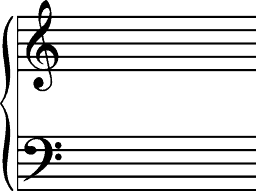
You don't have to be a monster sight reader, but it's extremely beneficial to maintain some basic reading skills. Practice reading in the common keys on a regular basis. If you play out of the Real Book, get used to reading the melodies in treble clef. If you want to play jazz, this will come in handy down the road.
Here's an angle to consider. How will you advance your understanding of music theory and how to interpret chord notation if you cant read written music notation. Examples are generally going to be written out.
Here's an old book I found online that teaches some interesting ideas on walking bass. It's of no use if you can't read written notation: [Bob magnusson] the_art_of_walking_bass_a_method_(book_za.org)
My suggestion is to maintain some ability to read in both bass and treble clef...essentially be able to read the grand staff.
You don't have to be a monster sight reader, but it's extremely beneficial to maintain some basic reading skills. Practice reading in the common keys on a regular basis. If you play out of the Real Book, get used to reading the melodies in treble clef. If you want to play jazz, this will come in handy down the road.

buldog5151bass
Kibble, milkbones, and P Basses. And redheads.
I try to learn every part exactly. I start with chord sheets, but use sheet music to notate any complex parts.
I’ve always read and like others needed it primarily for church music, large orchestra pop/ music theater when I was young and big band stuff. I’ve only seen chord charts for what I mostly play which is rock.
But something that others haven’t really highlighted has been very important for me - the better I’ve gotten at reading the better I’ve gotten at transcribing. I’ve found writing down a bass part is the best way for me to recall a line that I want to play exactly in a certain way.
But something that others haven’t really highlighted has been very important for me - the better I’ve gotten at reading the better I’ve gotten at transcribing. I’ve found writing down a bass part is the best way for me to recall a line that I want to play exactly in a certain way.
Both - I've played in groups where the bass line is laid out for a few measures, then chord symbols above it for the rest of the time, (Sammy Nestico's "Wind Machine" for example - a lot of big band jazz bass charts are like that) except for when there are specific ensemble parts. And the same goes for pit band work, like backing up a singer or a stage play.. This assumes a bassist know how to continue the groove, and improvise while staying within the feel the original written out bass part lays out.
I've been working my way through that book. The writing exercises are good too. That helps to stick what notes are what in your head.@WrapRough
Here's an angle to consider. How will you advance your understanding of music theory and how to interpret chord notation if you cant read written music notation. Examples are generally going to be written out.
Here's an old book I found online that teaches some interesting ideas on walking bass. It's of no use if you can't read written notation: [Bob magnusson] the_art_of_walking_bass_a_method_(book_za.org)
My suggestion is to maintain some ability to read in both bass and treble clef...essentially be able to read the grand staff.
View attachment 4209455
You don't have to be a monster sight reader, but it's extremely beneficial to maintain some basic reading skills. Practice reading in the common keys on a regular basis. If you play out of the Real Book, get used to reading the melodies in treble clef. If you want to play jazz, this will come in handy down the road.

There is an implication in some posts that focusing on notation will force some kind of trade off with learning to follow a chord chart. I think that's not really the case. I view chart reading is just a subset of notation. It's all part of reading to me, and every improvement I experienced in chart reading came from learning more about notation (repeats, dal segno, Codas etc) So I see the choice is a false one.
Few people learning bass will consciously focus on exclusively translating dots and beams while deliberately avoiding theory, song form and stylistic analysis. remaining ignorant of "chart reading skills" while learning notation would take an actual effort.
Few people learning bass will consciously focus on exclusively translating dots and beams while deliberately avoiding theory, song form and stylistic analysis. remaining ignorant of "chart reading skills" while learning notation would take an actual effort.
Last edited:
I've just read through the entire thread. Really, this isn't an either or situation. What your essentially asking is, do I read the first sentence of each paragraph, or the whole paragraph? There's information in both. Chord charts give you the structure, notation tells you how that structure is put together. Gads, that's an absolutely terrible analogy.
What you're asking is how much music do you really need to be able to read. I can't answer that. I can read notation and I can read chord charts. I know the theory behind the chords, and the inversions. And I continue to practice them. I can build bass lines for several different genre's of music when provided with a chord chart and a feel (funk in I-IV-V-vi at 160 bpm), and I can read specific notation (though I may need some practice time, my sight reading skills aren't what they used to be).
It boils down to what situations you expect to find yourself in. Music is a language. It's a good idea to be able to read the language you're learning.
What you're asking is how much music do you really need to be able to read. I can't answer that. I can read notation and I can read chord charts. I know the theory behind the chords, and the inversions. And I continue to practice them. I can build bass lines for several different genre's of music when provided with a chord chart and a feel (funk in I-IV-V-vi at 160 bpm), and I can read specific notation (though I may need some practice time, my sight reading skills aren't what they used to be).
It boils down to what situations you expect to find yourself in. Music is a language. It's a good idea to be able to read the language you're learning.
Most sheet music used by bands are lead sheets with the melody line and chord changes. That’s what all the Realbooks and Fakebooks are based on. The lead vocalist or instrument plays the melody and the rest of the band plays the chord changes. Between the lead sheet and being familiar with the song from hearing it, it’s a very concise way of keeping everyone in sync.


Ear training and on-the-fly transposing will do you good.maybe some open mic jazz nights in the future.

I've been investing time lately in improving my reading, and I have been mixing it up between sheet music and chord sheets. It's slow going but i'm improving, which is the main thing. Last night i got to thinking about which one gives me more bang for my buck in musical situations. I know the advice here will be "learn both", which I am doing.. But, in my head, it would seem that a more common scenario would be that I would be handed a chord sheet rather than a piece of sheet music that I need to play note for note. I dont plan on being a pro, or a session player, but I do plan on finding other musicians to play and jam with, and maybe some open mic jazz nights in the future. I am finding much more enjoyment and value from playing to chord sheets as it's really helping with my (lack of) improvisation skills.
So, which is the more common scenario you find yourself in? Being handed a sheet that you have to play note for note, or being handed a chord sheet and you deciding what to play? Would you rather be "ok" at sight-reading sheet and a demon with a chord sheet, or vice versa? And yes, i know, demon at both would be the ideal situation
It depends completely on where and with whom you aspire to play. For example, if you're in a city with a lot of musical theatre (London?) when the theatres fire up after Covid you would pretty much have to read to land those gigs. Large jazz ensembles probably would require reading, at least part of the chart. Movie and TV scores could very well require reading at least parts of the bass line.
On the other hand, In all the years I played pop rock, blues rock, country rock, including recording sessions, I was never given more than a chord chart and sometimes a demo tape or CD to listen to.


