• TalkBass has been independent since 1998. Add your voice.
    Create a free account to reply to discussions, view embedded media, and browse with fewer display ads.
    Join freeLog in
    Want zero display ads or expanded classifieds tools? Compare plans.

Shim?

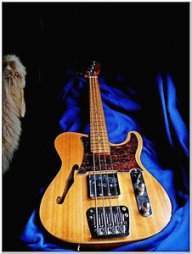
I have assembled a tele parts caster using SX body, bronco neck & Mustang bridge. The action is not bad & is playable.(But) I have a partial paralisis in my left hand which complicates things for me when playing. I want a lower action to assist in working against that handicap. The saddles are very very high & truss rod is set to full adjustment (clockwise). When I lower sadles I ger fret buzz. Do you think a shim @ the neck heel will allow me to drop saddles to lower action height?

mar2101-X3%201-L.jpg
 
Last edited:
Yeah, as diabolus says, shimming will not help this situation at all. You say you have the rod tightened all the way, but you haven't told us what the relief is on your neck. Have you checked it with a straightedge?

I'd blame the "compliments" on Spellcheck. It's always handy for blame. :D

BTW, it sure looks pretty. I hope we can get it playing right.
 
by relief do you mean measured distance (@ center of neck) from fret top to string bottom when capoed at first fret and depressed at about seventeenth?
Yes.

As far as shimming, does it not matter where the shim is placed. Heel to lower, top to raise action?
As far as the impact it has in either raising or lowering action, yes, of course. As far as the situation you are complaining about: i.e. getting string buzz even with a very high action, no, it doesn't matter at all - shimming will not change that regardless. That is the result of issues like neck relief and nut height.

In that regard, I once bought a used bass (Peavey Foundation 5) that had a buzz problem I couldn't fix with standard adjustments, and I quickly realized it was because someone had cut the nut too deep. I like a low action, and perhaps the PO had liked a very high action and the nut worked okay for that. It made a low action impossible. This is a problem that will, of course, be evident even playing open strings.
 
Last edited:
  • Like
Reactions: DiabolusInMusic
I would shim the neck up a bit to enable you to adjust up and down on the bridge. Use a straight edge down the fret board and the middle height adjust ment should touch the straight edge. Then take a straight edge and get the neck as straight as humanly possible using the truss rod. The nut should be filed or sanded so that you can hold a nickel between the first fret space and the strings. Once all of that is done string it up. If you are still getting buzz's, get a Fret Rocker and see if you have a high fret. This should do it. It could be any number of things but unless you have skills take it to someone who does. Any questions, feel free to ask.
 
i`m afraid that i will have to do the work myself. i live on an island in coastal alaska nowhere a tech. i rely on the internet for everything,
IVG, which end of the neck should be shimmed. intuition tells me the heel but i`m guessing and have been wrong before.
a nickel does fit (barely) under the E string at the first fret.
 
Last edited:
Relief is the slight bow that allows the plucked/picked strings to oscillate in an ellipse without rattling on the frets/board.
With your elbow, fret the highest fret, and with your finger, fret the 1st fret. the free space between the center fret and the bottom of the string is the 'relief'.
You don't need much- 1/32" to 1/16" usually.
If that's good and you still have to set the saddles high to keep it from buzzing, put a .030 to .040 shim (if you prefer shimming to shaving) in the front side (not the bridge end) of the pocket.
You should then be within working range of the saddles to get the action height you like.
A nickel thickness at the 1st fret is way high for me, but some may like it there.
Just fretting the 1st fret with that height will make it sharp.
 
i used a tuner tuning each string to pitch open and @ 12th fret. i don`t know how to know how much relief i have. is that a measurement of string height after truss rod adjustment? if so i answered that as being about 1/16" at neck center.

Do your 12th fret fretted and harmonics match? JustForSport spelled it out correctly: to check relief, fret the first and last frets simultaneously. You should be able to easily slide a business card between the string and 8th fret. Relief and string height are two different measurements.

Shims are a non-issue at the moment. They're used when string saddles are bottomed out. In your case (per pics), the saddles appear to be heading the other direction.

Riis
 
Shims work both ways- for when the saddles are bottomed out: shim in the bridge end of the pocket.
For the opposite- when the saddles are topped out: shim in the opposite end of the pocket.
But- relief first, action second, intonation third.
 
Just looking at pictures and reading the OP, my initial thought is that the truss rod is over tightened and has the neck in a back bow, and the saddles are are raised extremely high to compensate. As far as intonation goes, there is no reason that the strings wouldn't intonate properly if the saddles were raised that high, and the action is ok. If the anchor point is in the correct location, then the bass will intonate. BUT, the fact that the saddles are so high usually indicates another problem, that should probably be fixed.
 
"There's usually more then one way to go about things though."

Yeah, IMO the neck should be fit to the pocket/body at the proper angle to allow for adjustment- some manufacturers and luthiers do this.
If the angle is incorrect after relief is good, then the best solution is to fit the neck to the body at the correct angle.
But that takes tools, care, sometimes money- and shimming is easier, cheaper (some manufacturers find it acceptable, even) and is
a pretty common fix.
 

Latest posts