• TalkBass has been independent since 1998. Add your voice.
    Create a free account to reply to discussions, view embedded media, and browse with fewer display ads.
    Join freeLog in
    Want zero display ads or expanded classifieds tools? Compare plans.

Short Scale floppy strings

I play short scales only and floppy strings have been a problem for me.

ex. chromes are just right and pressure wounds are way too floppy. Precision flats are in between but work.

I'm looking for round wounds now that have the tension of chromes.

Is there a chart I can refer to? Any suggestions will also be helpful.

 
Heavy gauge rounds would have higher tension but may require nut slot widening.

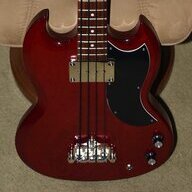
Labella deep talkin steel rounds are available in 44-110 shortscale. I had these on a Gibson SG and they had relatively high tension.
 
"Chromes" and "pressure wounds" aren't a monumental thing. Each is available in a range of gauges and scale lengths.

I don't think you read the question.

3234718 I'll look into those strings. Thanks.

In any event I don't have a lot of experience with round wound strings. So if anyone has experience with tension and short scales I would appreciate hearing from you.
 
I play short scales only and floppy strings have been a problem for me.

ex. chromes are just right and pressure wounds are way too floppy. Precision flats are in between but work.

I'm looking for round wounds now that have the tension of chromes.

Is there a chart I can refer to? Any suggestions will also be helpful.

I know this is a radical suggestion. Have you tried going toInvalid Link Removed? They list the tension for each string in every set and even offer a box to check to compare sets.
 
You may find strings that have the same "tension" but they are not going to have the same "flexibility." You are going to have to find the perfect balance between the flatwound tension and flexibility and round wound tension and flexibility.

But in general, you are going to need heavier gauge rounds to get your short scale to feel more "solid."
 
If you want to do some calculations on string tension, here's the link: https://www.dropbox.com/s/tckc2rjzxs095tx/StringCalculator.exe
StringCalc_zpsda6e0eed.jpg
 
You may find strings that have the same "tension" but they are not going to have the same "flexibility." You are going to have to find the perfect balance between the flatwound tension and flexibility and round wound tension and flexibility.

But in general, you are going to need heavier gauge rounds to get your short scale to feel more "solid."
Thanks

I was just reading another thread about flexibility.

Heavy gauge rounds seem to be the place to start.
whats the link for said thread? I'd like to know the difference myself.
If you want to do some calculations on string tension, here's the link: https://www.dropbox.com/s/tckc2rjzxs095tx/StringCalculator.exe
StringCalc_zpsda6e0eed.jpg
Super cool. Thanks for sharing!
 
whats the link for said thread? I'd like to know the difference myself.

Tension is how many pounds of pull have to be exerted on the string by the tuner to get the string to pitch. Flexibility is how bendy the string is.

Think about holding a .120 low B bass string and a guitar .009 high E string loose out of the package. At 0 lbs tension the .009 will be very flexible, you can wrap it easily around your finger. The .120 is much more stiff. It would not wrap around your finger easily.
 

Latest posts