• TalkBass has been independent since 1998. Add your voice.
    Create a free account to reply to discussions, view embedded media, and browse with fewer display ads.
    Join freeLog in
    Want zero display ads or expanded classifieds tools? Compare plans.

Double Bass Shortening Bridge -- Sanding Down Bridge Feet?

I posted on this site a few months back asking about endpin extensions or extra long rods to be used with my little Engelhardt M3, but I've since given up on that in favor of correcting the bass's godawful string action. If I can't make it taller, I can at least make it playable.

The guy who sold me this bass mentioned that the bridge had been installed hurriedly without being adjusted. So now I find that there's nobody in the immediate area (St. Petersburg, FL) who is able to perform the adjustment, but I figure I can just do it myself. The only problem is that I can't really find instruction online for this kind of operation, and I don't want to just sand the feet down in some ******** way and then realize I have to buy a new bridge.

I've attached a picture of the bridge. The space between the fingerboard and strings at the end of the fingerboard is something like 1.6 cm.
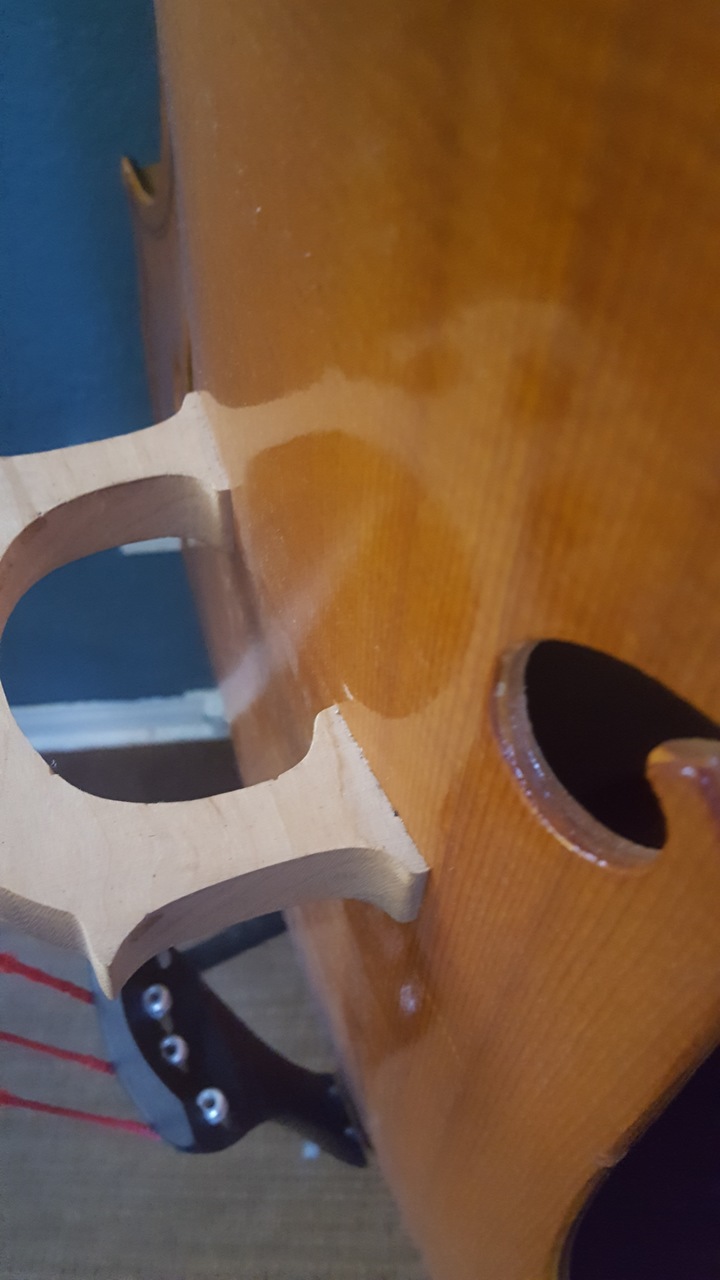
20170117_162308_1.jpg
 
If you are just trying to correct the string height yourself, don't touch the feet. They look OK from here. You will need to file the notches that hold the strings. Be very careful. File them one at a time. If you go too far you can't go back - and then you will HAVE to find a luthier to make another one. Lubricate the string notches with soft pencil lead so that the strings can slide easily in them. Also check the nut slots are low, smooth, nicely curved back and down and lubricated with graphite. Lastly, be aware that the playability of the bass may not simply be a matter of lowering the string heights!
 
If you are just trying to correct the string height yourself, don't touch the feet. They look OK from here. You will need to file the notches that hold the strings. Be very careful. File them one at a time. If you go too far you can't go back - and then you will HAVE to find a luthier to make another one. Lubricate the string notches with soft pencil lead so that the strings can slide easily in them. Also check the nut slots are low, smooth, nicely curved back and down and lubricated with graphite. Lastly, be aware that the playability of the bass may not simply be a matter of lowering the string heights!

Thanks for the advice! About how much would I have to file them? I just recently bought this bass after playing electric for years, so I'm definitely ill-informed, but wouldn't I need to file the notches a considerable amount to affect the string height in any noticeable way?
 
A luthier will normally file down each nut slot - using a correct-sized implement - so that a business card will fit snug under the strings at the nut. The slot should be filed so that it holds the string snug but not tight, and without any sharp bends.

IF the ebony fingerboard is properly shaped, a luthier will normally file down each bridge slot so that the height under the string at the bottom end of the fingerboard is around E-9mm, A-8mm, D-7mm, G-6mm. Depending on the strings and the player preference and the quality of the fingerboard surface you can go lower, but I suggest you start where I mentioned. If you go too low and there are even tiny bumps in the fingerboard, you will definitely hear them.

A luthier will also usually neatly trim off any surplus wood that is not necessary for holding the strings in position.

Good luck. Do the nut first, bridge next, snug not loose or tight, no sharp bends, and lube all the slots.
 
  • Like
Reactions: robobass and Ortsom
A luthier will normally file down each nut slot - using a correct-sized implement - so that a business card will fit snug under the strings at the nut. The slot should be filed so that it holds the string snug but not tight, and without any sharp bends.

IF the ebony fingerboard is properly shaped, a luthier will normally file down each bridge slot so that the height under the string at the bottom end of the fingerboard is around E-9mm, A-8mm, D-7mm, G-6mm. Depending on the strings and the player preference and the quality of the fingerboard surface you can go lower, but I suggest you start where I mentioned. If you go too low and there are even tiny bumps in the fingerboard, you will definitely hear them.

A luthier will also usually neatly trim off any surplus wood that is not necessary for holding the strings in position.

Good luck. Do the nut first, bridge next, snug not loose or tight, no sharp bends, and lube all the slots.

Thanks a ton, dude. I will update with results.
 

Latest posts