It all depends on the specifics.
What year? What specs? Any options on the bass?
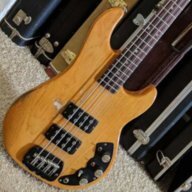
$1,400 would generally be too high for a used L-2K. However, if it has a flamed maple top, a bound body, an ebony fretboard, and so on and so forth, it could be closer to "correct."
Personally, I would not pay $1,400 for an L-2K, unless it was a dead mint pre-1985 model in a really cool color (on the rarer side as far as colors go), in practically mint condition, with original case. 1.4K is pretty much absolute maximum value for any used L-2K, even the most desirable of the pre-BBE models.
For your typical run-of-the-mill L-2K made in the BBE/McLaren era without much special, rare, or particularly desirable about it, I wouldn't go over $1,000 for any reason. That's a maximum for me on typical modern-era G&Ls. They are OK, but there really isn't anything that special about these basses IMO.
For a pre-BBE example in a typical color, I would only go over $1,000 if is was extremely clean and original and/or had something particularly unique/special and desirable about it. Typical value for a pre-BBE L-2K in a common color would be $600 to $1,000, for fair through excellent condition examples. An exotic color might add $100 or $200.
The most I have ever paid for a used G&L is $1,200. It was for a 1983 L-1000, as close to dead mint as one could hope to find, with the original hard case. The condition of the thing is just plain scary clean. Very typical color, though: burst with a maple board. Nothing "special" in the rarity department. Just a clean, clean (and did I mention CLEAN) machine, looking like it was sitting on the showroom floor in 1983. Even then, I hated to pay that much for it...but I paid a little bit more than I thought it was worth, because I couldn't bear to let it get away.
P.S. All of this is assuming OHSC. In all "cases" (hyuk hyuk), subtract $100 to $200 for a missing OHSC. The worse the condition of the bass, and the less original it is anyhow, the less the lack of the OHSC matters. E.g. a poor condition parts bass doesn't get dinged that much for not having the case...but a really clean example does. And I'm not talking some aftermarket Roadrunner crap, or a gig bag. The monetary value in the OHSC is in the O, meaning "original." It's about the value in originality, not simply the value in protecting the instrument.