
Enjoy the benefits of a premium membership!
Upgrade Account
-
TalkBass has been independent since 1998. Add your voice.
Create a free account to reply to discussions, view embedded media, and browse with fewer display ads.
Join free Log in
Want zero display ads or expanded classifieds tools? Compare plans.
You are using an out of date browser. It may not display this or other websites correctly.
You should upgrade or use an alternative browser.
You should upgrade or use an alternative browser.
Should you "try" to stay away from open strings?
- Thread starter streetknight
- Start date
More options
Who Replied?
I use open strings frequently. This is one of those instances where you can say "if it sounds good, it is good" - and open strings often sound good to me.

"if it sounds good, it is good" - and open strings often sound good to me.
This! +1000
when i was using a 5 strang-er i used to always use the 5on b for mylow E. in general it teaches you a bit moreabout scales and helps you understand hte patterns behind scales more. Also, having your finger anf a fret as a nut gives you more tonal versatility easier. try bending an open string up 3 semitones to see what i mean. Nowadays i use whichever one can get the specific emphasis i want more.

I actually like using open strings... but try not to when learning a song. You never know if the key will get changed.
Real example: Learned La Bamba in C. Relied heavily on open strings since it makes the line much much much easier at high tempos. Since I know the singer does the song in C, it was a safe bet. Unfortunately, the guitar player plays it in G. It threw me off to switch from C and open strings to G with no open strings given the tempo of the song.
Real example: Learned La Bamba in C. Relied heavily on open strings since it makes the line much much much easier at high tempos. Since I know the singer does the song in C, it was a safe bet. Unfortunately, the guitar player plays it in G. It threw me off to switch from C and open strings to G with no open strings given the tempo of the song.

I use open strings frequently. This is one of those instances where you can say "if it sounds good, it is good" - and open strings often sound good to me.
Avoiding open strings is pure snobbery. Typical mid-level player attitude who thinks he understood everything about the instrument. The same people tell you you shouldn't downtune.
+1 to both of these.
I have never understood why people are against them and I have yet to hear a solid argument as to why you should avoid them. The tone is different, but to me it's such a minute difference that I doubt any audience member or band member would really even notice it or think it so appalling that I must of done something wrong.
My only guess is that some people have trouble seeing chords and scales in positions that utilize open strings, and thus they avoid them and call them "improper" to make up for their inability to work with them.
Maybe you just don't like your A string?
Its probably his g-string that he just cant get used to
Do you do bar mitzvahs, too?Its probably his g-string that he just cant get used to

They're great for moving up and down the neck...I use them whenever they'll make playing easier (and when their twangier sound doesn't compromise on tone).
Yeah a guy said to me once that open strings are for cheats, but then the guys that write textbooks and make DVD's on playing don't have a problem with them. So let's see: young ego-maniac vs seasoned session player.
Yeah I think I'll go with the session guy
Yeah a guy said to me once that open strings are for cheats, but then the guys that write textbooks and make DVD's on playing don't have a problem with them. So let's see: young ego-maniac vs seasoned session player.
Yeah I think I'll go with the session guy

I used to use open strings frequently and then when I started working under my current instructor he suggested I try using less, and specifically had me NOT use them for a lot of exercises. I thought it was good, it broke me out of the habit of always playing up near the nut and it got me thinking about the entire fretboard rather than using open strings as a kind of crutch. And that was exactly his rationale for getting me to do that, not because he had an "open notes are BAD" philosophy. Now he cares less about it and if I play an exercise one way he'll often have me try it again but playing in a different position with a different fingering.
Example, two lessons ago he had me work on Coltrane's Giant Steps (kind of a challenge for me ). I worked out a fingering that used an open string twice because I couldn't find any other way to play it even close to the speed it was supposed to be played at without doing that. We went over it at last week's lesson, talked about what I did, and he said to try playing it using open strings anywhere I felt like it. I worked out a fingering that made it much easier to play and I was also playing it at a tempo that was even closer to the way it's supposed to be played. That helped reinforce what he's been stressing all along. Learn the fretboard well and you'll be much better able to play anything thrown at you, whether you use open strings or not.
Example, two lessons ago he had me work on Coltrane's Giant Steps (kind of a challenge for me
). I worked out a fingering that used an open string twice because I couldn't find any other way to play it even close to the speed it was supposed to be played at without doing that. We went over it at last week's lesson, talked about what I did, and he said to try playing it using open strings anywhere I felt like it. I worked out a fingering that made it much easier to play and I was also playing it at a tempo that was even closer to the way it's supposed to be played. That helped reinforce what he's been stressing all along. Learn the fretboard well and you'll be much better able to play anything thrown at you, whether you use open strings or not.
I have never understood why people are against them and I have yet to hear a solid argument as to why you should avoid them. The tone is different, but to me it's such a minute difference that I doubt any audience member or band member would really even notice it or think it so appalling that I must of done something wrong.
My only guess is that some people have trouble seeing chords and scales in positions that utilize open strings, and thus they avoid them and call them "improper" to make up for their inability to work with them.
Best reply so far....

There is one of those instances where a dogmatic rule makes no sense. There are certain advantages and disadvantages to using open strings, and making a general rule that one should or should not use open strings is unnecessarily limiting.
Using open strings has certain advantages:
-Open strings can facilitate position shifts.
-Open strings may eliminate unnecessary position shifts, particularly when playing with a Simandl style 124 left-hand.
-If you're reading music, open strings allow you to turn pages with your left hand.
-Open strings are necessary for playing the lowest note in the instrument's range.
-On a fretless or an upright, open strings provide a reference for intonation.
There are also times when there advantages to avoiding open strings:
-It can be more difficult to mute open strings with the left hand, particularly when playing the same note repeatedly.
-Vibrato is not available on open strings.
-Closed positions can facilitate pattern playing, making transposition easier.
As others have mentioned, open strings can sound different (though it is arguable how much of a difference that actually makes in a mix). Whether you prefer that sound or not is inherently subjective.
In short, use whichever approach makes the most sense for a particular situation.
Using open strings has certain advantages:
-Open strings can facilitate position shifts.
-Open strings may eliminate unnecessary position shifts, particularly when playing with a Simandl style 124 left-hand.
-If you're reading music, open strings allow you to turn pages with your left hand.
-Open strings are necessary for playing the lowest note in the instrument's range.
-On a fretless or an upright, open strings provide a reference for intonation.
There are also times when there advantages to avoiding open strings:
-It can be more difficult to mute open strings with the left hand, particularly when playing the same note repeatedly.
-Vibrato is not available on open strings.
-Closed positions can facilitate pattern playing, making transposition easier.
As others have mentioned, open strings can sound different (though it is arguable how much of a difference that actually makes in a mix). Whether you prefer that sound or not is inherently subjective.
In short, use whichever approach makes the most sense for a particular situation.
I think open strings can be a great tool in many situations. I recently recorded a slow country tune with a simple root-5th bassline and I used open strings for most of it. It was in the key of D and the verse just alternated 1 and 4 chords, so I just used open strings over those chords. It just sounded better that way for that particular tune, so that's what I did. Playing open G and D over the 4 chord sounded particlarly good.
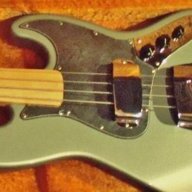
I have never understood why people are against them and I have yet to hear a solid argument as to why you should avoid them.
See posts #8 and #14. If you ever play fretless and develop a consistent vibrato technique, you'll understand. Or maybe I'm just a snobbish mid-level player, I don't know.
See posts #8 and #14. If you ever play fretless and develop a consistent vibrato technique, you'll understand. Or maybe I'm just a snobbish mid-level player, I don't know.
So you apply vibrato on every note?

If open strings are a bad habit, what to say of vibrato on fretless?
Note that on basses with headstocks (most of them do), nothing prevents the use of vibrato on open strings.
Note that on basses with headstocks (most of them do), nothing prevents the use of vibrato on open strings.
So you apply vibrato on every note?
Did you read posts #8 and #14? Your question has already been answered.


