
Wiring, pickups and all? I'd like to see some of those.If done correctly it's an artform. Many people try to copy Michelangelo's work down to the brushstroke. With that same attention to detail, relic refinishers can even make guitar finishes that pass the blacklight test. As long as it's not passed off as the real deal, if someone can build and finish a strat from scratch, take it to Gruhn's and have them appraise it and identify it as a legit all original 56 Fender Stratocaster, that's art as far as I'm concerned.

Enjoy the benefits of a premium membership!
Upgrade Account
-
TalkBass has been independent since 1998. Add your voice.
Create a free account to reply to discussions, view embedded media, and browse with fewer display ads.
Join free Log in
Want zero display ads or expanded classifieds tools? Compare plans.
You are using an out of date browser. It may not display this or other websites correctly.
You should upgrade or use an alternative browser.
You should upgrade or use an alternative browser.
SHOW YOUR DISTRESSED FINISHES!
- Thread starter JIO
- Start date
More options
Who Replied?
I'd like to buy one, honestly sounds like the ultimate reissue for those of us who are obsessed with every detail. I'm trying to find the article I read a while ago about the guy who made a relic refin appear real under blacklight. It's floating around the web somewhere...Wiring, pickups and all? I'd like to see some of those.
Edit: can't find it, if I do, I'll post it to this thread.


- Jun 30, 2010
- 49,611
- 222,111
- Disclosures
- musician/artist/owner - Gildaxe
I'll admit to "preaching to the chore" a bit as I know everyone supporting this ever growing visual reference of distressed basses/guitars here is more or less on the same page as I am - it's a 'distressed instrument safe zone.'  Thanks to all for this as the scenario I described concerning horses pops up constantly on tb in other threads. (especially the Fender RW threads) Personally I do maintain my basses, wiping them down every now and then if needed and I try to not put them in harms way etc, so they stay pretty clean and unscathed. I'm constantly (lightly) banging the hs into a mic or cymbal, but that's about it. I used to fuss more when I had only one bass, and like I said I'm not especially an aggressive player. I do the same with my bike - a clean/lubed bike is a happy bike. And I'm not a road-dog like Mike Watt or Nels Cline who tour constantly and both have very physical playing styles. It will be interesting to see Watts new shiny Reverend in a few years. Nels now has so many guitars that it's unlikely he'll radically distress any of them to the level his black '59 Jazzmaster evolved into. Kinda like Keith Richards - the iconic highly distressed guitars eventually get de-commissioned in favor of well dialed replacements needed to serve their player. So keep um' comin' - we heart distressed basses!
Thanks to all for this as the scenario I described concerning horses pops up constantly on tb in other threads. (especially the Fender RW threads) Personally I do maintain my basses, wiping them down every now and then if needed and I try to not put them in harms way etc, so they stay pretty clean and unscathed. I'm constantly (lightly) banging the hs into a mic or cymbal, but that's about it. I used to fuss more when I had only one bass, and like I said I'm not especially an aggressive player. I do the same with my bike - a clean/lubed bike is a happy bike. And I'm not a road-dog like Mike Watt or Nels Cline who tour constantly and both have very physical playing styles. It will be interesting to see Watts new shiny Reverend in a few years. Nels now has so many guitars that it's unlikely he'll radically distress any of them to the level his black '59 Jazzmaster evolved into. Kinda like Keith Richards - the iconic highly distressed guitars eventually get de-commissioned in favor of well dialed replacements needed to serve their player. So keep um' comin' - we heart distressed basses! 
Lowendtech
Happily trending in my own peculiar direction.
Bravo JIO.Relicing on guitars was (generally) started by the Fender Custom Shop doing a Tele for Keith Richards in the 90's. Imagine Keith playing a shiny new guitar and you get the picture. But distressing as a decorative technique has been used in the furniture world for a long time. It comes under criticism on guitars for a few reasons by players but at the end of the day it's just another finish. The rub comes in because it is what is implied by creating such a finish - that it alludes to a player worn instrument. A chair or table with a distressed finish is not looked at so personally... "why doesn't the owner of that (replica of a rare old chair) just sit in it enough to create real (sitters) wear." (poser!) It's clear how silly this is, and frankly I feel it's silly to level the same argument onto a "relic'd" guitar. As a student of history I appreciate 'real' player wear as it tells a story about the player, like an artifact. As an artist I love how forces both natural (temperature/time) and functional (playing) created a beautiful 'non-perfect' look. As a player, I love the way a well-worn instrument feels/plays and how it sounds. The combination of these things is why I love these 'road-worn' examples, and it's why I eventually acquired my own very player-worn '66 P. Do I feel like a poser because I'm playing a bass worn by someone else? Am I attempting to fool anyone seeing me play it that it was me playing the bass every day and night since 1966 that lead to the way it looks? The short answer to both questions would be no. FTR, Sting didn't own his '56 P since new.
Another factor which I've brought up before is that regardless of how much one plays their bass - not all players will heavily distress their instrument. I certainly don't. My much played basses show very minimal/subtle wear. My '64 T-bird is not checqued and the lacquer finish is still intact. The chrome is tarnished and it has dings, many that have happened since I've owned ('78) and played professionally for years in Chicago blues bars - but I wouldn't consider it distressed. I have basses with satin finishes which get shiny in the places I interface - and I dull the necks on them every once and a while when they get all shiny, with plenty of finish left.
In my opinion, Fender had a right to go the distressed route because their products from the golden age of guitars earned that right. The reason so many Fender guitars and basses are in these pages is 1) they were the most professionally played instruments during those prime decades, and 2) the thin nitro finishes shrink over time making them even thinner. The poly-epoxy finishes of today are incredibly tough. I removed the finish from an '96 MIJ '51 P reissue (the mustard colour) and it was one of the hardest things I've ever done. I finally ended up sending the slab body through a planer to fully remove the tenacious coating from the front and back. If that finish was done instead of nitro in the 40's/50's/60's - there would be very few if any "distressed" Fender instruments.
So in summery, I love these beautiful (real) distressed finishes - and all other 'relic'd' finishes I judge on their artistic merits, as in, if the relicing is done well/is convincing, or not. I never look at a relic'd instrument and see a "fake" - I see a good or poor finish job, and when I see a good job of relic'ing I study it for tips on how it was pulled off. And contrary to popular belief, these finishes are not created by being "dragged behind a truck"- when done well it is actually a sophisticated technique guided by a critical and studied eye. Fenders mass-produced relic finishes on the other hand are born of their companies marketing dept, but they have also innovated production techniques to accomplish that look. After decades of shiny finishes - attempting something different/creative (at least in concept) is welcomed in my book. The 'Flee" J is an extension of that and although I've never had one to study or play, many players love the way they and the Road-Worn series play/sound. In plain fact the RW series is a very popular ($) line for Fender.
Some players like shiny paint finishes, some like glitter finishes, some like 'natural' finishes, and others like a road-worn finish. I'm secure enough with my relationship to playing bass that I just don't take 'finishes' so personally. Funny statement from Mr Gildaxe as I love finishes of all types for many reasons - it's just that I keep hearing this beating-of-a-dead-horse that starts with ..."that's FAKE - just play your bass enough to cause REAL wear." (revisit chair analogy above)


My intent for this thread was to collect a library of characteristic distressed finishes resulting from (mostly professional, but also hard-core non-professionals) players active wear.
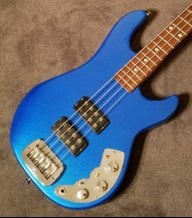
Here you go. About 35 + years of actual wear from being my daily driver. At least until a year ago when I bought a lighter bass do to shoulder problem.

Is that a preCBS stack-knob J?Here you go. About 35 + years of actual wear from being my daily driver. At least until a year ago when I bought a lighter bass do to shoulder problem.
View attachment 1171693

Is that a preCBS stack-knob J?
I wish I could say, "What the heck are ya' doin'??!"
But I'm just an observer.
I like it, it reminds me of a Warwick a little bit.I wish I could say, "Who the shag knows!"
But I'm just an observer.
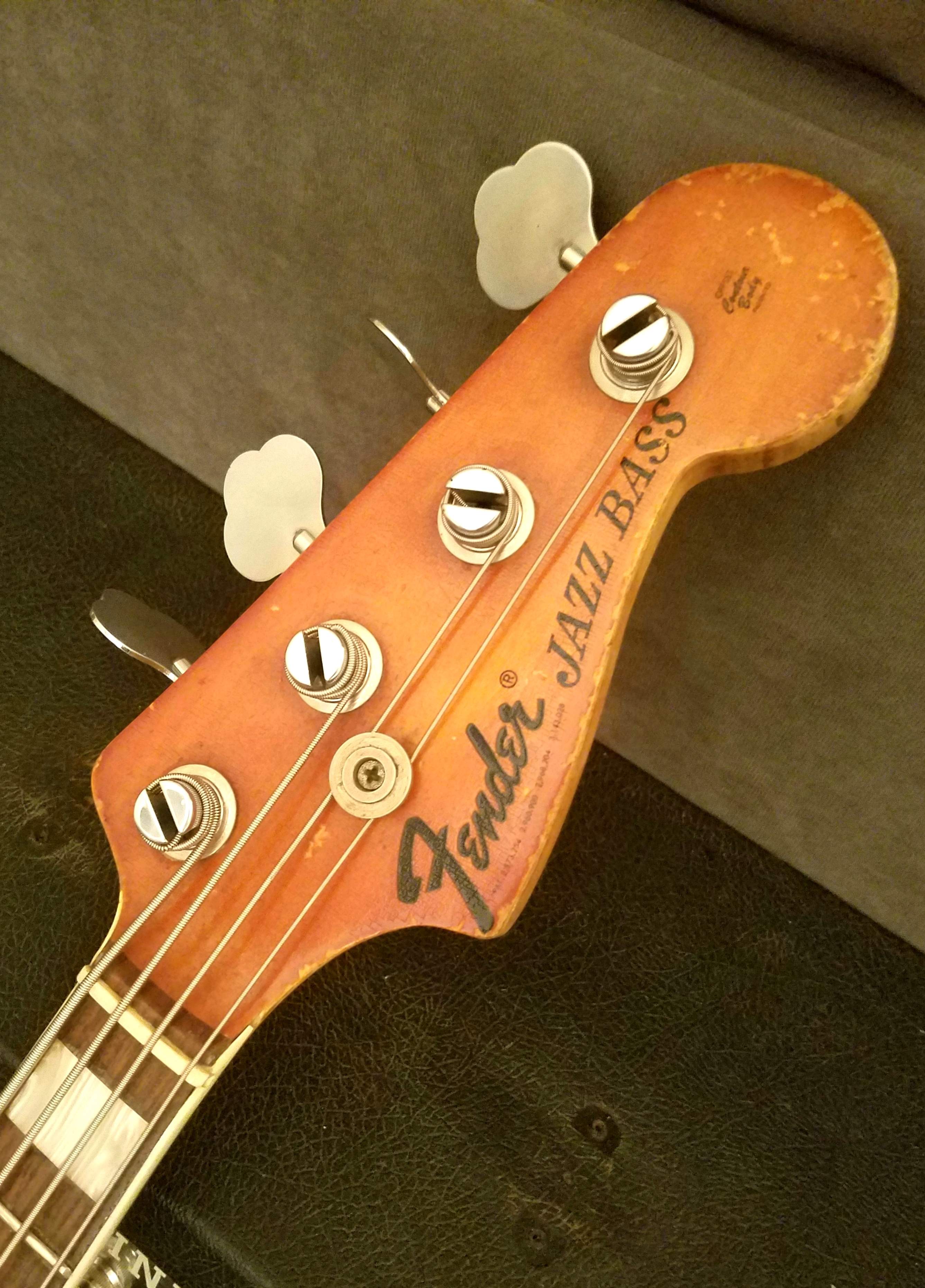
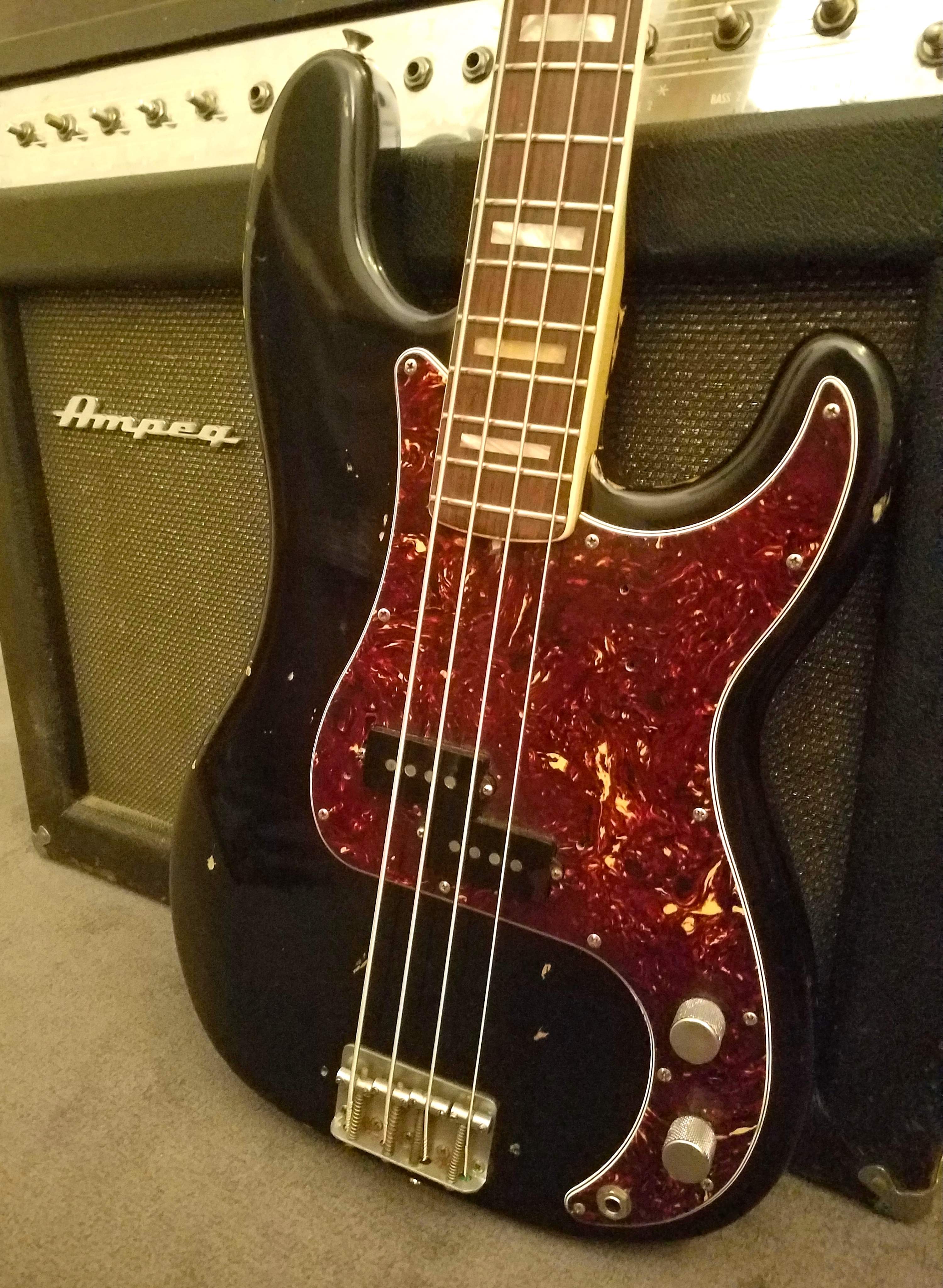
It's on the milder side of distressed, but here's my '71 Precision/'72 Jazz:

- Jun 30, 2010
- 49,611
- 222,111
- Disclosures
- musician/artist/owner - Gildaxe
Here you go. About 35 + years of actual wear from being my daily driver. At least until a year ago when I bought a lighter bass do to shoulder problem.
View attachment 1171693
Is that a preCBS stack-knob J?
...yes, what did it start its life as? We all love a good story and that bass has some!
- Jun 30, 2010
- 49,611
- 222,111
- Disclosures
- musician/artist/owner - Gildaxe
A good example of an aged and varied crackle finish - (no affiliation)
Vintage 1980's Charvel Charvette Bass Guitar Rare Yellow Crackle *Worldwide* | eBay
Vintage 1980's Charvel Charvette Bass Guitar Rare Yellow Crackle *Worldwide* | eBay
As an eBay Associate, TalkBass may earn a commission from qualifying purchases.
That's double the fun! Seems like a good price too.A good example of an aged and varied crackle finish - (no affiliation)
Vintage 1980's Charvel Charvette Bass Guitar Rare Yellow Crackle *Worldwide* | eBay
As an eBay Associate, TalkBass may earn a commission from qualifying purchases.
- Jun 30, 2010
- 49,611
- 222,111
- Disclosures
- musician/artist/owner - Gildaxe
It's on the milder side of distressed, but here's my '71 Precision/'72 Jazz:
View attachment 1171791
So many 70's hs faces look like this - as far as I know it was when they first started coating the face after applying the decal to protect it. Something about the product used lead to amber-ing/darkening over time. Also having them played in smoky bars/clubs - nicotine is pretty effective at effecting whatever it adheres to.
Is that a preCBS stack-knob J?
Yes. It is a 1960 Jazz. I bought it when I was a wee pup in high school. '70 - '71? As you can see, it has been heavily modified. Back in the day it was popular to reshape basses, and always liking Jaguars I kinda when for that shape. Had a humbucker in front for about 8 -9 months but didn't dig that, so had the P installed. Also bad ass bridge and brass nut. All the work was done by Dan Torres in Saratoga, ca. (next to San Jose where I grew up) At the time Dan was THE guy you wanted working on your instruments.
As far as regrets for modifying, killing vintage value? None. Like mentioned above, it was my daily driver until a little over a year ago. I bought a Spector that is a lot lighter, and sounds great, I use for rehearsals and gigs. I still use the '60 for recording as it plays excellent, and sounds phenomenal.
...yes, what did it start its life as? We all love a good story and that bass has some!
See post above.
That's an awesome story. So many hours must have been played on it. Really love that bass and the lack of regrets for modding.Yes. It is a 1960 Jazz. I bought it when I was a wee pup in high school. '70 - '71? As you can see, it has been heavily modified. Back in the day it was popular to reshape basses, and always liking Jaguars I kinda when for that shape. Had a humbucker in front for about 8 -9 months but didn't dig that, so had the P installed. Also bad ass bridge and brass nut. All the work was done by Dan Torres in Saratoga, ca. (next to San Jose where I grew up) At the time Dan was THE guy you wanted working on your instruments.
As far as regrets for modifying, killing vintage value? None. Like mentioned above, it was my daily driver until a little over a year ago. I bought a Spector that is a lot lighter, and sounds great, I use for rehearsals and gigs. I still use the '60 for recording as it plays excellent, and sounds phenomenal.
Thanks. This thing has seen every rehearsal, gig, jam, recording session I've ever played, not to mention the hours of playing/practicing around the house. I've never been concerned about the collector value becauseThat's an awesome story. So many hours must have been played on it. Really love that bass and the lack of regrets for modding.
A: Early on I kinda knew it was with me to the end, and the mods just made it more "me". And over time it has become an old friend. I have never entertained the idea of selling.
B: I've always thought the whole vintage thing is a bit over rated. Don't get wrong, an old instrument is nice, like a good worn in pair of jeans, but new jeans eventually wear in also. That, and I don't really think a Jazz bass, just because it's old, is worth 10 - 20 thousand $$. I guess the price is that high because some one is willing to pay it. Personally I wouldn't.
Isn't it just the nitro?So many 70's hs faces look like this - as far as I know it was when they first started coating the face after applying the decal to protect it. Something about the product used lead to amber-ing/darkening over time. Also having them played in smoky bars/clubs - nicotine is pretty effective at effecting whatever it adheres to.
I heard they were still using nitro on the headstock even when they went to poly for some time.

Isn't it just the nitro?
I heard they were still using nitro on the headstock even when they went to poly for some time.
That's my understanding, that the front of the headstock was sprayed with nitro.
I had a '78 Olympic Precision where the front of the headstock was very dark amber and was flaking off in strips.


