• TalkBass has been independent since 1998. Add your voice.
    Create a free account to reply to discussions, view embedded media, and browse with fewer display ads.
    Join freeLog in
    Want zero display ads or expanded classifieds tools? Compare plans.

Show Your Pandemic Mods

Finally whacked a switchcraft jack with cloth covered wire in the Squier CV 50's SCPB P and replaced the 0.047 cap with a 0.1uf... also some rewire tidying...

IMG_7482.jpg


...and some cloth covered wire in the correct colour for the Vintera P

So pandemic mods for this new bass are pickguard, Curtis Novak pups, shielding, rewire and cap switch.
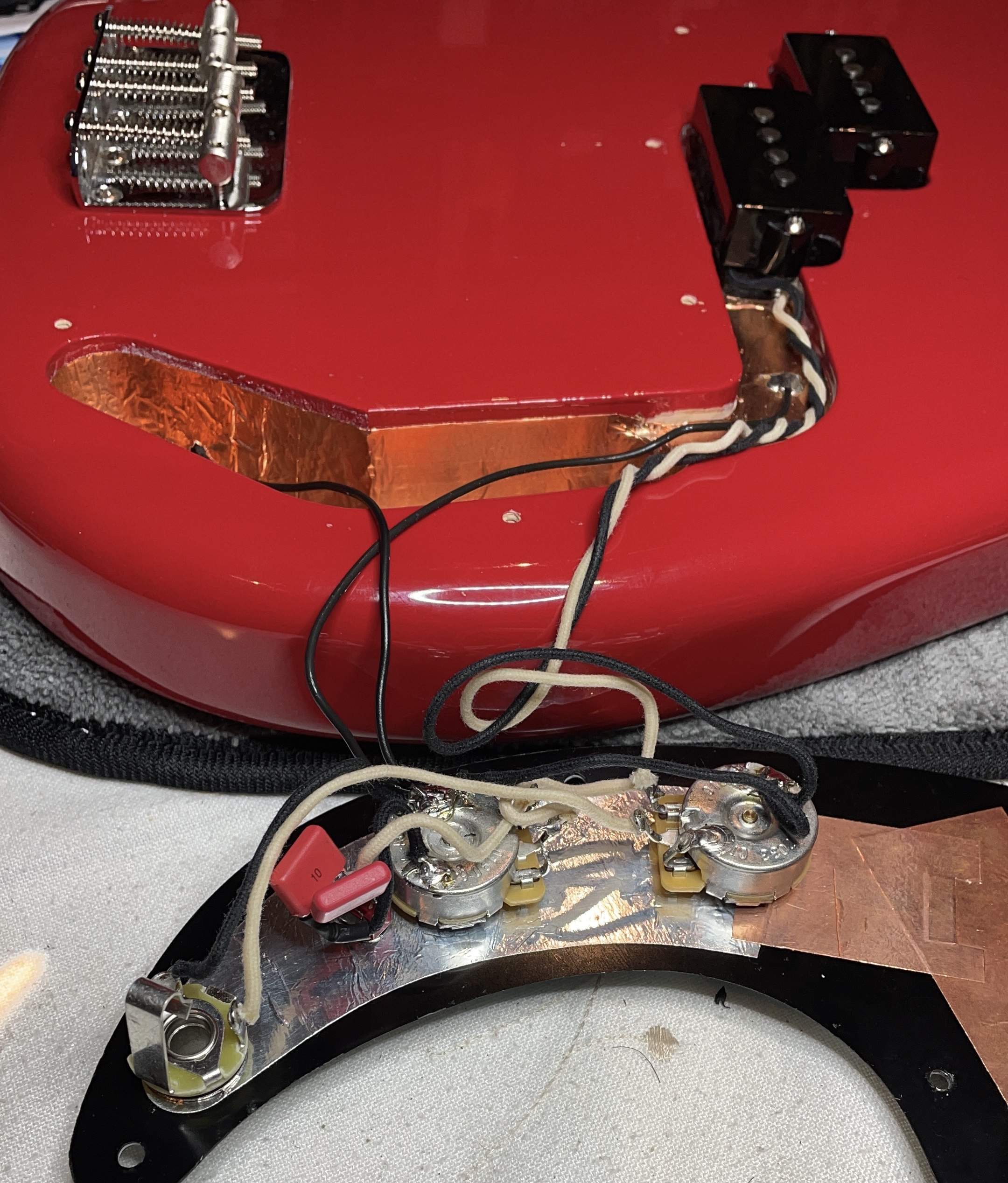
BBEA46CB-5376-4FC3-9AB0-9C75CCC79159.jpg


IMG_7487.jpg

Cheers !
 
My pandemic project resulted in what I call my "Lockdown Bass." It came about early in the summer of 2020. It started out with an MJT body on ebay that I couldn't pass up: A very lightweight swamp ash slab finished in Candy Apple Red. The neck was a brand-new Fender reissue '51 style neck made in Mexico. It is a baseball bat and feels like the real deal. Being shiny, bright, and brand-new, it looked wrong with the vintagy looking body and required a good deal of aging. Tinted lacquer took care of that. Old-school styled Res-O-Light tuners helped keep the weight down and maintained good balance as well as looking like they belong. The pickup is an SD Antiquities II which apparently is modeled on a late '60's Tele pickup. It all came together amazingly well. Folks often seem to think it's the real deal dating back to the early '50's.

1_0.JPEG
2_0.JPEG
5_0.JPEG
8_0.JPEG
2_0.JPEG


The last picture is the configuration that I actual use to play it. No pickup cover.
 
My pandemic project resulted in what I call my "Lockdown Bass." It came about early in the summer of 2020. It started out with an MJT body on ebay that I couldn't pass up: A very lightweight swamp ash slab finished in Candy Apple Red. The neck was a brand-new Fender reissue '51 style neck made in Mexico. It is a baseball bat and feels like the real deal. Being shiny, bright, and brand-new, it looked wrong with the vintagy looking body and required a good deal of aging. Tinted lacquer took care of that. Old-school styled Res-O-Light tuners helped keep the weight down and maintained good balance as well as looking like they belong. The pickup is an SD Antiquities II which apparently is modeled on a late '60's Tele pickup. It all came together amazingly well. Folks often seem to think it's the real deal dating back to the early '50's.

View attachment 4288599 View attachment 4288602 View attachment 4288607 View attachment 4288608 View attachment 4288609


The last picture is the configuration that I actual use to play it. No pickup cover.
Guess it's not breaking news......love everything about that beauty!:thumbsup:
 
Bass is back! Pictures to prove it happened.

Forgot to mention that I really like the Birchwood Casey Gun Stock Oil - allows a lot of flexibility in the finish based on number of coats. A thin coat for people that like a raw neck feel or multiple coats for more of a gloss finish (what I did). Just need to apply in thin coats and properly sand in between. This is also the stock finish for EBMM instruments.
 
  • Like
Reactions: 59jazz and JimmyM
My pandemic project resulted in what I call my "Lockdown Bass." It came about early in the summer of 2020. It started out with an MJT body on ebay that I couldn't pass up: A very lightweight swamp ash slab finished in Candy Apple Red. The neck was a brand-new Fender reissue '51 style neck made in Mexico. It is a baseball bat and feels like the real deal. Being shiny, bright, and brand-new, it looked wrong with the vintagy looking body and required a good deal of aging. Tinted lacquer took care of that. Old-school styled Res-O-Light tuners helped keep the weight down and maintained good balance as well as looking like they belong. The pickup is an SD Antiquities II which apparently is modeled on a late '60's Tele pickup. It all came together amazingly well. Folks often seem to think it's the real deal dating back to the early '50's.

View attachment 4288599 View attachment 4288602 View attachment 4288607 View attachment 4288608 View attachment 4288609


The last picture is the configuration that I actual use to play it. No pickup cover.
Amazing stuff ! Well done :)
 
I've been busy... =)

Schecter Stiletto Stealth Bass

* Replaced the stock P-bass pickup with a DiMarzio Relentless Middle (SKU: DP296GB)

Ibanez Mezzo SRMD200 Medium Scale Bass
* Replaced the stock bridge with an Ibanez B100 Bass Bridge
* Replaced the stock electronics with an EMG BTS System
* Replaced the stock pickups with an EMG PJ Set
* Added copper foil to the control cavity and behind the pickguard

SX URSA 2 LT MN Medium Scale Bass
* Replaced the stock bridge with a Fender High Mass Bridge
* Replaced the stock electronics with an EMG J Wiring Kit
* Replaced the stock pickups with an EMG JVX Set
* Added copper foil to the control cavity and behind the pickguard

Schecter PT Standard Guitar
* Replaced the stock tuners with Gotoh locking tuners
* Replaced the stock pickups with DiMarzio Twang King
* Added copper foil to the control cavity and behind the pickguard

Schecter C-1 Platinum Guitar
* Replaced the stock EMG pickups with EMG 57TW/66TW Humbucker Set
* Replaced stock electronics with EMG Push/Pull Wiring Kit
* Replaced switch and output jack with Switchcraft 3-way toggle and output jack
* Replaced stock tuners with Gotoh locking tuners

Schecter C-1 Platinum Guitar
* Replaced the stock EMG pickups with EMG H4/H4A Passive Humbucker Set [Meh]
* Replaced stock electronics with Bourns pots and Switchcraft 3-way toggle and output jack
* Replaced stock tuners with Gotoh locking tuners

Schecter C-1 Platinum Guitar
* Replaced the stock EMG pickups with DiMarzio Super Distortion & Super 2 [LOVE THESE]
* Replaced stock electronics with Bourns pots, Switchcraft 3-way toggle and output jack
* Replaced stock tuners with Gotoh locking tuners

Epiphone Les Paul Modern Guitar
* Replaced the broken 3-way toggle switch with a Switchcraft 3-way toggle switch

Schecter Corsair Semi-Hollow (in progress)
* Replacing the stock 3-way toggle switch and output jack with Switchcraft parts

Yes, I own three Schecter C-1 Platinum Guitars. I think that are the best value for the money.
 
The neck was a brand-new Fender reissue '51 style neck made in Mexico. It is a baseball bat and feels like the real deal. Being shiny, bright, and brand-new, it looked wrong with the vintagy looking body and required a good deal of aging. Tinted lacquer took care of that.

The last picture is the configuration that I actual use to play it. No pickup cover.

What was the process you had to go through to apply that laquer? I love the feel and the play of my Bronco neck that I swapped onto my Musicmaster but it's very pale maple. I already painted the headstock but if I thought I could do this laquer that would be cool too. Thanks!
 
  • Like
Reactions: JimmyM
What was the process you had to go through to apply that laquer? I love the feel and the play of my Bronco neck that I swapped onto my Musicmaster but it's very pale maple. I already painted the headstock but if I thought I could do this laquer that would be cool too. Thanks!
This neck was factory finished in poly. I lightly sanded all of it before applying any lacquer, but I didn't actually remove all that much of the poly. To get the neck as dark as I did especially on the headstock, I used two things. On the headstock, I first used Guitar Reranch Neck Amber Dye. That's pretty dark stuff, but it's just a dye and it requires clear lacquer over it. On top of that and on the rest of the neck, I used ColorTone Aged Clear Guitar Lacquer which has a nice vintage-looking color to it. You need to apply multiple thin coats of the lacquer so that when it's done, it's thick enough to allow for wet sanding without going through it. You can't rush it. You've got to allow a few days to lay down the coats and then allow it cure before sanding. By the way, you can paint right over the frets and then scrape the paint off the frets later. Not hard to do. The most important thing is to keep those coats thin and try to avoid runs. Runs will set you back because then you have to wait for curing, wet sand, and then lay down more layers. That can be frustrating.
 
This neck was factory finished in poly. I lightly sanded all of it before applying any lacquer, but I didn't actually remove all that much of the poly. To get the neck as dark as I did especially on the headstock, I used two things. On the headstock, I first used Guitar Reranch Neck Amber Dye. That's pretty dark stuff, but it's just a dye and it requires clear lacquer over it. On top of that and on the rest of the neck, I used ColorTone Aged Clear Guitar Lacquer which has a nice vintage-looking color to it. You need to apply multiple thin coats of the lacquer so that when it's done, it's thick enough to allow for wet sanding without going through it. You can't rush it. You've got to allow a few days to lay down the coats and then allow it cure before sanding. By the way, you can paint right over the frets and then scrape the paint off the frets later. Not hard to do. The most important thing is to keep those coats thin and try to avoid runs. Runs will set you back because then you have to wait for curing, wet sand, and then lay down more layers. That can be frustrating.


Thanks, sounds like another project outside my wheelhouse but so was swapping the neck and pickup when I did that.
 
  • Like
Reactions: JimmyM