

Enjoy the benefits of a premium membership!
Upgrade Account
-
TalkBass has been independent since 1998. Add your voice.
Create a free account to reply to discussions, view embedded media, and browse with fewer display ads.
Join free Log in
Want zero display ads or expanded classifieds tools? Compare plans.
You are using an out of date browser. It may not display this or other websites correctly.
You should upgrade or use an alternative browser.
You should upgrade or use an alternative browser.
Show your tidy pedalboard!
- Thread starter JakobT
- Start date
More options
Who Replied?

I use the OC2 for the synth tone and not of my dry signal while the OC5 is for the octave; i.e. a mix of the dry and the octave down. As you likely know, the OC2 has a unique synth sound on its own. I have heard the OC5 can replicate it, so I could go with just the OC5, but I don't like to turn knobs. I want to set it and forget it.Hi, I would like to ask You the way You're using both of Boss OC's. I am huge fan of Boss and I own OC-5+OC-3.
Why You keep OC-2 on Your pedalboard?
How do You like OC-5?
What is the secret of using them?
Cheers ;-)

Sascha Erni
Making things go whoomp, whoomp since 1994
Ah, you use the Super Two Hundred in a dual-channel setup? So I guess the DG adds the high-gain distortion? How do you like that combination?
I'm asking as just yesterday, I took my Super Two Hundred for a real-life live spin for the first time – and noticed I didn't need the low-gain overdrive pedal I have on my board, anymore, like, at all. I used to have a crunchy preamp as my main tone, and the classic low-gain > high-gain combo of two pedals. But the Super Two Hundred was more than enough, reacting nicely to variations of attack, so I stopped using the low-gain three songs in. I'm now considering dropping it from the board, but as other Super Two Hundred users are hard to come by, I felt like quoting you here directly to ask about your setup and your experiences.

Yes I run the super 200 very clean and the Darkglass is dirty. Both are mixed at the FOH in separate channels. Love the Super 200.Ah, you use the Super Two Hundred in a dual-channel setup? So I guess the DG adds the high-gain distortion? How do you like that combination?
I'm asking as just yesterday, I took my Super Two Hundred for a real-life live spin for the first time – and noticed I didn't need the low-gain overdrive pedal I have on my board, anymore, like, at all. I used to have a crunchy preamp as my main tone, and the classic low-gain > high-gain combo of two pedals. But the Super Two Hundred was more than enough, reacting nicely to variations of attack, so I stopped using the low-gain three songs in. I'm now considering dropping it from the board, but as other Super Two Hundred users are hard to come by, I felt like quoting you here directly to ask about your setup and your experiences.

It’s the perfect unit for my needs, for sure. Almost all of my work now is musical theatre, where I’m using two inputs (usually electric and upright). The Canvas lets me run separate XLR outs to the house (either LI or DI) and let’s me sum the 1/4” outs to send both signals to one amp, if we have stage volume.How do you like canvas? I use a JDI so I was curious what the Canvas offers, besides taking up a little less room on the board.

My first attempt and doing the under board zip-tie thing. Not nearly as tidy as some others....but it's definitely the most tidy my board has ever been.
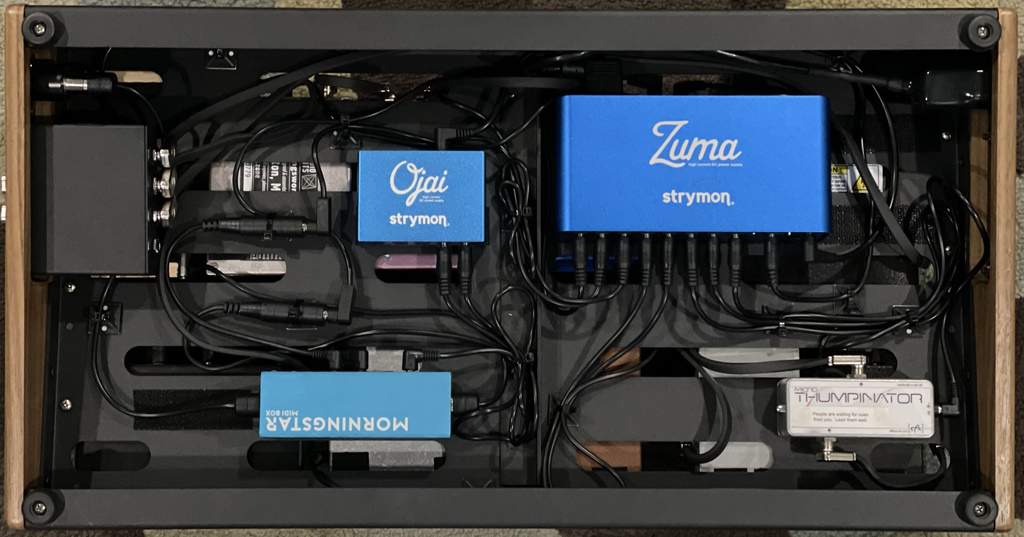
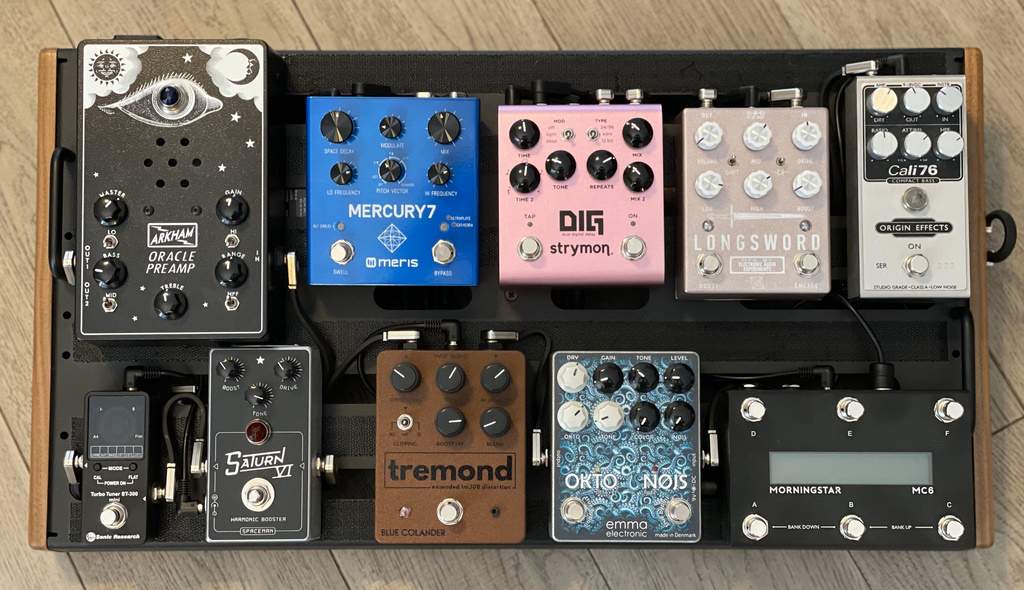
Wow! Esthetically pleasing! How do you like Tremond?My first attempt and doing the under board zip-tie thing. Not nearly as tidy as some others....but it's definitely the most tidy my board has ever been.
View attachment 5041230
View attachment 5041231
My first attempt and doing the under board zip-tie thing. Not nearly as tidy as some others....but it's definitely the most tidy my board has ever been.
View attachment 5041230
View attachment 5041231
Really interesting board. I like the wood on the sides.
The morningstar is for making presets i see, cool..
Agree on the tidy part, you could add zip-ties after every 1" of cable, but the only way to get it super-tidy is to get rid of the excessive wire length; cutting everything to length + soldering new plugs, which takes a lot of time and is not a job for everybody + it will make your pedalboard-layout and wiring a solid-design, you won't be able to re-order / add things.
That said, i think, for a non-custom wire length pedalboard, it's really tidy.
I'm currently in the thinking-process of making a new pedalboard myself,
and i have some questions:
- Did you buy the pedalboard-base or self-made?
- What do number 1, 2, 3 exactly do ?
Last edited:
Thanks!Wow! Esthetically pleasing! How do you like Tremond?
So....I'm not really sure what I think of the Tremond. Just got it in a few days ago - haven't had a chance to play it with a band, but I may not get that far. I like a lot of things about it - the way the blend is implemented, the distortion doesn't hugely affect the volume, so it's easy to dial in more/less without having to make other huge adjustments, and it has a really nice unique sound after octave when you can blend and boost the low end.
What surprised me is that it doesn't do low gain very well at all. With a blend control like that, you'd think it would be perfect for dialing in a little dirt and keeping most of your clean intact....but the clean is too dark (even with the internal "brittle" switch on), and it the dirt is either on or off - not very touch sensitive at all (so you can set it be be clean-ish, but as you dig in, it goes to full dirt....not gradually dirtier). As just a nice mid gain drive, it does have some merit, but dialing in similar sounds with my Longsword and a/b-ing them - I always preferred the Longsword. It really does have its own baked in sound and the pedal itself is really well built and easy to dial in - I think I just don't care for its flavor (this is my first rat based pedal - I probably just don't like rats). I can absolutely see and understand someone loving it, though.
When all is said and done, I think I'll probably get rid of it. Pretty sure I can't send it back to Poland, so it'll probably hit the classifieds here soon (thanks for letting me think out loud about it and come to this conclusion).
Really interesting board. I like the wood on the sides.
The morningstar is for making presets i see, cool..
Agree on the tidy part, you could add zip-ties after every 1" of cable, but the only way to get it super-tidy is to get rid of the excessive wire length; cutting everything to length + soldering new plugs, which takes a lot of time and is not a job for everybody + it will make your pedalboard-layout and wiring a solid-design, you won't be able to re-order / add things.
That said, i think, for a non-custom wire length pedalboard, it's really tidy.
I'm currently in the thinking-process of making a new pedalboard myself,
and i have some questions:
- Did you buy the pedalboard-base or self-made?
- What do number 1, 2, 3 exactly do ?
View attachment 5042146
Yeah, I don't think I'll probably get to the point where I'm cutting my power cables to length....but who knows - baby steps

The pedalboard is by Creation Music Company. I really love it. Feels nice and has swappable modules on the sides, etc. (power with a switch being my favorite):
1 is a patch bay module (and right above it is MIDI out...which is actually a Temple board module). I use it basically as an effects loop in the middle of my board. So after the Oracle, it goes out and in there before going back to the Longsword, DIG, and Mercury7, then going back out the top jack. So if I'm not running anything else, it just patches through and I use that top jack as my board out, but I primarily have it for my Moog Minitaur. I can run my signal out through it and back in (and also run MIDI to it for presets, parameter controls, etc.). This lets me put dirt, delay, and reverb on my bass synth and still let me use them on my dry bass. Also, since my dry signal goes through the Moog, I can use the filter in it on my dry signal (and foot control it with expression pedal into the Morningstar).
That brings up #2. Since the MC6 only has 2 TRS outs, that would work fine for the DIG and Mercury7, then the standard MIDI out for the Moog......but then I wouldn't be able to use one of the TRS jacks for expression. So standard MIDI goes out from the MC6 to the MIDI Box (which splits off 8 MIDI TRS ports) and then through to the patch bay (to the Moog).... all basically just to free up a jack for my expression pedal into the MC6 (which besides using it for the Moog filter, can be used for any CC value on any of the 3 MIDI controlled devices - for instance, I can turn off wet volume of the DIG, use the expression pedal to control dry volume and use it as a volume swell into the Mercury7).
3 is a "bandwidth optimizer".....which is really just a glorified HPF. It does do something more to my tone than other HPFs I've had, though. It's very, very steep (36 dB/octave) and very low (@25hz)...but I think it has a bit of resonance in the low audible range above that cutoff that makes the low fundamentals tight, punchy, and more present. I've tried taking it off my board before.....and I always have to put it back on - everything just sounds better. I may need to buy another one just as a backup.
Yeah, I don't think I'll probably get to the point where I'm cutting my power cables to length....but who knows - baby steps
The pedalboard is by Creation Music Company. I really love it. Feels nice and has swappable modules on the sides, etc. (power with a switch being my favorite):
View attachment 5042201
1 is a patch bay module (and right above it is MIDI out...which is actually a Temple board module). I use it basically as an effects loop in the middle of my board. So after the Oracle, it goes out and in there before going back to the Longsword, DIG, and Mercury7, then going back out the top jack. So if I'm not running anything else, it just patches through and I use that top jack as my board out, but I primarily have it for my Moog Minitaur. I can run my signal out through it and back in (and also run MIDI to it for presets, parameter controls, etc.). This lets me put dirt, delay, and reverb on my bass synth and still let me use them on my dry bass. Also, since my dry signal goes through the Moog, I can use the filter in it on my dry signal (and foot control it with expression pedal into the Morningstar).
View attachment 5042194
That brings up #2. Since the MC6 only has 2 TRS outs, that would work fine for the DIG and Mercury7, then the standard MIDI out for the Moog......but then I wouldn't be able to use one of the TRS jacks for expression. So standard MIDI goes out from the MC6 to the MIDI Box (which splits off 8 MIDI TRS ports) and then through to the patch bay (to the Moog).... all basically just to free up a jack for my expression pedal into the MC6 (which besides using it for the Moog filter, can be used for any CC value on any of the 3 MIDI controlled devices - for instance, I can turn off wet volume of the DIG, use the expression pedal to control dry volume and use it as a volume swell into the Mercury7).
3 is a "bandwidth optimizer".....which is really just a glorified HPF. It does do something more to my tone than other HPFs I've had, though. It's very, very steep (36 dB/octave) and very low (@25hz)...but I think it has a bit of resonance in the low audible range above that cutoff that makes the low fundamentals tight, punchy, and more present. I've tried taking it off my board before.....and I always have to put it back on - everything just sounds better. I may need to buy another one just as a backup.
Nice. Thanks for explaining, inspiring to see this pedalboard and to read about it.
Interesting to see the Oracle preamp after your first signal-chain section, to equalize the first gain/synth/octave effects and the Moog trough the same signal-chain, cool. Do you ever use both in the same set? Does your bass signal pass through the Moog when it's off or is it a switchable loop?
I've read the HPF switch of the oracle cuts everything below 100hz -6db, the bandwidth optimizer cuts at 25hz -36db. In theory, it seems you don't need the 25hz cut because the Oracle cuts that too. I guess there is more then just 6db under your 100hz frequency range, resulting it to have something left after cutting everything by 6db under 100hz.
Is the 25hz cut is a wide cut, not a narrow cut, and also affecting the 0-150 hz frequency range for example? It might result in cutting everything under 100hz leaving nothing left under 100hz maybe.. that would explain the added tight feeling. Do you notice a difference with and without the Oracle HPF Switch engaged ?
Anyway, smart to cut below 100hz, this makes the kick-drum/bass sound work easily together. (pro-sound engineers also cut a few frequencies of the bass in that frequency region, a narrow cut of the somewhere between 80 - 100 hz where the low-punch of the kickdrum is , makes everything punchy..)
Just curious, have you ever used the TC Electronic Polytune 3 ? What's the advantage of using the Sonic Research Turbo Tuner ST-300 Mini over the Polytune 3? To me it seems they have the same specs, besides the switchable buffer and the red vs green/red leds in the Polytune 3.
Last edited:
Interesting to see the Oracle preamp after your first signal-chain section, to equalize the first gain/synth/octave effects and the Moog trough the same signal-chain, cool. Do you ever use both in the same set? Does your bass signal pass through the Moog when it's off or is it a switchable loop?
To be honest, I haven't had the chance to use both yet in the same set yet...but largely because I'm still waiting on the Second Sound UniSyn that I ordered. It will track and send CV pitch to the Moog Minitaur so that I can play it with my bass - that's the endgame. Currently I'm just using a MIDI keyboard - which I haven't felt like bringing to a live set.
I have a preset on the Moog that I can send with the Morningstar MC6 that has the oscillators all the way off, dry volume to 100%, resonance off, filter fully open....and after calling that preset the MC6 sends a note on command. Without the note on, the gate on the Moog stays closed and no sound passes through....but with the oscillators all the way off, you don't hear the MIDI note. Once I get the UniSyn, I can have it control the gate via CV so that I don't have to have a MIDI note always on.
I've read the HPF switch of the oracle cuts everything below 100hz -6db, the bandwidth optimizer cuts at 25hz -36db. In theory, it seems you don't need the 25hz cut because the Oracle cuts that too. I guess there is more then just 6db under your 100hz frequency range, resulting it to have something left after cutting everything by 6db under 100hz.
I don't actually ever use the HPF on the Oracle (I notice it's on in the picture, probably from having my board upside down while wiring). Some people like it on and then boosting the bass to compensate (since 100hz is kinda high for an HPF), but I don't prefer it that way - so it stays off.
Is the 25hz cut is a wide cut, not a narrow cut, and also affecting the 0-150 hz frequency range for example? It might result in cutting everything under 100hz leaving nothing left under 100hz maybe.. that would explain the added tight feeling. Do you notice a difference with and without the Oracle HPF Switch engaged ?
Anyway, smart to cut below 100hz, this makes the kick-drum/bass sound work easily together. (pro-sound engineers also cut a few frequencies of the bass in that frequency region, a narrow cut of the somewhere between 80 - 100 hz where the low-punch of the kickdrum is , makes everything punchy..)
HPFs don't really have a Q - they just have a slope which continues forever below a certain point. It's cut is just defined by how steep it's slope is past that frequency. Their website has a graph of what it's doing here (4th image on the top): [sfx] sfx sound: micro-Thumpinator v2. You can see that there's a slight boost above the cutoff (the orange above the green) in the low register...particularly between 25-100hz. That's where I'm guessing I'm feeling the difference (besides what it tightens up by removing inaudible stuff that your amp doesn't have to process - watch the video).
Just curious, have you ever used the TC Electronic Polytune 3 ? What's the advantage of using the Sonic Research Turbo Tuner ST-300 Mini over the Polytune 3? To me it seems they have the same specs, besides the switchable buffer and the red vs green/red leds in the Polytune 3.
I have a Polytune Mini (don't believe it's the Mini 3) that I used to use. The turbo tuner is just a lot faster - particularly with lower strings. It's basically instant, and I really like using the strobe. It drove me nuts at first because it's very, very sensitive (hard to get it to completely stop moving)....but that really just means it's more accurate. I tried it at the same time as a Polytune and realized that when it's moving slowly, that's actually what the Polytune shows as being perfectly in tune....so you don't have to make it completely be stopped....as long as you get it to a slow crawl, you're more accurately in tune than with most other tuners.
HPFs don't really have a Q - they just have a slope which continues forever below a certain point. It's cut is just defined by how steep it's slope is past that frequency. Their website has a graph of what it's doing here (4th image on the top): [sfx] sfx sound: micro-Thumpinator v2. You can see that there's a slight boost above the cutoff (the orange above the green) in the low register...particularly between 25-100hz. That's where I'm guessing I'm feeling the difference (besides what it tightens up by removing inaudible stuff that your amp doesn't have to process - watch the video).
Yes, boost between 25 - 100 hz and gradual cut below 25 Hz.
The difference is clearly visible in the video yes, but it confused me when i looked at the specs of the used bass-amp/cab:
- A Glockenklang poweramp (Heart-Rock Poweramp 1000 watts i assume?) looked up the manual: the specified frequency range it puts out is 25 Hz - 20 kHz.
- The cab looks like a Glockenklang Quattro 4x10" cab, technical data says: frequency range: 36 Hz - 18 kHz.
( The cab you are using; the Aguilar SL 112 cab: 37 Hz – 16 kHz )
Does the specified frequency range mean it's not putting out anything below/above the lowest/highest specified Hz points OR that most of it's frequencies are between the specified range and actually also putting lower volumes of the frequencies outside the specified frequency range?
If the power-amp + cab is not putting out anything outside the specified frequency range, then the "SFX micro-Thumpinator v2" is actually "only" providing/acting like a boost/frequency improvement, between 25 - 100 Hz, when using it in that setup?

If it's not putting out anything outside the freqency range, then why is the speaker moving less when using the Thumpinator that is actually boosting?
I hope I'm not annoying you guys because this really off-topic, just trying to understand and learn.

I have a Polytune Mini (don't believe it's the Mini 3) that I used to use. The turbo tuner is just a lot faster - particularly with lower strings. It's basically instant, and I really like using the strobe. It drove me nuts at first because it's very, very sensitive (hard to get it to completely stop moving)....but that really just means it's more accurate. I tried it at the same time as a Polytune and realized that when it's moving slowly, that's actually what the Polytune shows as being perfectly in tune....so you don't have to make it completely be stopped....as long as you get it to a slow crawl, you're more accurately in tune than with most other tuners.
Nice, i had the same experience when moving from Korg Pitchblack to the Polytune 3.. Much faster response.. So i guess you are tuning at lightning speed and accuracy now..
 probably too fast for my eyes to track haha.
Last edited:
View attachment 5042728
Yes, boost between 25 - 100 hz and gradual cut below 25 Hz.
The difference is clearly visible in the video yes, but it confused me when i looked at the specs of the used bass-amp/cab:
- A Glockenklang poweramp (Heart-Rock Poweramp 1000 watts i assume?) looked up the manual: the specified frequency range it puts out is 25 Hz - 20 kHz.
- The cab looks like a Glockenklang Quattro 4x10" cab, technical data says: frequency range: 36 Hz - 18 kHz.
( The cab you are using; the Aguilar SL 112 cab: 37 Hz – 16 kHz )
Does the specified frequency range mean it's not putting out anything below/above the lowest/highest specified Hz points OR that most of it's frequencies are between the specified range and actually also putting lower volumes of the frequencies outside the specified frequency range?
If the power-amp + cab is not putting out anything outside the specified frequency range, then the "SFX micro-Thumpinator v2" is actually "only" providing/acting like a boost/frequency improvement, between 25 - 100 Hz, when using it in that setup?
If it's not putting out anything outside the freqency range, then why is the speaker moving less when using the Thumpinator that is actually boosting?
I hope I'm not annoying you guys because this really off-topic, just trying to understand and learn.
Ok, guys and girls, i've done some thinking. These questions are a rabbit-hole and will result in a lot of off-topic comments in this topic. I will make a separate topic for these questions. So we can keep this topic clean and on topic about showing and viewing the pedalboards and get inspired by it.
Feel free to join:
What is frequency response? Bass amps, speakers, cabs.
Yup! All custom, just lots of measuring to get the holes all lined up
Basically, gave myself a footprint that would fit into the Pelican knockoff I use and went from there.
View attachment 5025011
What kind of material is that? How is the weight? I'm inspired by your DIY pedalboard, would like design it myself using AutoCAD and finding a company that can cut / bent the metal bits for me to design my own pedalboard.. I'm undecided about what material to use, steel, stainless steel, aluminum.. etc. I would love it too be lightweight, but i have no idea if the weight-difference between for example 400 mm x 700 mm x 5 mm steel and aluminum is.. Steel is probably cheaper, but weight is important too!
Last edited:

Ok, guys and girls, i've done some thinking. These questions are a rabbit-hole and will result in a lot of off-topic comments in this topic. I will make a separate topic for these questions. So we can keep this topic clean and on topic about showing and viewing the pedalboards and get inspired by it.
Feel free to join:
What is frequency response? Bass amps, speakers, cabs.
What kind of material is that? How is the weight? I'm inspired by your DIY pedalboard, would like design it myself using AutoCAD and finding a company that can cut / bent the metal bits for me to design my own pedalboard.. I'm undecided about what material to use, steel, stainless steel, aluminum.. etc. I would love it too be lightweight, but i have no idea if the weight-difference between for example 400 mm x 700 mm x 5 mm steel and aluminum is.. Steel is probably cheaper, but weight is important too!
Some steel bends better than aluminum, but a lot depends on what kind (if something is harder, it is usually more brittle) Overall, steel will probably be 3 to 4 times heavier than aluminum. Depending on the manufacturing process, aluminum will probably be easier to work with, lighter, and cheaper. Most boards seem to be aluminum or wood.

If you are going to bend aluminum, be careful of the type. 6061 is strong, but brittle, so it doesn't bend well. 5052 is better for bending, but not as strong.
If you are going to bend aluminum, be careful of the type. 6061 is strong, but brittle, so it doesn't bend well. 5052 is better for bending, but not as strong.
Good advice here.

I envy all of you. I don't think I'll ever be a typo achieve this level of cleanliness.
How do you do it? Pull all pedals on the board, then flip it upside on a bed or blanket so you can work on cables?
How do you do it? Pull all pedals on the board, then flip it upside on a bed or blanket so you can work on cables?

I envy all of you. I don't think I'll ever be a typo achieve this level of cleanliness.
How do you do it? Pull all pedals on the board, then flip it upside on a bed or blanket so you can work on cables?
Everyone has their own method. But I'd say that doing a "dry run" where you don't have any velcro/adhesive to lock the pedals down is a good start; then you can organize/layout everything, and really finesse it without ruining the velcro. At that point you can start running cables. I tend not to worry about the underside at this point; just get the right cable lengths, or as close as you can get. I don't cut/make my own cables, so I work with the ones I can grab already made. Once you've got the "dry run" done, then I'd grab the velcro and start laying everything down.
Honestly, as far as the underside goes, I don't stress getting that "perfect" look, since that often involves custom cable lengths, and tying everything down pretty tight; at that point you are pretty much locked in to your choices... what if you decide you want to make a change? It involves a crazy amount of destruction of all your hard work. My underside isn't chaos, but nor is it supremely tidy. Hanging/long are loosely zip-tied, and then put underneath some velcro, so it's not a rat's nest, but it is fairly easy to make little swaps and adjustments.
My interpretation for "tidy" has always meant easy-to-access pedals (and well-laid out) on top, easy-to-access power underneath, and no errant cable lengths sticking out anywhere. But, clearly, YMMV!

This is a good point: it's not about the look. It should be about function. While I do make my underside tidy in a visual sense, I prioritize running the power, TS, and TRS cables in ways that minimize noise (audio and power only crossing perpendicular and not running in parallel, etc.). In theory the cable shielding should eliminate noise, but I still think it best to wire as if that were not the case.Honestly, as far as the underside goes, I don't stress getting that "perfect" look


