I'm still bendiing with my test wood, but next time it's for real... Using my bending form and heat blanket I finally got good results on the c-bout, except for a very small break out on a tight bend. I decided to try bending another "C" on the bending iron to see if I could do as well. I was pretty confident that I could. I was wrong. Getting those tight little corners is a bear (although the wood was just a little oversized so the bend was pretty close to the edge). How hard to push, how hot, why is it scorching, how wet? These are all things that experience teaches you I suppose, and bending two pieces of wood on a hot pipe is not enough experience for me to feel good about starting in on the "real" wood. I'm guessing that I'll need to get some more wood resawn to allow for mishaps. I'm surprised at how much pressure you have to apply to get a tight bend to take, the whole time wondering if it's going to break. Also, the long part of the bend didn't turn out as smoothly as I would like. I think I need to keep moving a bit, and rocking the wood on the pipe. I've got all kinds of respect for the guys that can do this and make it look great. The plans I'm following call for 2.3mm rib thickness. I'm working with quarter sawn maple. Anyone care to give an opinion on rib thickness? -don

Enjoy the benefits of a premium membership!
Upgrade Account
-
TalkBass has been independent since 1998. Add your voice.
Create a free account to reply to discussions, view embedded media, and browse with fewer display ads.
Join free Log in
Want zero display ads or expanded classifieds tools? Compare plans.
You are using an out of date browser. It may not display this or other websites correctly.
You should upgrade or use an alternative browser.
You should upgrade or use an alternative browser.
Double Bass Side bending results
- Thread starter Don Harris
- Start date
More options
Who Replied?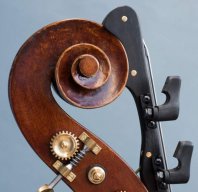
Matthew Tucker
Commercial User
- Aug 21, 2002
- 2,686
- 387
- Disclosures
- Owner: Bresque Basses, Sydney Basses and Cellos
You might like to think about cutting a stick of 10" x 2 x 1 and cutting a slot into it to take the edge of the rib, plus some tin as a bending strap. That way you can get some purchase close to the end without stressing the wood or your fingers too much.
Although i did most of my bending straight onto the form, I did enought to know that the wood will tell you when it's hot enough and ready to bend. No point forcing it.
How wide is your pipe? and how thick are the walls? If you are bending on a thin pipe the concentration of heat might be adding to the scorching problems.
Also - why not practice on a few sheets of thin plywood. It bends OK.
Although i did most of my bending straight onto the form, I did enought to know that the wood will tell you when it's hot enough and ready to bend. No point forcing it.
How wide is your pipe? and how thick are the walls? If you are bending on a thin pipe the concentration of heat might be adding to the scorching problems.
Also - why not practice on a few sheets of thin plywood. It bends OK.
The plywood is a GREAT idea. The pipe is 2" electrical conduit with a charcoal grill starting element inside. The walls aren't terribly thick. I could be wrong, but I think there's no fault there. I think I just spent too long and too hot on one spot without re-wetting. I am using a piece of aluminum flashing for a bending strap. No handles though. I just lay the aluminum down and then use a couple 1 x 2's to put pressure on either side of the pipe. I think I will try putting handles on for the corner curves though. If the plywood works well, I'll be in business. It will give me time to get a feel for things.
When the wood's ready to bend, it doesn't just "go" effortlessly does it?
When the wood's ready to bend, it doesn't just "go" effortlessly does it?

Jake deVilliers
Commercial User
- May 24, 2006
- 6,349
- 607
- Disclosures
- Owner of The Bass Spa, String Repairman at Long & McQuade Vancouver
Don, I use a piece of 2" aluminium scaffold pipe with about a 1/4" thick wall with a propane torch. The thickness and the aluminium make a larger area of good heat that minimizes scorching and makes it easier to rock the wood to heat it more generally, ratrher than in one narrow spot.
Good tip from Matthew on the holder.
Good tip from Matthew on the holder.
Many makers thin the rib stock in the area of the tight bends. 1.7 to 2mm in that area is typical. Be mindful of "springforward"; often the wood will keep bending as it cools (in the really tight bends).
Matthew Tucker
Commercial User
- Aug 21, 2002
- 2,686
- 387
- Disclosures
- Owner: Bresque Basses, Sydney Basses and Cellos
When the wood's ready to bend, it doesn't just "go" effortlessly does it?
Not effortlessly, but under a certain pressure you can feel it "relax" and say "now bend me"!!
If your pipe's walls are too thin it will lose heat too quickly in contact with the damp wood.
Not effortlessly, but under a certain pressure you can feel it "relax" and say "now bend me"!!
If your pipe's walls are too thin it will lose heat too quickly in contact with the damp wood.
I think that may be part of my problem. I'll call around and see if I can get something thicker.
Don, I use a piece of 2" aluminium scaffold pipe with about a 1/4" thick wall with a propane torch. The thickness and the aluminium make a larger area of good heat that minimizes scorching and makes it easier to rock the wood to heat it more generally, ratrher than in one narrow spot.
I did get 2" aluminum pipe with 1/4" thick wall and it does make a huge difference. It takes forever to heat up, where my conduit pipe heated almost instantly. So I was getting scorching but it wasn't steady enough heat to get a good bend. Now I'm getting good bends on my test wood that has already been scorched and bent every which way but Tuesday. I'm waiting for my calipers to come so I can get the ribs to the right thickness with some accuracy.
Thanks for all your comments and suggestions. They really helped. -don
Not effortlessly, but under a certain pressure you can feel it "relax" and say "now bend me"!!
If your pipe's walls are too thin it will lose heat too quickly in contact with the damp wood.
EXACTLY what was happening.

My bending "iron" is aluminum, and has 1/2" thick walls. I heat it with a propane torch. It takes probably 20 minutes to get hot enough to use, but works quite well after that point.
Got my calipers today, and my test wood was almost 3mm thick throughout. I was just checking on the edges with sliding calipers before, so I was kind of flying blind on thicknesses. With my thicker walled bending iron and thinner wood I'm feeling better about bending. I also put oak handles on my bending straps. Tomorrow I'll get the ribs to the correct thickness and start bending for real. I'll do the c-bouts in the bendng form and the upper and lower bouts with the bending iron. I'm epoxying my laminated neck together too. Bubinga center strip with black veneer on either side, then maple. I know it's not traditional, but the bubinga should add some stiffness and stability, and it allows me to carve my first scroll on a $100 chunk of wood as opposed to $300-$500.
-don
-don
Latest posts
-

-

-
 Guyker 4 String Headless Bass Bridge (and headpiece) report!
- Latest: Matt Liebenau
-

