• TalkBass has been independent since 1998. Add your voice.
    Create a free account to reply to discussions, view embedded media, and browse with fewer display ads.
    Join freeLog in
    Want zero display ads or expanded classifieds tools? Compare plans.

Side-dot discoloration issue

May 20, 2005
4,883
3,665
Esteemed builders of Luthier's Corner,


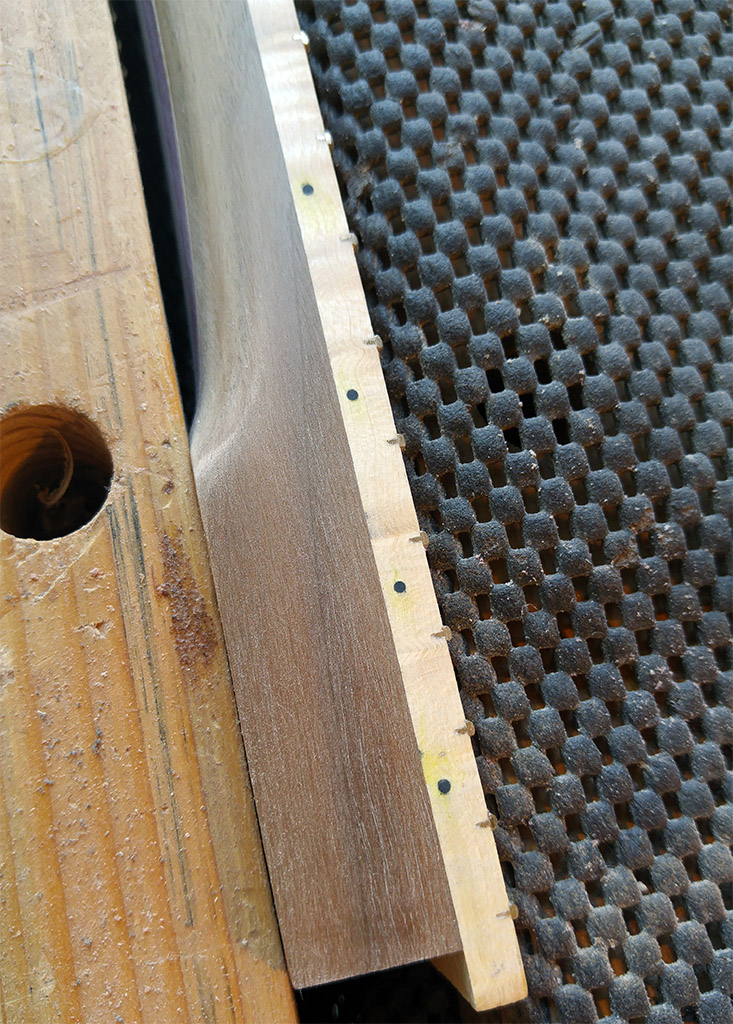
Thanks for looking at my thread! I'm having a problem I can't figure out with my latest build. The neck is a laminated affair of mostly Claro walnut, with purpleheart stringers, maple veneer accents, and a birdseye maple fretboard. The problem I'm having is related to the side-dots in the fretboard. See below:
xfJEFG4.jpg


As you can see, there is some yellow discoloration around some of the side-dots. The discoloration appears nowhere else on the fretboard, or the neck, or even the body. So I can only guess that it is related to the side dots, or to the super-glue I used to install them, or perhaps an interaction between the two. The side-dot material is a 0.06" diameter carbon fiber rod, and they're affixed in place with Titebond Instant Bond medium-viscosity super glue.

Sanding the affected area doesn't seem to be helping, nor does scraping. Scrubbing it with either acetone or denatured alcohol doesn't help either.

I applied a small dab of the eventual finish (danish oil) to the discolored area around the first fret, and it does show through the finish. So I need to get rid of it before I can proceed.

Any suggestions?

Thanks,
Mark.
 
Esteemed builders of Luthier's Corner,


Thanks for looking at my thread! I'm having a problem I can't figure out with my latest build. The neck is a laminated affair of mostly Claro walnut, with purpleheart stringers, maple veneer accents, and a birdseye maple fretboard. The problem I'm having is related to the side-dots in the fretboard. See below:

xfJEFG4.jpg


As you can see, there is some yellow discoloration around some of the side-dots. The discoloration appears nowhere else on the fretboard, or the neck, or even the body. So I can only guess that it is related to the side dots, or to the super-glue I used to install them, or perhaps an interaction between the two. The side-dot material is a 0.06" diameter carbon fiber rod, and they're affixed in place with Titebond Instant Bond medium-viscosity super glue.

Sanding the affected area doesn't seem to be helping, nor does scraping. Scrubbing it with either acetone or denatured alcohol doesn't help either.

I applied a small dab of the eventual finish (danish oil) to the discolored area around the first fret, and it does show through the finish. So I need to get rid of it before I can proceed.

Any suggestions?

Thanks,
Mark.

I have no idea what causes that, but I have had the exact same thing happen on a maple board. It doesn't have anything to do with your fret markers however
 
Yeah, it's probably not caused by the side dots themselves. My guess would be that the glue has a small amount of yellow dye in it for some reason. For a simple test, put a little bit of the same glue on a scrap of the same wood and see if it does the same thing.

Unfortunately, fixing it may not be easy. That looks like a dye which has sunken into the wood. It may not sand out, as you are finding out. If all else fails, you may have to apply the same glue carefully all along the edge of the fingerboard to try to even the color out.
 
This calls for some thin wood binding. Pull the frets, use a rabbit bit to cut a neat recess down both sides of the fingerboard, glue on thin strips of wood. Either scraps from the same bird's eye, or some nice contrasting wood. Make it look like like it was supposed to be that way!
 
I know very little and people who know way more than I do already chimed in. What material are the markers? Wood? What were they glued in place with? Seems suspicious that the yellowing only occurs in the spots there are markers?

Hammerd- hope you can come up with a fix which does not require staring over. . . . starting over is a drag, but I learn something every time I am forced to do it!

Good luck, please share your final, successful solution. . .and although it does not feel like it right now. . . YES there will be a solution which is successful therefore final!
 
I'd agree that you should buy a rabbet bit if you don't own one, and go for it. You could also up the game to a "bound" board by cutting back the fret-tangs so the face of the fret overhangs the binding, but the slot does not show on the side.

And consider this yet another reason to try and remember to test new processes and materials on scrap.

With appropriate jigging you could probably do it with a straight bit, if the rabbet bit is holding you back.
 
Last edited:
just feel bad for him. To get to that point is when I will breathe a sigh of relief on my project. It just plain sucks

I had this happen to me once and the project sits, unfinished as of yet in my garage. I have a '70 Camaro. I had restored it once when I did not know how to weld. Bought a welder, learned how to weld, took the entire car back to bare metal (I used lacquer primer and it screwed up the paint in a couple of places, hence my DISDAIN for lacquer). Hung new panels, did all of the bodywork, painted the best job I ever laid down with ghosted stripes. . .the whole bit. While I lost track, my estimate is start to finish, 500 hours. I closed the door after a final polishing, chipped piece of paint the size of my pinkie nail on the bottom front edge of the door where a panel was too tight. I closed the garage door that day and did not touch that car again for 2 years!! It is just very disheartening when you get to that point and something goes amiss!!

Hope you can save it!