• TalkBass has been independent since 1998. Add your voice.
    Create a free account to reply to discussions, view embedded media, and browse with fewer display ads.
    Join freeLog in
    Want zero display ads or expanded classifieds tools? Compare plans.

Double Bass Simandl Shifting and Rabbath pivoting in jazz technique

Chris Fitzgerald

Student of Life
Staff member
Administrator
Gold Supporting Member
Oct 19, 2000
27,574
38,471
Louisville, KY
www.chrisfitzgeraldmusic.com
Just to get the ball rolling, I'll open the first thread on the first topic presented in the "Topics" thread. All other opinions and insights welcome.

Flanning said:
I would really like to hear the perspective of a primarily Jazz focused teacher on Simandl style shifting v Rabbath pivoting (or any other left-hand technique that they use that might be different).

Personally, I teach both, starting with Simandl fingerings and progressing to Rabbath and Petracchi (for thumb position, which is kind of a melding of the two in its own way) fingerings when the student seems ready, or when the musical application presents itself. To me, the right answer for what fingering to use always comes down to "what fingering provides the best solution in terms of intonation and ease of use for any given passage"?

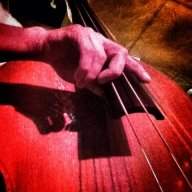
Given the scale length of the lower positions, Simandl is the most logical place to start, since if you can't play in tune using Simandl fingerings, you're probably not going to play in tune adding a pivot to them in either direction. Once the "one finger per half step, and considering 3 and 4 together to be the same as 4 in the lower positions" technique is ingrained, there are plenty of musical situations where the extra half step on either side of this chromatic position is more ergonomic and logical than a shift - especially when the position pivoted from is returned to before a shift becomes necessary. For my hands and technique, the half step pivot involving a turn of the thumb on the back of the neck usually feels safe as regards intonation after a modicum of practice of using it in the general sense. So if a shift isn't really necessary when a pivot is available, I'll usually go with the pivot.
 
As a veteran instrumental music teacher, but a double bass neophyte, I have found it interesting to explore these fingering systems simultaneously. The fingerings I choose seem to depend on where the bass line is headed. It's good to have a variety of options in my small (but growing) arsenal!

Knowledge of the various systems also helps me to explain things more clearly to my students. It never hurts to challenge their musical, mental, and physical skills.

Thanks for starting this pedagogy forum - nice addition!
 
I guess in some sense I use the Rabbath technique pretty much exclusively, although in my view the Rabbath system incorporates most of what you find in other LH systems but often also has several other fingering options.

I remember one time when I thought I had come up with a really clever fingering for a passage in Koussevitzky, showed it to Francois, and got schooled - he asked me why I wasn't using a more traditional fingering. There was no need for anything else in that passage.
 
  • Like
Reactions: AndersLasson
Rabbath pivoting is very much an addition or rather extension of Simandl. It should be brought into lessons ONLY after the student gets to grips with Simandl. I was luck enough to take part in Fraticek Posta's very last master class. At one point he held up his left hand rigidly fixed in the Simandl half position and declared, 'in the orchestra, this is intonation!' I agree, but solo playing sometimes demands extreme solutions and the Rabbath system offers exactly that.
FC
 
I use Montag instead of Simandl. I find it more musical. I like to start a bass guitar
doubler using Rabbath fingerings in fourth position (seventh fret on a D neck bass)
with the fourth finger pivot and the first finger back pivot from cello fingerings.
Thumb positions start immediately rather than waiting a year or two. I also like
octave division exercises up and down a single string (linear) to teach shifting and
finger replacement. Harmonics are also a good way to feel locations and distances
between positions - I like to introduce the bow with harmonics along with open strings.
 
I am more careful teaching/using pivot, four-finger or any extended hand positions pizzicato, esp. unamplified.
I would say they should not be off limits but should be studied, practiced and employed sparringly in a jazz or other pizzicato context.

I think Simandl positions are best and most solid for walking quarters or even for the bass function in free jazz.
 
Let's not forget that Ray Brown actually produced a video with Rabbath!
[Invalid or Expired Link Removed]
Clayton sings Rabbath's praises as well... but what would those guys know about playing jazz?:D


Dig it:

The Simandl method is a *left hand* fingering system... moreover, one designed for a less "modern setup," as some would say. The older setup with gut and high action lends itself to Simandl etc... steel and lower action allow us to do so many different things as well.

Whether it's pizz or arco, a good left hand is just a good left hand.

Rabbath's system is absolutely wonderful if taught correctly, and I feel, is a great way to get kids playing scales all over the bass, in tune, very quickly.


One more point... the pivot is just one small part of Rabbath's technique... check out his first book if you haven't. Great melodic stuff in 1st position no pivots, great exercises for bow control too.
 
  • Like
Reactions: AndersLasson
The Simandl method is a *left hand* fingering system... moreover, one designed for a less "modern setup," as some would say. The older setup with gut and high action lends itself to Simandl etc... steel and lower action allow us to do so many different things as well.

I have always said using the closed hand tech (1,2,4 - Simandl), the open hand (1,2,3,4) where comfortable and adding a half step pivot up or down combined with the thumb positions covers everything you could ever need.
Tom Gale
ASODB.com
 
I have always said using the closed hand tech (1,2,4 - Simandl), the open hand (1,2,3,4) where comfortable and adding a half step pivot up or down combined with the thumb positions covers everything you could ever need.

I forgot to add the thumb positions can also be used below the octave - not just from the octave and up.
Tom Gale
ASODB.com
 
damon, have you heard of Streicher's method?
it's quite unique, and certainly was perceived as revolutionary, maybe even "wrong" when first introduced, as it differs from Simandl in many ways.

The title of his books translates to something along the lines of "How *I* play the bass." Not how *to* play the bass, but how *HE* felt the instrument was best played.

or

"There's more than one way to play this thing."
Bill Adam, trumpet guru

People will argue til red in the face, but as far as I'm concerned, if you play it in tune with your feet, that's perfectly valid. Eventually all this pedagogical pedantry will melt away, and players will be encouraged from day one to do what works, when it works, anywhere on the instrument.

fwiw Hans Glawischnig has a very "modern" left hand, and is one of the most in-demand bassists in NYC. Swell guy, too.
 
I remember WAY back, an Italian system of closed hand which used 1, 2/3, 4. I tried it for a few times and it really wasn't worth it. The beautiful, lyrical 2nd finger was no more! Anybody remember the name of the book/author??
Tom Gale
ASODB.com
 
Co,-
I bite the strings like I a starving dog on a milkbone and use it all. Simandl, pivots, 4 finger, thumb wherever the hell I wanna put it, 3rd finger in 1st position. If you guys are ever in Chicago, come to one of my gigs... I'll buy you a beer.;)

Tom- are you talking about Bille?
 
I remember WAY back, an Italian system of closed hand which used 1, 2/3, 4. I tried it for a few times and it really wasn't worth it. The beautiful, lyrical 2nd finger was no more! Anybody remember the name of the book/author??
Tom Gale
ASODB.com

Yeah, Billie. I did it for a few weeks, it does make it easier to play in tune, but I missed the 2nd finger. The books is nice to play out of and good to have around.
There are a lot of arguments against it - but most Italian bassist I have ever heard play just great!

I am a fan of using it all, just for old fashioned, digging in unamplified pizzicato Simandl fingering seems the easiest on the body.
I use all of it pizz, as well. I just don't default to the other methods when the old way works.
I tend toward the others when amped or when a lighter touch works - like durring a solo or drummerless group.
 
Co,-
I bite the strings like I a starving dog on a milkbone and use it all. Simandl, pivots, 4 finger, thumb wherever the hell I wanna put it, 3rd finger in 1st position. If you guys are ever in Chicago, come to one of my gigs... I'll buy you a beer.;)

Tom- are you talking about Bille?

YES! I really liked the etudes but hated the fingerings so I remember covering the printed fingerings, hitting the print shop and writing in my own. Very nice music but no way I'm giving up that great lyrical 2nd finger.
Tom Gale
ASODB.com