• TalkBass has been independent since 1998. Add your voice.
    Create a free account to reply to discussions, view embedded media, and browse with fewer display ads.
    Join freeLog in
    Want zero display ads or expanded classifieds tools? Compare plans.

Simple chord progression analysis help

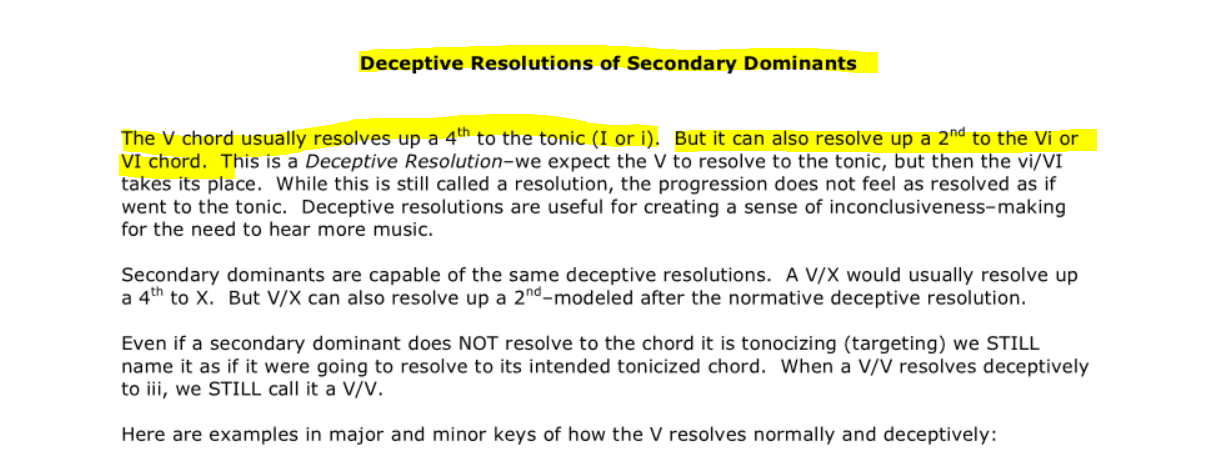
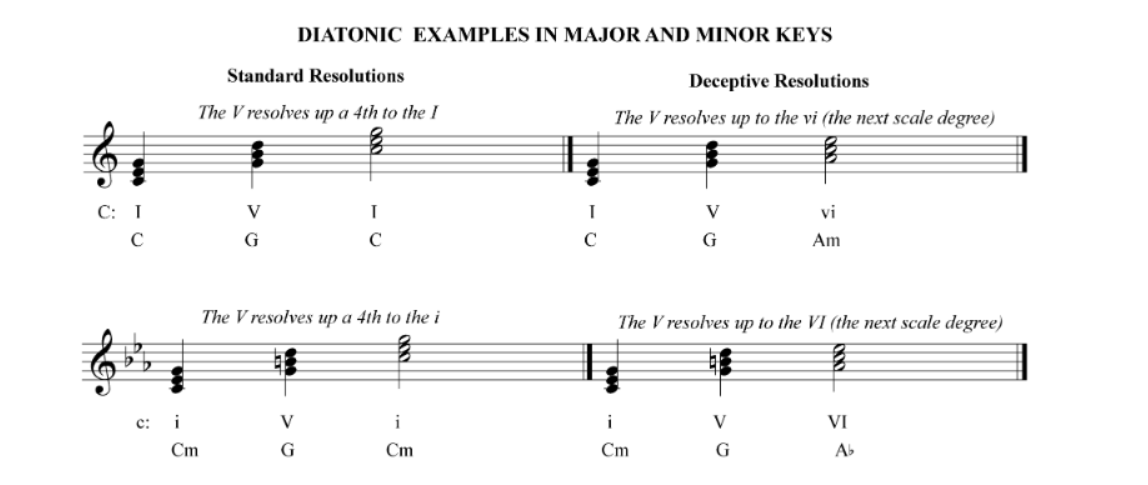
Some info about "Deceptive Resolutions of Secondary Dominants".
From here.
http://jkornfeld.net/Deceptive_secondary_resolutions.pdf

Dsdr.PNG
Dsdr-2.PNG
Dsdr-3.PNG
 
  • Like
Reactions: mambo4
Rusty on the theory. I came up with a little chord progression I came up with just to practice some position transitions for a song I'm working on on guitar (Jim Croce's "Time In A Bottle") and I realized I don't quite know what's going on with it. So it's simple enough, just 4 chords:

Dm7 Bdim Cmaj7 A7

Now the first three chords to me imply C major as the key, but then the A7 to Dm7 implies D minor. Is it just waffling between the two keys or is there something more going on? The transition from the Cmaj7 to the A7 doesn't sound all that jarring or "out of key" so I'm guessing I'm missing part of what's going on harmonically.
Stay in C major, but substitute c# for c natural on the A7. Treat it as an accidental. That will give you d melodic minor. It will sound more consonant than switching to D major, or D harmonic minor. Try soloing over the the changes using these different scales and decide what sounds best to you.
 
You would label that borrowed even in Dm? Its not just labeled as harmonic (or melodic) minor? Im a little rusty on my minor tonality theory.....

Yes. A7 is diatonic to the key of Dm. Not borrowed or substituted or anything else. C# is the leading tone. The fact that it does not appear in the key signature is irrelevant.
 
Found another weird instance in another favorite: Dylan's "Ballad Of A Thin Man": Bm F#aug/Bb D/A E7/G# G ... I think I might try moving it to Dm, better for my voice...
 
FWIW, here's what my little practice progression has morphed into:

Still not sure quite what's going on, theory-wise, but it sounds ok to me (in a twisted way).
 
Yeah, many songs do it, some in minor keys, some in major. Sometimes the chords actually change, sometimes not.

When a Man Loves a Woman
Forever Young
The Weight
Dark End of the Street
Whiter Shade of Pale

Those are all in major keys.
Even though the chord itself may not change, the moving bass line is forcing the change, just like the C, CMaj, C7, C6 example that was mentioned.
 
  • Like
Reactions: Russell L