• TalkBass has been independent since 1998. Add your voice.
    Create a free account to reply to discussions, view embedded media, and browse with fewer display ads.
    Join freeLog in
    Want zero display ads or expanded classifieds tools? Compare plans.

Simplest Possible Jazz Bass Controls?

It's something that can be tried. Many people do it and have had excellent results.

I learned this from reading an article by master Bass luthier Rick Turner.

It's a great thing to try, but it's far from a slam dunk as being an improvement IME. As I said, it just depends.
Yel_wink.gif
 
Has anyone else seen these “Tele-Jazz” control plates?

Stellartone Tele-Jazz bass tone control system KIT, v.4S (master volume and BASS TEN ToneStyler)

It has a blade 4-way switch.
That's a sensible design, nicely executed, with a snazzy control plate. If you have some soldering know-how, it wouldn't be too hard to replicate the circuit on the cheap, but if the price doesn't put you off, there's your simple-but-versatile control panel.

Edit: Having experimented a fair bit with capacitor switching, I'd say the six-position ToneStyler would be fine, saving some expense over the ten-position one above. Stellartone Tele-Jazz bass tone control system KIT, v.4S (master volume and BASS SIX ToneStyler)
 
Last edited:
  • Like
Reactions: sikamikanico
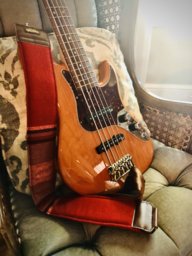
I have always preferred the simplest passive setup on my bass. My number one is a 1998 Fender Dlxe J5. I had the pick ups permanently, hard wired in series, full on with a simple volume control. Since it has one knob, I call him One Eyed Jack.... everything I need and nothing I don’t. Unfortunately, I cannot answer your technical questions, as I had this professionally done and I’m clueless in that regard :)
 

Attachments

  • 9FB857EE-D5AA-4DA1-816F-242A02217444.jpeg
    9FB857EE-D5AA-4DA1-816F-242A02217444.jpeg
    668.3 KB · Views: 84
  • Like
Reactions: 4sight
Hey guys!

I recently converted my active fender jazz bass to passive. Now, inspired by the Ernie Ball Joe Dart bass, I want to take it a step farther and remove the tone pots so the pickups are wide open all the time. I also want to be able to switch between pickups as the only means to modify tone.

I can think of three possible configurations:

1. Neck Volume/Bridge Volume
2. Master Volume/Master Blend
3. Master Volume/3-way selector switch.

Which of these options do you think are the most practical and offer the least resistance to the pickups? Or is there another option?

Thanks guys!!!
I tried a volume/blend config on a Jazz, but quickly discovered I had much more control over my overall sound/tone with a volume/volume setup. I've never tried a volume/three way switch as it would limit you to three tones, and how loud you wanted them to be. I guess if one of those three choices suited you, you could just hard wire your bass in that configuration and eliminate the switch and possibly one of the pickups as well.
 
Correct me if I'm wrong, but can Option 2 even exist on a passive bass? I thought blend controls were inherently active.
No, they are not. Pan controls just happen to be more common on basses with built-in preamps, that's all. I have two passive basses with a very clever, and useful pan control on each of them. My other passive basses have either VT-selector switch, or VV-selector switch.
 
  • Like
Reactions: Eminor3rd
No, they are not. Pan controls just happen to be more common on basses with built-in preamps, that's all. I have two passive basses with a very clever, and useful pan control on each of them. My other passive basses have either VT-selector switch, or VV-selector switch.

Interesting -- I've been under the wrong impression for years. Thanks for the info.
 
Does anyone know how I could wire one master Volume, bridge on/off switch, and neck on/off switch? A kill switch for each pickup basically.

I see a lot of on/on toggles online. Would those work as an on/off if I just don’t connect anything to the second side?

My reasoning here is that my American deluxe has a side output jack on the body, and jazz control plates have a minimum of 3 holes. And I want all holes occupied.
 
My reasoning here is that my American deluxe has a side output jack on the body, and jazz control plates have a minimum of 3 holes. And I want all holes occupied.
Who says you have to use someone else's prefabricated jazz control plate? You can have one made, and put as few holes in it as you want.

Personally, if I was going for utter simplicity, I'd wire the pickups straight to the jack and do away with the controls entirely. (I did that on a bass once and loved it.) But you can do whatever you want, just don't feel like you have to have three controls just because there are three holes.
 
  • Like
Reactions: Jeff Scott
For those of you who have removed the tone pot - did it introduce any 60-cycle hum?

I just rewired a PJ VV based on this thread and followed the SD wiring diagram. A bit of buzz is there now. I figured it was either the wiring itself or a grounding issue. When I touch the bridge or jack plate it goes away. If I touch either of the pickups (just with my hand - not strings) it gets a bit worse. Do I have a ground issue?
 
For those of you who have removed the tone pot - did it introduce any 60-cycle hum?

I just rewired a PJ VV based on this thread and followed the SD wiring diagram. A bit of buzz is there now. I figured it was either the wiring itself or a grounding issue. When I touch the bridge or jack plate it goes away. If I touch either of the pickups (just with my hand - not strings) it gets a bit worse. Do I have a ground issue?

Are you sure the buzz was not there before? It may simply be more pronounced now without the loading of the tone pot.
 
  • Like
Reactions: El Güero
Are you sure the buzz was not there before? It may simply be more pronounced now without the loading of the tone pot.

I was thinking the same thing. I've substituted a tone pot with a cap selector switch (no pot) and found the sound had a lot more presence or brightness. That would make noise that was already there more obvious. The pot/cap control seemed to muffle the sound. I did have to use caps with larger values, but it's easy to try different one to see what you like, and you can add them in parallel to get "in between" values to fine tune it to your preference.
 
One push-pull pot.

It should be a tone pot with the muggiest, muddiest, nastiest, darkest capacitating decapitating capacitor available.

Push-pull should switch between series and parallel.


Volume is in the fingers.