• TalkBass has been independent since 1998. Add your voice.
    Create a free account to reply to discussions, view embedded media, and browse with fewer display ads.
    Join freeLog in
    Want zero display ads or expanded classifieds tools? Compare plans.

Single-Cut question?

It's said to increase stability, resonance, and sustain. I've owned a ton of them and I couldn't claim that the singlecut factor alone increased any of those things, although I don't doubt that it may add more of them to some small degree. I get them only for the aesthetic aspect (that and they feel really nice against the torso).
 
It's said to increase stability, resonance, and sustain. I've owned a ton of them and I couldn't claim that the singlecut factor alone increased any of those things, although I don't doubt that it may add more of them to some small degree. I get them only for the aesthetic aspect (that and they feel really nice against the torso).

I agree with Bryan. (Hey, that's twice in one night!:smug:) There have been various claims made about the singlecut design. I bought mine for the aesthetics of the design, not any purported improvements in stability or sustain.
 
Pretty much aesthetics. The idea of clamping one side of the neck and not the other is, at best, a dubious idea.

I guess one thing with the single cut design is that you can increase the mass of the body a bit while keeping the size of the body relatively small. However, you can do the same thing with a more dense/heavy body wood in a standard body.

If I were to do a single cut, I'd find an execution like the one that Pete Skjold uses with his 'whaleback' models... single cut to increase body mass and give you that 'look', but a bolt on design to keep the neck attachment symmetrical.

IMO, although Chris Stambaugh pretty much feels the same way and suggests that his customers not do a single cut design.
 
I know for a fact that singlecuts are that way just to fill the definition of the nomenclature; other wise they would not be... singlecuts. :eyebrow: :hmm: :hiding: :rolleyes:

Seriously, A bolt on single cut often will not have body to neck attachment, but through neck models do (at the upper bout).
 
Pretty much aesthetics. The idea of clamping one side of the neck and not the other is, at best, a dubious idea.

I guess one thing with the single cut design is that you can increase the mass of the body a bit while keeping the size of the body relatively small. However, you can do the same thing with a more dense/heavy body wood in a standard body.

If I were to do a single cut, I'd find an execution like the one that Pete Skjold uses with his 'whaleback' models... single cut to increase body mass and give you that 'look', but a bolt on design to keep the neck attachment symmetrical.

IMO, although Chris Stambaugh pretty much feels the same way and suggests that his customers not do a single cut design.

I respectfully disagree. The structural benefit is there.
Having built an appreciable number of basses, both SC and DC, my empirical data supports this.

The SC basses I've made, and a few others that I've owned by other builders, have stayed essentially flat
after the point of connection with the body.

Although the asymmetrical neck joint would theoretically pose problems, the reality IME is that the torquing moment on the neck is negligible or non-existent,
whereas the added stiffness from the shorter cantilever is measurable and, in my mind, valuable.
I think the benefits from this construction are not the same as those gained by simply adding body mass.
It's a change in neck flexibility.

The Veillette bolt-on singlecut that I co-designed has an
extremely asymmetrical neck attachment, and we've never had a failure or even a minor issue with that detail.
It sounds great and is extremely strong.

Chris Stambaugh's opinion is just that - one informed opinion from a talented builder, in an ocean of other informed opinions from talented builders. Ken Lawrence, Fodera, Elrick, and a few others believe in the singlecut thing...so do I, I guess, from my own experience.

Who's right? Doesn't matter. If it sounds good
to you, buy it!

But, in light of the ease with which things get written off in this industry as 'hype' or BS, I thought the other side of this question needed a little support. I and a few other people think it's more that just looks.

Cheers,
Martin
 
There is supposed to be an acoustical benefit to the bass (low note) side of the body being bigger. It is the same with mandolins, at least the "F" style body with the extended scroll part on the bass side of the instrument. The bigger resonant body/space on the low note side is supposed to enhance the low frequencies from the nearby low strings. Or so I have been told . . . .
 
I respectfully disagree. The structural benefit is there.
Having built an appreciable number of basses, both SC and DC, my empirical data supports this.

The SC basses I've made, and a few others that I've owned by other builders, have stayed essentially flat
after the point of connection with the body.

Although the asymmetrical neck joint would theoretically pose problems, the reality IME is that the torquing moment on the neck is negligible or non-existent,
whereas the added stiffness from the shorter cantilever is measurable and, in my mind, valuable.
I think the benefits from this construction are not the same as those gained by simply adding body mass.
It's a change in neck flexibility.

The Veillette bolt-on singlecut that I co-designed has an
extremely asymmetrical neck attachment, and we've never had a failure or even a minor issue with that detail.
It sounds great and is extremely strong.

Chris Stambaugh's opinion is just that - one informed opinion from a talented builder, in an ocean of other informed opinions from talented builders. Ken Lawrence, Fodera, Elrick, and a few others believe in the singlecut thing...so do I, I guess, from my own experience.

Who's right? Doesn't matter. If it sounds good
to you, buy it!

But, in light of the ease with which things get written off in this industry as 'hype' or BS, I thought the other side of this question needed a little support. I and a few other people think it's more that just looks.

Cheers,
Martin

I think the key here, and the point I was trying to make, is that if the OP likes the look, go for it. Since I've never had a neck that was really a problem with any design, and since you can get pretty much any body density, weight, etc. you want with any design, then if a player likes the look of a single cut, I say go for it.

I agree, even though the design seems a little strange to me personally, the probability of it causing problems is quite low assuming the rest of the design and execution and materials are top notch. To me, it's primarily an aesthetic choice and not much more. IMO and IME!
 
Seriously, A bolt on single cut often will not have body to neck attachment, but through neck models do (at the upper bout).

+1, that's why some luthiers like Pete Skjold like this single cut design... the additional mass of the single cut, the look of the single cut, but not the attachment to the top of the neck. That's the whole point of these designs.
 
I simply like the design of the single cut., I don't care about all the theory about single cut vs double cut. I'm no scientist.
that's the only reason I have a single cut on order.
I also think, access to the upper register is easier.
 
In his latest interview, Anthony Jackson mentioned that he was having some neck stability issues with what was to be his last double-cut Contrabass. Vinny Fodera came up with the single-cut design as a way to solidify the neck/body structure when the next version of the Anthony Jackson Contrabass was built. Anthony said he didn't care for the idea at first, but was more enthusiastic when he saw the design plan for it. In this instance, there was a definite physical reason for the single-cut.

AFAIK, neither AJ or anyone at Fodera claimed to be the first to come up with the single-cut as we know it today - meaning the body meeting the neck at the 12th fret or so. I faintly remember that the Kenneth Lawrence Brase may have predated the Fodera design by a year or two.
 
...access to the upper register is easier.
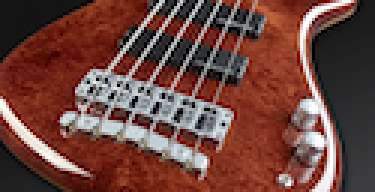
How would a single cut(as opposed to a double-cut)affect uper register access? :confused:

More on topic & to clarify my earlier post, I believe there is a structural effect inherent to the single-cut, but doubt if I could detect it. Furthermore, my comment regarding Chris Stambaugh's opinion on all this is very much a paraphrase. For his opinion, call the man- he will very likely answer the phone. :)
Keith Guitars, I very much appreciate the *Voice of genuine experience* here.
 
In his latest interview, Anthony Jackson mentioned that he was having some neck stability issues with what was to be his last double-cut Contrabass. Vinny Fodera came up with the single-cut design as a way to solidify the neck/body structure when the next version of the Anthony Jackson Contrabass was built. Anthony said he didn't care for the idea at first, but was more enthusiastic when he saw the design plan for it. In this instance, there was a definite physical reason for the single-cut.

AFAIK, neither AJ or anyone at Fodera claimed to be the first to come up with the single-cut as we know it today - meaning the body meeting the neck at the 12th fret or so. I faintly remember that the Kenneth Lawrence Brase may have predated the Fodera design by a year or two.
I actually heard this direct from Anthony himself. His example was that he could hear a slight detuning of the strings as he leaned the bass forward, in playing position....the big neck was pulling, and he swore he could hear the difference. So Vinny designed the SC version for more stability in the bigger-necked basses.

Aloha, Garey