• TalkBass has been independent since 1998. Add your voice.
    Create a free account to reply to discussions, view embedded media, and browse with fewer display ads.
    Join freeLog in
    Want zero display ads or expanded classifieds tools? Compare plans.

single subwoofer placement

we have been successfully using a non-subwoofer system for a couple of years, but the mains (2x qsc hpr122i) can't do it anymore. we need a sub. we're close to buying the qsc ksub, but we only want one.

THE QUESTION is about placement: can i put it under ONE of the mains (i.e., to the side) instead of the middle? we are a pretty large band and space is at a premium. finding space for a stand-alone sub is going to be tough. and affording 2 subs is also not in the cards.
 
we have been successfully using a non-subwoofer system for a couple of years, but the mains (2x qsc hpr122i) can't do it anymore. we need a sub. we're close to buying the qsc ksub, but we only want one.

THE QUESTION is about placement: can i put it under ONE of the mains (i.e., to the side) instead of the middle? we are a pretty large band and space is at a premium. finding space for a stand-alone sub is going to be tough. and affording 2 subs is also not in the cards.


That's what I do. Given that the low end produced by that sub is not nearly as directional as the higher frequency produced by the tops, you should be fine.
 
What he said - that's what I do too. Test setup in my garage, have used at 2 gigs so far, another one coming this Sat.


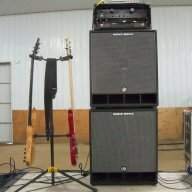
PA5.jpg
 
as i mentioned in your other thread maybe get A KW181 or some used HPR subs. My band has 4 of the HPR181s ans 2 151s. If you go with one sub try and use walls for boundary reinforcement. Also keep the sub on the floor and not elevated.
 
ggunn and Jimmy M, If you are only using one sub you will get more output by getting it closer to walls or better yet a corner. It is the same principle as a bass amp.

Yes, corner loading will increase output but in my experience it causes more problems than it cures since it introduces more reflected sound as opposed to accurate, time-aligned, direct sound from the speakers themselves. There may be exceptions but in my experience corner loading = mud.
 
  • Like
Reactions: 31HZ
Yes, corner loading will increase output but in my experience it causes more problems than it cures since it introduces more reflected sound as opposed to accurate, time-aligned, direct sound from the speakers themselves. There may be exceptions but in my experience corner loading = mud.
Wasn't going to say anything, but now that you mention it, it will reinforce a sub to stick it in a corner, but boundary reflections can cause cancellations in certain frequencies as well as these time-alignment issues, although I'd really like to see some data on how smeared the time alignment really becomes because it can't be by much. I prefer just to use a sub that can handle it when a corner isn't available.
 
Wasn't going to say anything, but now that you mention it, it will reinforce a sub to stick it in a corner, but boundary reflections can cause cancellations in certain frequencies as well as these time-alignment issues, although I'd really like to see some data on how smeared the time alignment really becomes because it can't be by much. I prefer just to use a sub that can handle it when a corner isn't available.

The data would be different for every room, which is part of the larger problem. Remember that reflections aren't just late, they are different from the source as some frequencies are absorbed & diffused by the wall/floor materials or cancelled when they interact with other reflections or the direct sound. You are also creating additional time alignment problems by shifting the subs behind the main speakers to tuck them in a corner.

Any one of these effects might be negligible by itself but they are cumulative. Since most of our gigs are in "far from ideal" acoustic spaces, all we can do is use best practices to rule out as many anomalies as possible. Then it's up to the musicians and the person pushing the faders to make it groove.
 
I too prefer dead center. Last weekend I placed it to might right of the stage with a top on it via a pole. These are K12 sub and K12 tops. I also had my modest bass amp behind me (MBass F100 and avatar B210). I found by having the single sub where it was that my entire stage area was a low end wash and I could actually feel the strings on my bass go into feed ack sustain as I hit them. Naturally as the sound guy I tried to fix it. My band band mates too felt it and thought I was to loud. Fortunatley we had our ex drummer and ex lead player out front and they said it was all good. When I stepped out front the bass was actually undiscearnable it was so low. Lesson for me, don't be lazy next gig and set out center like before.

Thoughts are welcoem.

Chris
 
This thread is timely...I dragged my lead and rythym players out to the store this weekend to convince them we need to upgrade our mains. The QSC K12 and Ksub is an awesome combination, albeit expensive!

I don't think we need a Ksub for the small clubs we play. I can carry the house with my rig alone and the drummer has a heavy right foot. If anything, the kick, only, should go to the mix to avoid the bass wash that was discussed here. Open subs like the k12 sitting out front of the band will have 360 degree radiation. The ksub really does not need corner loading...its a beast on its own. Careful adjustment of the subwoofer gain will help balance the sound.

If the guys buy the K12/ksub rig, we will pole mount one of the K12s on the sub (opposite side form my bass, please!). For the other side, I will build a faux sub box to pole mount the other k12. This eliminates the need for the tri-pods that are always in the way and gives us a useful storage box for cables, etc.

good luck!
 
The bass is always buggered somewhere. Oftentimes it's more even throughout the room when there's only one sub (or they are together) ('cause there's less comb filtering - no power alley).

I'd try putting the bass rig right behind the single sub, shooting cross stage. This should minimize comb filtering between the bass can and the bass in the PA.