• TalkBass has been independent since 1998. Add your voice.
    Create a free account to reply to discussions, view embedded media, and browse with fewer display ads.
    Join freeLog in
    Want zero display ads or expanded classifieds tools? Compare plans.

Small Hands

This is an answer that everyone just glosses over as if it is unimportant or not correct. The fact is that with proper technique, small hands can play most any neck. Further more, a meatier neck puts you hand in better posture to avoid tendon and and joint injury.

If you get some instruction on proper technique and practice with the same bass, you will get used to a meaty neck and it will become comfortable. If you think a P bass neck is meaty, try playing double bass. People do and people with small hands do. I know, I am one.

Much agreed. One also needs to be very careful or the masses get very offended, which I fully accomplished recently responding in a thread complaining about gloss finished necks.

Technique is generally something most musicians gloss over. I've known a few teachers who don't even teach it, especially if they weren't taught it by their teacher (and so on). Inefficiency, being only able to play certain neck shapes, and long term joint/nerve damage can happen to us mortals if we don't use proper technique.
 
Observation: general threads about shorties seem to be split evenly between 8ft tall, shovel handed Mountain-Who-Rocks types saying they love their shorty, and tiny handed short-scale-humans saying they can play a P-Bass no problsm.

I can't see that playing a shorty is going to put you at a disadvantage, any more than it did McCartney, Jack Bruce, Bill Wyman, Trevor Bolder, etc etc. If the scale length of a P is a mental barrier when you're starting out (and the fact that you've started this thread suggests it is), then by all means get a shorty and learn to love bass playing. A beginner's enthusiasm can be fragile enough without this kind of nagging doubt to deal with.

If, at a later date, you decide you want some certain something that your shorty can't deliver, then you can jump back to full-scale length, although you may have to change your technique a little. But you'll have the general knowledge of the instrument, the regular slot in a jam group, and the structure to keep going through any difficulty.

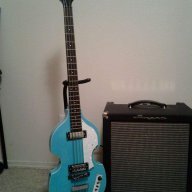
Personally, I love my Jag SS, and the only upgrade I can see myself making in future is perhaps to a vintage or MIJ Fender Mustang.
 
The only problem with some commercially available shorties is that the top horn is disproportionately shorter, often adding a touch of neck dive and making the first position reach about the same.

Sure, the frets are closer together. I find that a good amount of bassists want to play with 1 finger per string. In the lower register, this isn't happening if you have small hands. I also see big fret jumps like 3-4 fret stretches when it might be more appropriate to play that note on the higher string.
 
Observation: general threads about shorties seem to be split evenly between 8ft tall, shovel handed Mountain-Who-Rocks types saying they love their shorty, and tiny handed short-scale-humans saying they can play a P-Bass no problsm.

I can't see that playing a shorty is going to put you at a disadvantage, any more than it did McCartney, Jack Bruce, Bill Wyman, Trevor Bolder, etc etc. If the scale length of a P is a mental barrier when you're starting out (and the fact that you've started this thread suggests it is), then by all means get a shorty and learn to love bass playing. A beginner's enthusiasm can be fragile enough without this kind of nagging doubt to deal with.

If, at a later date, you decide you want some certain something that your shorty can't deliver, then you can jump back to full-scale length, although you may have to change your technique a little. But you'll have the general knowledge of the instrument, the regular slot in a jam group, and the structure to keep going through any difficulty.

Personally, I love my Jag SS, and the only upgrade I can see myself making in future is perhaps to a vintage or MIJ Fender Mustang.

+1. I don't see how one can beat the Squier SS Jag.
 
I rreally do not know what is up with some folks..

the answer to the question "what are some decent short scale basses" is not now, or ever has been ..get a P bass and some lessons

If the OP ias asking about short scales basses, please check your ego and preference at the door and answer the question.

It is simpler, easier, more fun and way more practical and productive to learn on a short scale bass, and of course it is then a simple transition to a larger scale bass if and when the user decides to do so
 
Shift; don't stretch! For example if you need to play F (1st fret E string) followed by Ab (4th fret E string), don't leave your 1st finger glued to 1st fret and stretch your 4th finger to reach the Ab; but rather shift your entire hand/wrist/arm up 1 fret so now your 1st finger is at the 2nd fret and the Ab is comfortably under your 4th finger.
+1

Listen to a good string bass player and you will realize that hand size is not even a factor in great playing. I also had a teacher that taught "pivot" which is leaving your thumb anchored while moving your hand up or down one fret.
 
I have the same physiology. My solution was to start on a full scale bass, playing a lot of punk rock, blues, and rock standards. Then over the course of a several months worked my way up to jazz and progressive rock. Developing good technique, stamina, and desire will get you there.


cricman
 
I rreally do not know what is up with some folks..

the answer to the question "what are some decent short scale basses" is not now, or ever has been ..get a P bass and some lessons

If the OP ias asking about short scales basses, please check your ego and preference at the door and answer the question.

It is simpler, easier, more fun and way more practical and productive to learn on a short scale bass, and of course it is then a simple transition to a larger scale bass if and when the user decides to do so

These are supposed to be educational forums where we exchange information and experience; I don't think there's anything wrong with sharing a few friendly tips to prevent hand injuries. I've been in the OP's exact situation, and my comments were well-intentioned. :)
 
I rreally do not know what is up with some folks..

the answer to the question "what are some decent short scale basses" is not now, or ever has been ..get a P bass and some lessons

If the OP ias asking about short scales basses, please check your ego and preference at the door and answer the question.

It is simpler, easier, more fun and way more practical and productive to learn on a short scale bass, and of course it is then a simple transition to a larger scale bass if and when the user decides to do so

I consider short scale basses to be a crutch. I toughed it out and got used to my P's chunky neck and now feel like I can play anything. In fact, after getting used to my P I feel like the slightly slimmer neck on my new Jazz is an absolute joy - I can't put it down.

My fear is that once the OP (or in my situation, myself) gets used to a short scale then there may be a natural aversion to a full scale bass which would limit development.

Now, I do have to declare one thing - I can reach four frets with my left hand. I couldn't at first, stretching exercises were essential. These exercises are very dull but highly rewarding, which is something I may not have done if I bought the VM Jaguar I was thinking of.

OP - Jaguars are fantastic instruments, and a great bargain - I almost bought one. If you really want a short scale then it's hard to go wrong with a VM Jaguar and drop in new pickups. My advise is to tough it out because it's worth it in the end.
 
I have smallish hands but have played for many years. I tend to compensate by being able to stretch and put my pinky to good use. lol. Takes practice, but I can usually play faster and usually be able to do some riffs the average"bigger" hand endowed player might even have some difficulty doing.
 
I have small hands with short fingers, and played 34 inch scaled basses for over 30 years. yes, I use proper technique and had an excellent teacher starting out. I even made fun of folks who used shorties and considered the short scales as "crutches" as one poster put it.

I am eating my words now.

Osteoarthritis reigns these days and often makes it painful to stretch and play, and I have had a joint fusion on one finger and it looks like another will be necessary. Short scales are now a necessity when arthur comes to visit.

Anyway, I have grown to love these pint sized basses and enjoy playing them. I have also used them professionaly without much flak from my musical cohorts. Glad I'm over that part of my ego trip. If you enjoy playing shorties, then I say go ahead and play them. Just don't ever rule out the possibility of playing a long scale. I still do play long scales, and enjoy recording with them, but I really like those short guys. Long live short scales!
 
I was about to say the same thing. Eddie Gomez is one of my favorite jazz DB players - played will Bill Evans (about the coolest gig ever) and many others.

Several yrs ago I went to one of his clinics at the UofM music school - I couldn't believe how tiny his hands are.

Go for it!