• TalkBass has been independent since 1998. Add your voice.
    Create a free account to reply to discussions, view embedded media, and browse with fewer display ads.
    Join freeLog in
    Want zero display ads or expanded classifieds tools? Compare plans.

Double Bass Small intro and question re: avoiding feedback

Hi all,
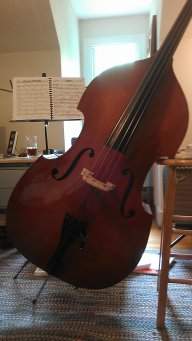
I recently bought a double bass and I'm really happy with it. I am hoping to sit my grade 8 ABRSM exam later this year (sat grade 6 20-ish years ago). A challenge is good! :-)
I play in my local orchestra and also some bands including a jazz big band.

I have a question about on stage use with a band and a p.a.
Has anyone made a small document or list of points for a soundman so they can prepare before a gig so that feedback can be minimized?
I suspect that many soundmen have never encountered a double bass w/ pickup; I've had two rotten experiences recently and had to swap to bass guitar.

 
There's lots of information here if you do a search on "feedback" and "preamps" and similar words using the Search box in this sub-forum. That said, you don't state if you're using a preamp for your signal to the sound man. A lot of bass players rely on the high pass filter that some preamps offer because many times it's the lower frequencies that are causing the feedback to start. Some preamps have an adjustable high pass filter so that you can dial in to the point where feedback stops rather than an arbitrary shelf. There are standalone high pass filters for not a lot of money that you can put into your signal chain, too. Are you using a preamp now? Does it have any kind of notch or high pass filter?
 
  • Like
Reactions: webmonster
What pickup are you using? But no, i have never had feedback issues at gigs with a sound man while using a pickup. It's actually always gone very smoothly in that respect.

My setup is the pickup(Realist or Rev Solo II) into a preamp, one line goes from preamp to my personal amplifier on stage, the other line goes to the house PA. My personal amplifier supplies most of my bass monitoring, and i generally want the stage monitors to feature more so the other musicians in the band and less of my own bass.
 
  • Like
Reactions: webmonster
Hi all,
I recently bought a double bass and I'm really happy with it. I am hoping to sit my grade 8 ABRSM exam later this year (sat grade 6 20-ish years ago). A challenge is good! :)
I play in my local orchestra and also some bands including a jazz big band.

I have a question about on stage use with a band and a p.a.
Has anyone made a small document or list of points for a soundman so they can prepare before a gig so that feedback can be minimized?
I suspect that many soundmen have never encountered a double bass w/ pickup; I've had two rotten experiences recently and had to swap to bass guitar.
Same old problem for the last 45 years haha...
My experience is most sound guys do not have a clue how to deal with an upright (or horns for that matter). I always choose a mic in front of my speaker. The sound guys always want to go direct.

With my pickup, an Underwood, direct is like a willow branch creaking in the breeze. With a big PA system I'll use an old tube Ampeg Portaflex (flip top). Stick a mic in front, no feedback and the thing sounds like an upright should.

Concentrate on getting a great feel and groove, and don't let the amp play you.
And always have fun!
 
  • Like
Reactions: webmonster
Hi all,

I have a question about on stage use with a band and a p.a.
Has anyone made a small document or list of points for a soundman so they can prepare before a gig so that feedback can be minimized?
I suspect that many soundmen have never encountered a double bass w/ pickup; I've had two rotten experiences recently and had to swap to bass guitar.

Here are Uncle Toad's feedback considerations

Several Considerations;
  1. The onstage bass volume should be low, feel the low end and presence of the bass through the PA.
  2. Use the onstage system with mids and highs only as a personal monitor to stay in tune.
  3. Dial in the front of house sound without any on stage sound whatsoever and then turn up your rig just enough to play in tune when everything else kicks in.
  4. Try to get whatever personal monitors you use up off the floor near your ear and away from the body of the bass.
  5. Stay well behind the main speakers and well away from the subs.
  6. Keep the bass out of the floor wedges and stay as far away from any on stage speakers as you can.
  7. Use the rubber stopper on the endpin and don't stick the pin directly into the floor.
  8. Experiment with phase reversal on the preamp.
  9. Experiment with high pass filters on the preamp. (try the fdeck preamp!)
  10. Stay away from compressors in your rig or on your channel in the mains.
  11. Place a foam wedge or towel between the body of the bass and the tailpiece if you still have feedback.
  12. Weave a strip of velcro through the afterlength of the strings between the bridge and tail piece.
  13. If there is no PA and you are trying to get your rig as loud as you can put it in front of you pointing out at the crowd. You'll hear it just fine and it won't feed back near as much as if it's behind you or beside you.
Gollihur Music also has a section about feedback on their website.
Ric
 
Hi all, many thanks for all the ideas and advice. Pickup is an underwood and I do have an fdeck Hpf 3... but I've used it more often with bass guitar to tame poor acoustics in venues! I'll need to experiment with it purposefully - I usually rehearse un amplified.
Gig was not ideal in lots of ways - outdoors concrete stage with PA stacks on stage, double bass thru monitors (bass guitar via mic'd amp), really loud drummer, even for Jazz gig. Toms and kick drum thru PA were helping my bass feedback. I have no idea how PA channel was set.