• TalkBass has been independent since 1998. Add your voice.
    Create a free account to reply to discussions, view embedded media, and browse with fewer display ads.
    Join freeLog in
    Want zero display ads or expanded classifieds tools? Compare plans.

SMB-35 Simpson Scroll Bass project

Here are some updates. I recently got back to working on these. I have been haviing some back problems and trying to avoid surgery... therapy, chiro, spinal injections and pain management docs. I am doing better now than I have in the last year so I am back to building.

So here are some update pics of #1. nothing is glued together in these. There will be a black veneer between the center and both the top and back to create a black line like the necks have.

This pic shows the placement of the Seymor Duncan SSB-4 pickups.
IMG_20120129_190257.jpg


This is the back for #1 with the centerline in pencil.
IMG_20120129_185218.jpg


Here I am drilling for the alignment dowels so the top and back can't shift when they are glued and clamped together. The dowels fit into the back about 1/8" deep or so. They are drilled where they will be routed away when the pickup and neck pockets are routed.
IMG_20120129_180127.jpg


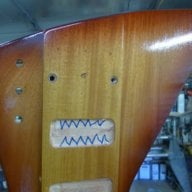
Here is the top with the dowels in place. It's a pity to cover most of this with a pickguard but what shows will look flamey.
IMG_20120129_185155.jpg
 
Also I have had many pm and email requests for templates and I am just not interested in making templates to sell because there are 4 templates (body outline with f holes, body center with cavity routes, neck pocket and pickup pocket and the one for the pickguard) and they take several hours to make and I want to spend the time I have to work on building guitars and basses. Maybe at some point in the future but not now.
 
I also get a steady stream of requests for drawings, templates, leftover necks, etc., from guys wanting to build their own Ampeg replicas. I'm a nice person and I'm generally willing to offer advice and some help to other builders. But, as a rule, I'm not going to sell drawings, templates, or kits. For one thing, I build Scroll Basses for a living, and I have close to 20 years invested in developing the design of my instruments and the process of building them. It's fine with me if you want to build your own Scroll Bass. But I'm not going to give away all my work and make it easy for you, either.

As you can see here in this thread of Blind Dog's project, building a replica Scroll Bass is a complicated project! There are a lot technical issues that have to be sorted out. It's not just a cool looking shape. Even if I sold you a complete set of drawings, it would still be a complicated project requiring a lot of special fixtures and techniques. If you want to take on a project like this, you need to start from the beginning, think it out carefully, and do all the homework. Like what Blind Dog has done here.

This thread is a great example of what it takes, and why so few builders (or companies) build basses like this. It's a lot of work, both in the R & D and in production of the actual instrument. Even with all of my tooling and special machines, I put between 100 and 120 hours into each of my high-end Scroll Basses. That's 2 to 3 times as much labor as goes into most high-end limited production basses. Even a simpler design Scroll Bass, like the original Ampegs, will be 50-70 hours each in production. I haven't been able to uncover Ampeg's labor hour numbers, but I'll bet they lost money on every one they sold! They couldn't possibly compete with Fender on price.
 
  • Like
Reactions: pc
Thanks Bruce, I have always admired your work and research on scroll basses. I enjoyed looking at all the pictures on your website. As you noted it is not like building a Fender inspired bass. Even the templates are more complicated. I am trying to stay as close to the original as i can although there may be some differences in how I build mine.

Thanks,
Mike Simpson
 
Thanks, Mike!

By the way, Ampeg did build a few AEB-1's and AUB-1's with necks made from one piece of flame maple. I have one of them, AUB-1 #173, here in my shop now for restoration. It's in almost basket case condition, needing structural work and complete strip and refinish. For some unknown reason, it appears that Ampeg had painted the whole back of the neck red, covering up the flame figuring??? I'm hoping that I get enough of it cleaned out that I can refinish the back of the neck in the traditional clear/amber.

The neck on #173 is one piece, including the headstock. I've only seen one other Ampeg like that. Most have a single slab-sawn maple piece for the shank of the neck, extending out in a fork, forming the upper half of the pegbox sides. Then the headstock block glues onto the underside of the fork, extending back to the shaped heel under the nut. Some of the headstock blocks were cut from a single block of maple with horizontal grain; others are a block for the lower half and a smaller block glued on for the upper half of the head. Regardless of the construction, they are notorious for delaminating, cracking, and even splitting apart! On almost every Ampeg that comes in here, I have to structurally rebuild the headstock. I usually separate the blocks, refit them, reglue them, and usually reinforce the joints with carbon fiber thread.

This is one of those big issues with building Scroll Bass type headstocks. The combination of thin side walls on the peghead, the loading from the tuners, and the large block of wood that forms the head, all are begging for problems with cracking. When the wood starts to move around, something is going to let go.

In my early days building my new Scroll Basses, I built my necks pretty much like Ampeg did; a slab sawn neck with the fork, and a one piece headstock maple block. As hard as I tried, I had cracking problems. I think it is was #007 whose headstock developed a huge crack, right after I had finished painting it! Aaaaargh!. I tried laminated headstock blocks with horizontal seams, but they looked bad under the paint. And sometimes cracked. I finally went to laminating the headstock from two side-by-side blocks, which are cut from the same board, dried for a year, and match cut to be nearly bookmatched in grain. That seems to have stopped the cracking.

Around 2005, I also switched to a 3-piece laminate for the shank of the neck. I use a narrow vertical grain (quarter-sawn) strip in the center. The strips on either side are cut so the grain is at opposing 45 degree angles, with the V going up. All three strips are likewise cut from the same board, dried for 1-3 years, and match cut in a router fixture to get them completely flat in their natural state. It's all about aligning the wood so that, when it moves, it moves equally and balances itself. It's a lot of extra work, but that's how you eliminate twisting and cracking. On a neck like this which requires so much labor, I don't want to risk having problems later. Since my first 20 Scroll Basses, I haven't had any problems with necks twisting or cracking.

By the way, I use West Systems epoxy for all of the structural joints in my necks.

Myself, I won't build Scroll Bass necks out of flame maple. I have too much experience building flame maple guitar necks for clients, with expensive necks that twist and bow. To me, the beauty isn't worth the risk on a neck as touchy as a Scroll Bass. I have recently been working with cooked flame and bird's eye maple on some guitar necks, and it's much more stable. I might someday try cooked flame maple for one of my necks.

You'll probably be okay with the flame maple on your two necks, because you've wisely chosen the two-piece side-to-side lamination. The break you've taken from the project is probably to your benefit, in letting the boards settle more. Recheck the fit and recut the mating surfaces if needed. Make sure that you're not forcing them together with the clamps. They need to be flat by themselves. Take the extra care in the early steps.
 
Those numbers for the labor hours aren't wild guesses. I keep very accurate logs of all the labor hours I put in on each instrument. As a business, it's really important to do that. I have the whole build process broken down into about 110 discrete steps (depends on the model and features) and I log the time for each step, for each instrument. I do it all on Excel spreadsheets on a shop computer that I use like a timeclock.

To give you an idea where the time goes, here are the major groups for a typical Scroll Bass:
Building the neck, up to ready for paint: 29:05 hours
Building the body, up to ready for paint: 14:15 hours
Building the pickups & wiring harness: 8:05 hours
Building the metal hardware: 13:15 hours
Painting the body: 17:35 hours
Painting the neck: 13:30 hours
Final assembly & testing: 5:00 hours
 
Those numbers for the labor hours aren't wild guesses. I keep very accurate logs of all the labor hours I put in on each instrument. As a business, it's really important to do that. I have the whole build process broken down into about 110 discrete steps (depends on the model and features) and I log the time for each step, for each instrument. I do it all on Excel spreadsheets on a shop computer that I use like a timeclock.

To give you an idea where the time goes, here are the major groups for a typical Scroll Bass:
Building the neck, up to ready for paint: 29:05 hours
Building the body, up to ready for paint: 14:15 hours
Building the pickups & wiring harness: 8:05 hours
Building the metal hardware: 13:15 hours
Painting the body: 17:35 hours
Painting the neck: 13:30 hours
Final assembly & testing: 5:00 hours

Thanks for the breakdown. Assuming you work 40 hours a week (I know I don't) that's 3 weeks for a 120 hour bass. Is this correct?
 
I will have more time in mine because I am figuring out every step as I go. I have spent enough time making templates to have built a guitar. I built a body out of plywood and pine just to figure out how the original pickup system worked. I still have the machine work on the bridge and tailpiece to work out.

 
Thanks for the breakdown. Assuming you work 40 hours a week (I know I don't) that's 3 weeks for a 120 hour bass. Is this correct?

Yeah, I wish! In reality, 1.) there are lots of steps in the process that require drying times, 2.) I'm always building several Scroll Basses at a time, 3.) I'm building other model basses too, and 4.) I do other business, such as subcontract work for other luthiers and companies. The quickest I've ever built a Scroll Bass, from start to finish, is about 5 months. Most of them have been about a year. The one I just completed, #074, was almost exactly a year from the time I started cutting wood on it.

I wish I could concentrate on nothing but building Scroll Basses and turn out one per month steadily. Even that would just barely pay the rent and overhead. Trying to make a living building basses is very, very tough! I've been at it for about 20 years, and I'm still just barely scraping by.
 
I will have more time in mine because I am figuring out every step as I go. I have spent enough time making templates to have built a guitar. I built a body out of plywood and pine just to figure out how the original pickup system worked. I still have the machine work on the bridge and tailpiece to work out.


Oh, absolutely. I easily put in 500 hours before my first two Scroll Bass prototypes were completed in 1996. When I made a major upgrade to my Series IV models in 2005, I put in several hundred more hours in R & D and new fixtures and tooling. That included a bench mule instrument for working out the pickup system, building a pickup winding machine (and learning how to use it!), rebuilding my fingerboard radiusing machine to do a 4" radius, etc., etc. When you break away from using the common geometries and hardware, there's a huge amount of extra work involved.