• TalkBass has been independent since 1998. Add your voice.
    Create a free account to reply to discussions, view embedded media, and browse with fewer display ads.
    Join freeLog in
    Want zero display ads or expanded classifieds tools? Compare plans.

Double Bass So, I disregarded all advice...

...And got a really cheap bass. I've inquired with the local music stores for renting opportunities, but I didn't like the basses I tried, plus one dealer tried to blame on my technique a problem that the bass had (A string would buzz and give weird harmonics when played open. If it was my technique, all the strings would have done the same).
I'm planning on investing on new strings, a better tailgut, probably an adjustable bridge and maybe a wire/composite tailpiece.
I'm no luthier but I did do some tech work on electrics, so I'd like to take this as a learning opportunity. If I can't solve the issues on my own, I'll invest in a luthier.

Meanwhile I want to improve this bass as much as I can, and I need your advice!
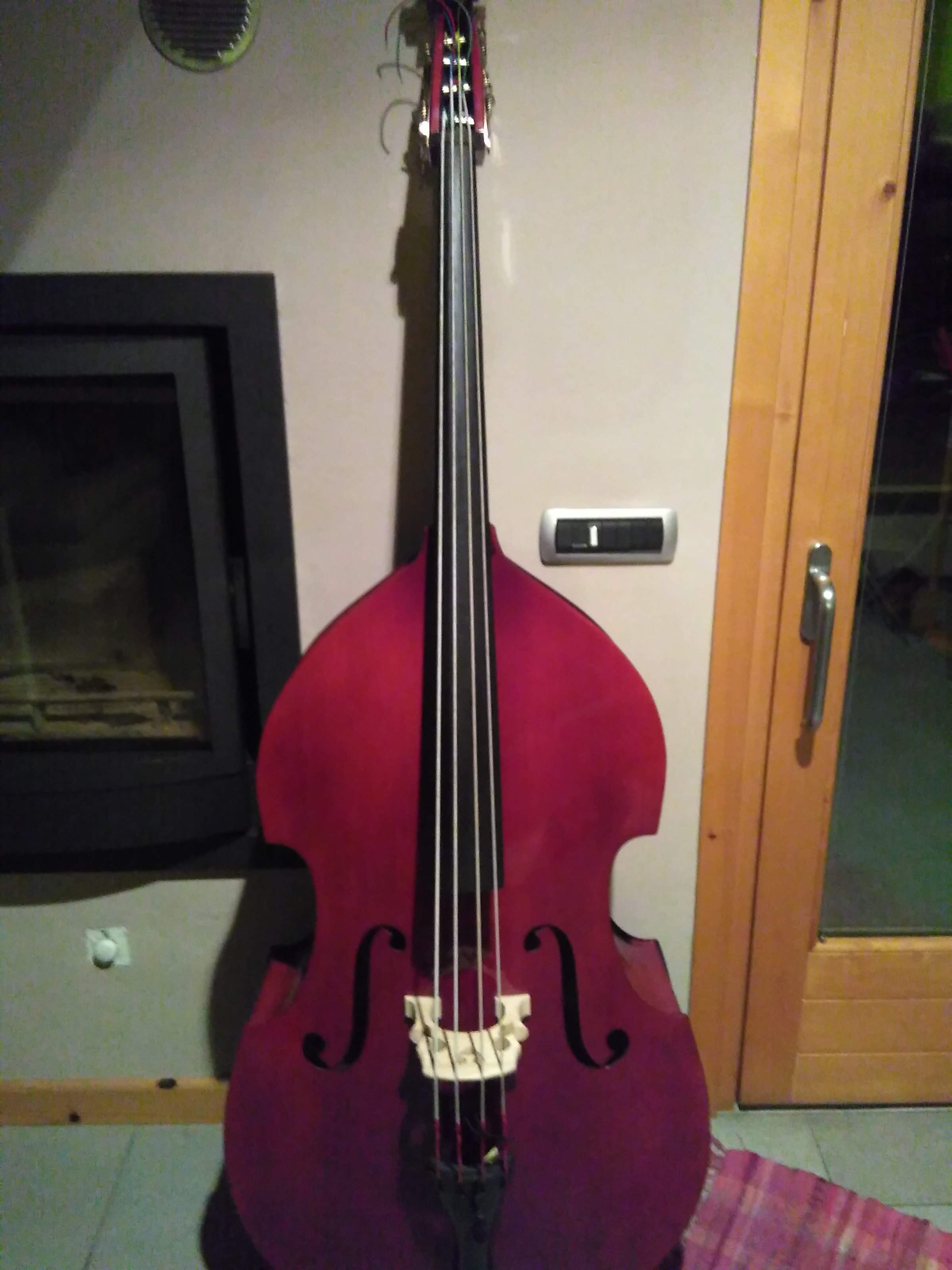


IMG_20150714_222957.jpg

Brand is Johan Bruck, 3/4; I paid 400€ for it, used, and I have to say that it plays better than the ones I've tried in the store. I've thoroughly checked it for cracks, loose joints etc. before buying. Previous owner played it for maybe an year, then put it in its soft case and laid on its back on a bed for a couple years. When I picked it up, it had almost detuned to D standard overtime.

It has nylon strings on since the guy played rockabilly, slap etc. They are quite dirty; I'd use alcohol to clean them while I wait to decide which strings to buy, but I'm not sure it's a good idea what do you think?
I'm looking for a good pizz tone, sustain, the ability to use some arco and a lot of volume. I don't think I'll slap.
I've listened to the samples a French bassist uploaded to his site, and Thomastik Spirocores sounded really, really good to me. They are also very, very expensive so I'm thinking of buying used, is that a good idea? If not, are they worth the extra price compared to medium priced strings (most I see are around 100€)? Should I avoid cheaper strings (60-70€)? Are there any good alternatives?


It does have a couple of issues: let me first point out that I'm only playing pizz for now (haven't bought a bow yet; I also tried some slap but I don't like the tone compared to an eletric)

First, the E string is dead compared to the others. Played open it's not so noticeable, but playing a G on it completely lacks bottom. However I don't believe it's a construction issue, as for instance an A played on the open string sounds much better than an A played on the E string.
If I slap it, it's not so evident. If I use a lot more force on that string it's better but not good enough in my opinion.
I noticed that the E string groove on the bridge is a bit too deep (deeper than half the string, and it's also too wide), so I think that might be the problem. I'm thinking of "filling it" with some wood glue&sawdust, is that a good idea? Or could it just be that the string is dead and needs replacing? Or maybe it's just a technique issue on my part?


When playing amplified I also get a lot of feedback and muddy tone; previous owner said I need to plug the f-holes somehow, and he demonstrated the effect by pushing a couple of pillows on them. He used to plug them with foam and tape, but removed them before showing me the bass, and I'm looking for a better solution - one that can be plugged/unplugged at will and that does no cosmetic damage (there are still traces from the tape glue). Is there anything on the market, or am I better off just making something myself?
I don't like the amplified tone particularly though; it seems the piezos could be installed better by using better-fitting wood pieces in order to increase contact surface, since right now they are kept in place by these wedge like scraps:
IMG_20150714_223143.jpg

I also noticed that the contact zone between the bridge and the top is not perfect, since the material under the bridge does not cover the whole patch, could this be a problem too?
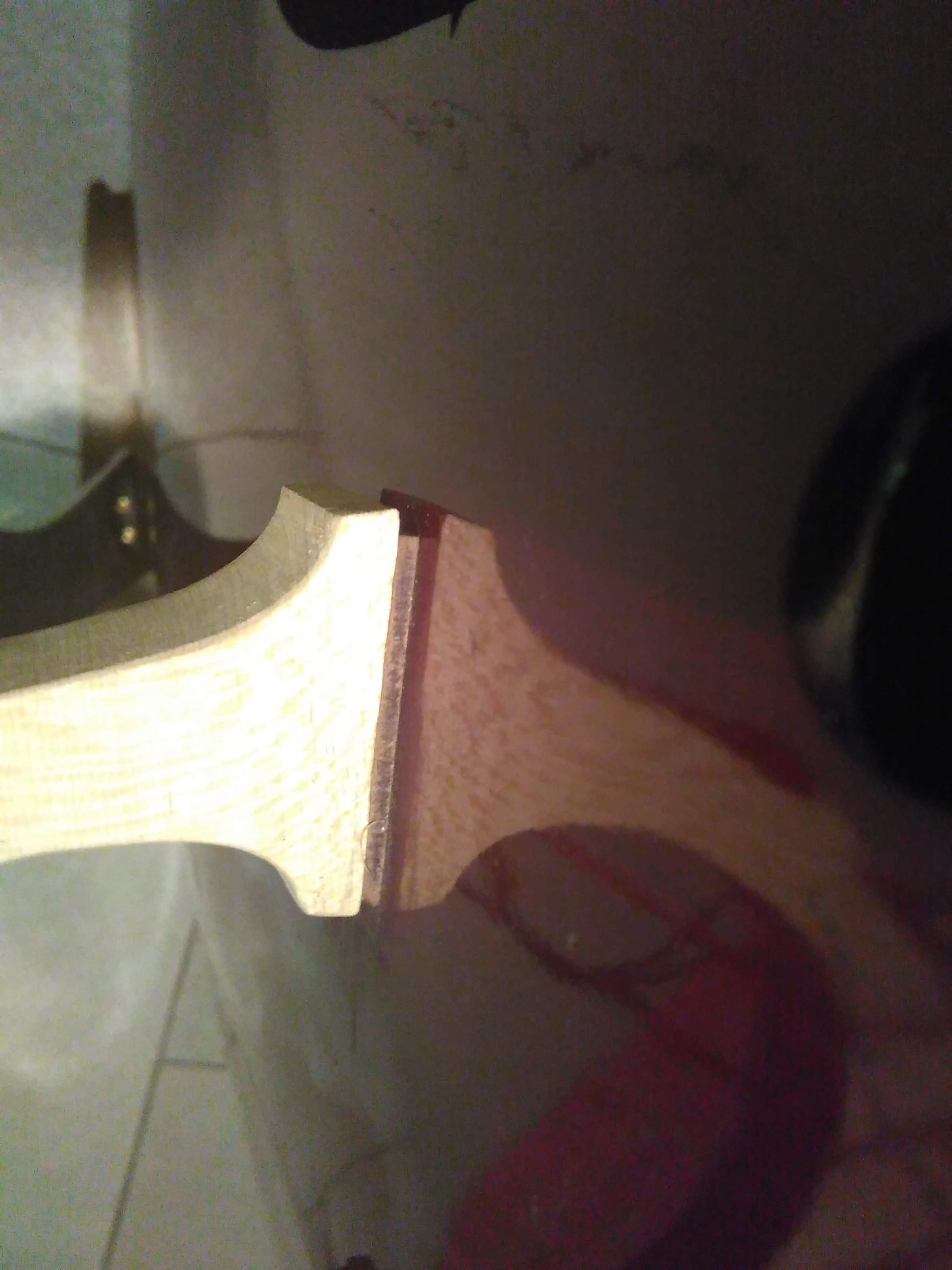
IMG_20150714_223205.jpg


I'd also like to replace the tailgut (which seems to be some kind of rubber cable) with a better one; I've read people have had good results with "aircraft" stranded cable, but I've also read that a more flexible material could be better for me since I want it to be as easy playing as possible. So I'm debating whether nylon cable would be a better fit.
Also, to replace it I'll need to loosen all the strings of course - which means that the soundpost could fall? Is there a way to secure it or I need to just buy the adjusting tool?


What do you think?
Thank you for any advice you might give me!
 
Last edited:

Everything in your pictures shows that it was put together as it was shipped. Those wood pieces stuck into the bridge are not supposed to be there. There should be no shims under the bridge feet. This shows that the bass was never set up at all and is not in playing condition. You will end up spending more than the bass is worth to get it into playing conditions and likely it's a bass that won't last long and is a poor investment.

This is what we ward people away from all the time. I'd return it and get your money back, while you still can. Dead serious.

Run, don't walk.
 
Last edited:
Everything in your pictures shows that it was put together as it was shipped. Those wood pieces stuck into the bridge are not supposed to be there. There should be no shims under the bridge feet. This shows that the bass was never set up at all and is not in playing condition. You will end up spending more than the bass is worth to get it into playing conditions and likely it's a bass that won't last long and is a poor investment.

I'd return it and get your money back, while you still can. Dead serious.

Run, don't walk.

I'd like to have a luthier look it over before doing something so drastic...
I don't have great plans for this bass, I just want to use it for some acoustic gigs and for learning. It's not perfect but I can play it half-decently and enjoy it... Why isn't that "playing condition"? Why do you think it won't last long?
I cannot afford to spend on a better bass, since I'd still want to have it setup by a luthier with new strings (so the extra cost would still be there). And renting is not an option, so basically I have no other way to play a DB.

The wood pieces stuck on the bridge were put there by the previous owner in order to install the piezos; as for the shims, I have no idea why they're there, but if I removed them I don't understand what the problem would be.
Aside from this, what else seems wrong from the pictures? Is there anything else I should check? Are the other issues I listed actually indicative of an issue with the bass's construction? I mean, if it's just a bridge slot I can take care of it...
 
  • Like
Reactions: s2bs2
Everything in your pictures shows that it was put together as it was shipped. Those wood pieces stuck into the bridge are not supposed to be there. There should be no shims under the bridge feet. This shows that the bass was never set up at all and is not in playing condition. You will end up spending more than the bass is worth to get it into playing conditions and likely it's a bass that won't last long and is a poor investment.

This is what we ward people away from all the time. I'd return it and get your money back, while you still can. Dead serious.

Run, don't walk.
There's a saying: "a boat is a wood-lined hole in the water into which the owner pours money". This bass is a boat.

Here's a list of what this bass most likely needs:
New strings
Fingerboard dressing
Bridge properly fitted, if possible w/ existing bridge, otherwise, new bridge
New tailpiece wire

Don't know about Italy, but in the states, that's about $1500-2000 worth of work on a bass that's essentially firewood. Save up some money, do some research, find someone who knows something about double basses and ask questions.
 
Last edited:
  • Like
Reactions: Ross Kratter
There's a saying: "a boat is a wood-lined hole in the water into which the owner pours money". This bass is a boat.

Here's a list of what this bass most likely needs:
New strings
Fingerboard dressing
Bridge properly fitted, if possible w/ existing bridge, otherwise, new bridge
New tailpiece wire

Don't know about Italy, but in the states, that's about $1500-2000 worth of work on a bass that's essentially firewood. Save up some money, do some research, find someone who knows something about double basses and ask questions.

A new bridge is 50€. Tailpiece wire is less than 10€.
I don't know how much fitting the bridge or dressing the fingerboard would cost, but I'm told a setup usually costs around 100€, which includes setting the bridge...
 
A setup with fingerboard dressing, fitting the bridge and nut, new tailpiece cable and adjusting the soundpost can easily cost 400 Euro. So together with a set of long lasting strings it would be more than 550€.
Do you have a bag and a bow yet?

Ask a luthier if the bass would be worth the money you have paid and have to put in now to have something useable. If not try to give it back.

The problem with DIY is, that you need to know a lot more about a double bass than you do now and if you have got the knowledge you might refuse to get such an instrument because of the time you need for setup and the uncertainty how long that cheap thing will last.

Some distributors of cheap basses include a setup, but the time they take for it might not lead to avoid fit and if you cannot get it from there and have some spare time there, you need to live with what you got.
 
  • Like
Reactions: mat666
dont be too hard on the OP. it's really hard not to be tempted to just scarf something up sometimes.

I'd say it was either never set up or was done by a total noob. Might be that it needed the bridge raised cause of extra high overstand. You'll probably need a whole new bridge - best to get one with adjusters. This one's going nowhere.

If you are going to try and play on it you will need to spend more than the cost of a low end, but decent Kay. Good luck either way.
 
Congratulations on the bass.

I suggest before you stress with all these upgrades and stuff just play the thing, and see what sounds you can get.

You could get years of learning out of this bass. You're over thinking the whole process.
There is that old saying that Ray Brown sounds like Ray Brown no matter what bass he plays.
 
Last edited:
  • Like
Reactions: mat666 and Lo-E
I am going to see a luthier ASAP and will report back.
Meanwhile, I'd very much like to find some reading (besides the info I already found on Gollihur, AES and general googling) about setups. I'd really, really like to do most of the work myself, and not only to save a buck but also to learn. Unless the luthier says it's firewood, in which case I'd try to return it or sell it to some other poor soul, I'd say I'm prepared to put in the time and effort to improve it myself - and I'm also prepared to face the consequences for sloppy work on my part. Besides I can try some stuff without risk - like fitting the bridge, since I plan on buying an adjustable one anyway.


I'd also like to ask posters to try and answer the practical questions I ask in the open post - can I clean nylon strings with alcohol? Do I need to stuff the F-holes in order to have a decent, not feedbacking amplified sound? What tailgut material should I use if I want more flexibility and left hand ease? Should I avoid cheaper strings? etc.
That's the kind of advice I'm looking to get - arguing about whether I wasted my money or not for 10 pages won't benefit anyone, dig it?


A setup with fingerboard dressing, fitting the bridge and nut, new tailpiece cable and adjusting the soundpost can easily cost 400 Euro. So together with a set of long lasting strings it would be more than 550€.
Do you have a bag and a bow yet?

Ask a luthier if the bass would be worth the money you have paid and have to put in now to have something useable. If not try to give it back.

The problem with DIY is, that you need to know a lot more about a double bass than you do now and if you have got the knowledge you might refuse to get such an instrument because of the time you need for setup and the uncertainty how long that cheap thing will last.

Some distributors of cheap basses include a setup, but the time they take for it might not lead to avoid fit and if you cannot get it from there and have some spare time there, you need to live with what you got.

Yep, I got the bag with the bass. As for the bow, it's not a priority and I can borrow a friend's cello bow - not ideal, but should do (?).
The nut seems fine, but if it's anything like an electric's one I can do that myself. I can maybe skip the fingerboard dressing, or try that myself too (I have a couple of cheapo fretless electrics which I can practice on first).
Even setting the soundpost doesn't sound like rocket science, and if I take the proper precautions I should be able to get there via trial&error without damaging the bass. As I said I'm no luthier but I did do some woodwork, I know how to be careful and I always make sure to get all the info I can BEFORE actually trying to do something.

Why won't it last?

Whats your cheap bass horror story? | TalkBass.com
Palentino | Page 6 | TalkBass.com

The funny thing is that you disregarded the collective community's advice. So the next step is to come here and ask what you should do next to make it better? :rolleyes:

I definitely did not disregard it lightly, since I did my best to find one available for rent in the area.

dont be too hard on the OP. it's really hard not to be tempted to just scarf something up sometimes.

I'd say it was either never set up or was done by a total noob. Might be that it needed the bridge raised cause of extra high overstand. You'll probably need a whole new bridge - best to get one with adjusters. This one's going nowhere.

If you are going to try and play on it you will need to spend more than the cost of a low end, but decent Kay. Good luck either way.

Well, I can try and play it right now. The sound and playability aren't perfect, but it works. Unfortunately Kays are nowhere to be found in italy. An adjustable bridge was already on my mind. Strings aren't very low, by the way - I measured around 0.9 cm (average from all the strings, though they are close) from the top of the string to the fingerboard, so I can't imagine why those "washers" were put in.
 
Last edited:
Congratulations on the bass.

I suggest before you stress with all these upgrades and stuff just play the thing, and see what sounds you can get.

You could get years of learning out of this bass. You're over thinking the whole process.
There is that old saying that Ray Brown sounds like Ray Brown no matter what bass he plays.

That said if your going to spend money it should roughly be in this order:
Setup (bridge, finger board)
Strings, ask the luthier what they recommend and just stick with it. Strings are a black hole what sounds good on one bass doesn't mean it will sound good on yours and the only way to find out is to buy them (used is fine)
all the other crap: tailgut, pick up, bag .... (btw i think your pickup in the wrong place i think it's a fishman bp-100)

In my experience there is little you can do about a weak E string. yeah raising it will help and a better string maybe sound post when the bridge gets fitted??? might get it all sorted???
It's why it's always good to start with a boomey E string. But like you said you were not working with a lot of choice to begin with.

Thank you. I know what you mean about overthinking. But the E string is a real issue. When playing it open it's fine, but when I "fret" it completely loses any punch, body and sustain it's supposed to have. Are you sure it's not a setup issue? I mean, the bridge groove IS too deep and too wide.
The pickup doesn't have any markings and the old owner didn't recall the brand, so I suppose it's just a cheapo no-name chinese pickup.
IMG_20150715_041339.jpg
 
Dressing an upright fingerboard is far different than dressing a fretless bass guitar's fingerboard. This bass needs a complete setup, and should be done by a professional who is proficient in upright basses. Half the issues you have with the sound of this instrument will be resolved through a properly set bridge, a dressed board, good strings, and the other half with the appropriate professional-grade gear, such as a good piezo pickup, preamp and perhaps an HPF to more effectively mitigate those tone and feedback issues.

You went cheap on the bass. No big deal. Don't skimp on the setup, though, or you'll never know what that bass could truly sound like, or play like, which might very well be a passable club gigger.
 
I suggest before you stress with all these upgrades and stuff just play the thing, and see what sounds you can get.
I agree completely. Let your luthier tell you if it's worth keeping, but if it is, don't bother upgrading anything yet. Let the luthier tell you what it needs to be playable - that's all.
It'll need new strings for certain - which may be the problem with your E string - but it may not need anything else to be something you can make some music with until you can afford something better.

Yes, the bridge should be perfectly fit to the top, but if it's not.... what happens? The bass doesn't sound as good. It might cause the top to become slightly misshapen. It might cause the bridge to be less stable.
It's a plywood bass. A cheap plywood bass. How much damage will an unfit bridge do, really? Probably not too much.

Whatever the tailpiece and tail gut are made of, leave them alone. Do they keep the strings on the bass? Good. They're doing their job.

Could your fingerboard need some dressing? Yes, it probably could. If it's playable, leave it alone. Don't fix what isn't broken on an inexpensive instrument. If it needs it, your luthier will tell you. Explain that you want to invest as little as possible and that the sole purpose of the bass is to get some experience playing a DB. If he's an honest guy, he won't push any work on you that isn't necessary.

None of these things are the end of the world. On a good bass, these are real causes for concern. On a beater, who cares? Get it playing okay and have some fun with it. As long as you have realistic expectations (and it sounds like you do) you'll be fine.

....and welcome to the dark side.
 
I have been through something similar a few years ago, but I bought a bass that I knew was unplayable. Total investment over about a 5 year period was around $450 AUD (I know, it was cheap). That was the cost of the bass, cheap chinese strings, a new fingerboard and a new adjustable bridge (all cheap).

I had intended doing all the work myself and making it into a playable instrument. I know that given time and the collective knowledge of the internet I would have been able to do it.

At the 5 year mark I sold the lot for around $400. My time just wasn't available. My right wrist was also not up to playing anything fingerstyle - so my interested in having and upright bass was greatly diminished.

The person I sold it to did a lot of work on it and ended up with a good playable bass. I am very pleased for them.
 
You're in so far over your head, and you don't even know it. In no particular order:

Many, if not most basses, have an acoustically weak E string. It's the nature of the beast, and you learn to compensate with good technique. But if your bass is crap, you'll never get a solid note out of it.

Your bass clearly doesn't work, or you wouldn't be here complaining about it. Garbage in, garbage out.

You're in no position to improve the bass you bought. Setting the soundpost isn't rocket science? Fitting the bridge isn't a risky job? Sucka, are you kidding me? Why do you think we pay luthiers the prices they ask for their hard-earned expertise?

Clean nylon strings with alcohol? Why not go hard and clean them with acetone? Good Lord.

Same goes for stuffing the ff-holes with foam to play it loud before you have any idea how to play. Just, no.

You have serious professional players and luthiers responding to your post, trying to help you make the best of the bad situation you admit you got yourself into by ignoring the conventional wisdom, and you're arguing with them. Because you clearly know better, having bought a piece of crap that sounds and plays like poop, but you have all these ideas about how to polish your turd.

If you're not going to listen, why are you wasting all of our time?
 
(sorry for the long post but there will be answers for you within this..)

haha. just read through this and yes this is hilarious as there was another guy who was trying to do something like this.. Here is the real low-down.

You will never be able to tell yourself without experience if that bass is good or not.. unless it just blows you away with feeling and sound from the moment you play it..

so here is most likely what's really going to happen:

- It boils down to when you play the open strings and then up and down the neck in all the most playable positions, does it work and sound good..

- in this case, you say no it doesn't, like the E-string problem. ofcourse this sounds like its strings and a bridge problem and could even be where the sound post is located..

1. So After you take your bass to the luthier who has the experience to tell you if you need a new bridge (you definitely do) and possibly a finger board planing and god knows what else he may throw at you.

Once you can get an idea of what the luthier wants to fix, you can decide but here is what I would personally do in your situation:

of course depending on what the luthier tells you..
-only do a new bridge.. and or nut work if it needs it.. have him check where the sound post is ..

show him the dead G-note on the E-string..

Do not do the fingerboard planing if you are ok with playing it for now and just practicing with it. Unless he offers to do it cheap and you don't want to do it later.. Look down from the scroll to the bridge and look at how straight and curved everything looks..
(picture below)

2. Unless the luthier thinks the tailpiece is going to break then don't change it.. for a cheap practice bass why would you change the tail piece?? really?

3. Do not waste tons of money for new spirocore strings unless you are serious and have the money! i mean its that simple.. what is your budget and willing to spend..

the priorities in order of importance are:

1. BRIDGE/SOUNDPOST

2. Nut/Fingerboard


3. Tuning pegs tight and make no buzz and twist without screeching? cause that means they might be bent/turning bent..

4. Strings/tailpiece ...


These are the kind of things you have to bring a friend who knows double basses with you if YOU yourself doesn't know about them.. I am sooo guilty of this with electric bass as I bought so many electric basses and always the wrong ones that I always was never happy with soon after using them on gigs.. and I kept doing it.. buying and buying the basses that always had problems and I hated the sound of.. some try to tell me it was technique.. and then I saw the TRUTH.. I went to a high end boutique bass store and tried the "real" deal "expensive" basses.. the Truth was it wasn't my technique.. it was the pickups,body-wood and amps I used!

now some of the high-end basses I still wasn't impressed with by the way!

so the point of all this is if you are hell-bent on keeping the bass just Start with the luthier and what he thinks you need to replace/fix..

and remember the only really serious thing is the bridge/soundpost... don't do those yourself.. you will fail. and probably implode your bass if you don't set the soundpost correctly and the strings are on full tension.. think about that!

** Edit - Oh and yes, everything has to work correctly and not inhibit the string.. like the tuning pegs can mess with the string.. if the string is twisted when you tune it up -check for that too by tuning down the string loose and reinstalling it.. but keeping the string still on .. make sure it's not twisted..

and take off that stupid shim.. ask the owner why its there and there should be nothing between the bridge feet and the bass.. you will probably need a new bridge.

-when you take it off, only loosen 2 strings and keep the weight on the other 2 strings so your soundpost doesn't fall.
good.JPG
 
Last edited: