Thanks for your interest. I've been building resonator basses since 2000. I was looking for an alternative to the standard acoustic bass guitar,which I find to be an oxymoron,because they can't really be useful unless they have electronics & are plugged in.
I started out making them quite deep(up to 5 1/4"!) in an effort to increase the volume,I find that the resonator adds more midrange to the instrument, thus allowing it to "cut through" when being played with other acoustic instruments. Unfortunately, the deeper bodies seem to lose bass frequencies(it is my belief that the soundwaves cancel each other out between those bouncing off the back and those coming off the cone in the deeper bodies).
I did have success in building an acoustic resonator bass using the standard "Dobro' thickness(3 1/4"). The best wood combination turned out to be solid mahogany back & sides with a spruce top and a 3pc. mah/walnut/mah. neck with a brazillian rosewood fingerboard. The body did use a soundwell and I found that the neck angle was crucial in the acoustic output of the bass.
After building a customer a thin body resonator guitar(1 7/8" thick). I was really impressed with the volume of the instrument acoustically, he actually mic'd it in the studio,not plugging it in at all. It stood out in the mix really well.
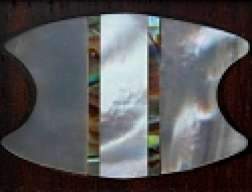
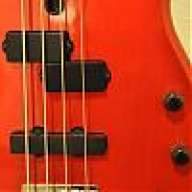
That is what gave me the idea to build a thin body reso. bass. It has contiuously evolved over the years and while I think that the solid wood long scale model has the best acoustic tone, the Resolectro model, which is a short scale instrument with a body that consists of high grade pine/swamp ash frame and masonite for the top and back really nails that old school 60's hollowbody bass tone when plugged in and still has quite a bit of volume when played acoustically. The thin body models do not use a soundwell.
As for the amount of time involved in building these; I have worked very hard designing these to be built as production instruments, utilizing templates along with pin routers, which allows me to build a high quality instrument, while keeping labor cost to as much of a minimum as possible. At this time, If I were to concentrate on solely building these instruments(I currently do a large volume of repairs, as well as my production), I could build six instruments a month. I do operate a one man operation.
Once again, I thank everybody for their interest. I am now building a baritone(Tic-Tac) version of the Resolectro as well as a semi hollow bass version minus the resonator. I will have photos of these instruments as they are completed.
God Bless. Moonshine.