• TalkBass has been independent since 1998. Add your voice.
    Create a free account to reply to discussions, view embedded media, and browse with fewer display ads.
    Join freeLog in
    Want zero display ads or expanded classifieds tools? Compare plans.

Sonic Nuance Electronics unveils third generation tuner DI combination pedal

TalkBass

News Poster
Mar 12, 2004
1,626
3,442
Fremont, California, April 2020: The new TDI (tuner DI) pedal provides a compact tuning and active DI solution for musicians who want to reduce stage clutter without reduction in sound quality. Unlike other DIs with tuners, the TDI can be powered via XLR via 48V phantom power to eliminate the need for an ac adapter or batteries even when the ground is lifted (it also may be powered by an ac adapter).


Features

  • Third generation design is 30% smaller, lighter, more durable, quieter and lower priced!
  • Costly high quality, wide dynamic range, low noise and low distortion opamp-based buffers for transparency
  • EMRS (electro- magnetic relay soft) switching technology for the ultimate in reliability (relay rated at over 10 million cycles) and sound quality
  • 1/4" output is buffered and transformer isolated from the XLR output which has a ground lift to prevent hum and buzz
  • Tuning mode mutes the 1/4” and XLR outputs quietly
  • Bright LED display
  • Proprietary tuning algorithm with range : B0 (20Hz) – B7 (660)
  • High input impedance of 2M ohms can be driven directly by everything from low output single coils to the loudest hum buckers and even active and high impedance piezo pickups.
  • 48V phantom or 9-18V dc powered (ac adapter not included)
  • Signed personally, built and tested in small batches by Ted for quality - never mass produced for quantity
  • Powder coated cast aluminum enclosure with precise CNC cuts for durability and consistency
  • Three year warranty
Ted Burmas of Sonic Nuance Electronics designed the TDI and says the following, " In 2012 I started Sonic Nuance Electronics after playing on worship teams for years and wondering why I couldn't combine my DI with a tuner and make it XLR powered. I wanted the only things I needed to bring to gigs were my instrument, a cable and the TDI. I took everything I learned from the previous generations of the TDI as well as customer feedback and realized I had to start from scratch to be able to make the TDI smaller, lower cost and have higher reliability (after several faulty foot switches over the last eight years, I am no longer a fan of true bypass and have designed a circuit that uses electromagnetic relays specifically designed for small signals typical of musical instruments instead. This new approach is called "EMRS" switching and stands for electro magnetic relay soft switching. It is more costly to manufacture but has proven superior in terms of reliability, consistency and sound quality). I improved my proprietary tuning algorithm to make it respond even smoother and faster. The active signal path have the widest dynamic range possible by designing a new power supply circuit for XLR operation making sure it works when ground is lifted as well as allowing for dc powering from 9V to 18V. I and others have beta tested this design over the last year on worship teams and recording sessions using five string bass, upright bass, acoustic and electric guitars making small improvements along the way. I went through several prototypes to dial things in and now I am very excited to reveal this final design I think others will benefit from."


Availability & Pricing

TDI is available now for $209 direct at sonicnuance.com
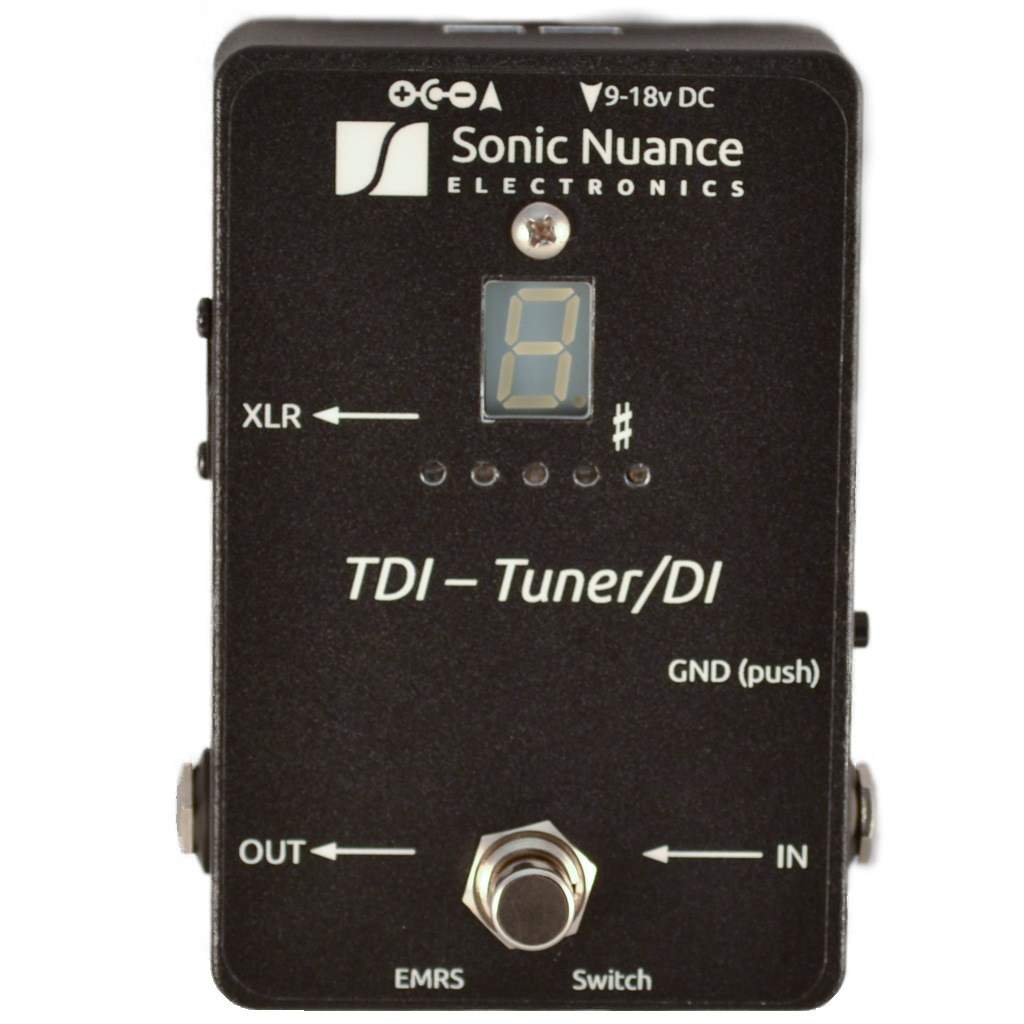
TDIFrontIsolated.jpg
 
I am very intrigued by the concept. I also play many sizes of live worship venues, and over the years have settled usually on my Lakland DJ5 and either the Tone Hammer or the LR Baggs Stadium DI with a (these days) Peterson StroboStompHD tuner. I’ve grown to like simple, especially with great sound from phantom power. Two questions...previous versions appear to have Jensen transformers, but this one is different...how does it compare? How would you characterize the sound? The YouTube demo is ok, but tough to grasp the tone, though prior version reviews rave about the great tone. Thoughts?
 
  • Like
Reactions: GentProvocateur
I am very intrigued by the concept. I also play many sizes of live worship venues, and over the years have settled usually on my Lakland DJ5 and either the Tone Hammer or the LR Baggs Stadium DI with a (these days) Peterson StroboStompHD tuner. I’ve grown to like simple, especially with great sound from phantom power. Two questions...previous versions appear to have Jensen transformers, but this one is different...how does it compare? How would you characterize the sound? The YouTube demo is ok, but tough to grasp the tone, though prior version reviews rave about the great tone. Thoughts?
Thanks for the feedback on the website. I'll try to offer more audio snippets in the future.

I do offer the current generation TDI with a Jensen transformer as a custom order but it increases the price by about $80. The reason I went away from the transformer design in the current generation is a) I came up with a different phantom powering scheme that allowed the output to be electronically balanced and thereby reduce the cost b) I was able to use high grade op amps which keep the signal as clean as possible c) since it is active the output isn't 20dB attenuated like it would be with the transformer and d) the input impedance is very high and can be driven by piezo pickups directly.

As far as sound I did my best to make the pedal as transparent as possible by making the supply headroom greater than 10V (when phantom powered) and able to be powered by up to 18V when using a dc adaptor. This keeps distortion due to high dynamic range inputs as low as possible. Also, I use high slew rate op amps which respond quickly to fast input signals so they don't experience slew rate limiting. Finally, the op amps are low noise... All this to say I tried very hard to make sure the active TDI didn't have a "sound". Compared with the Jensen equipped version, since I buffer the signal before the transformer anyway, the difference in sound (other than 20dB attenuation) is minimal. A quality transformer in a DI matters most when it is a passive architecture. Since I buffer the signal going to the transformer in the new TDI (if a custom Jensen equipped one is ordered), it acts like an active instrument driving a passive transformer.
Compared to the previous generation TDI which was passive only, I'd say this generation has a bit more high frequency range. The sonic difference is small if not imperceptible and mostly is swamped by the passive versions 20dB attenuation.

I happen to love Jensen transformers but many customers wanted a lower cost option. Since I felt sonically I could offer the same if not better performance I decided to design the TDI as an active only architecture. If anyone wants the Jensen equipped version I don't argue - but so far everyone who has tried the new design hasn't wanted to change.

You are welcome to try the TDI out. If you don't like it you can send it back within 10 days for your money back (minus shipping (about $8)). I sign each one I build to emphasize that I personally care about the quality of each one. I don't stock the Jensen transformers but I can get them in about 2-3 days.

Thanks for the great questions!
Ted
 
Last edited:
Thanks for the detailed reply. I’m excited to try it. My only other question...how has your feedback been from FOH folks in comparison to the many commonly used DIs on bass out there?
Actually some of my most enthusiastic customers are FOH engineers - they usually "get it" fastest when I explain the concept. Not only do they love not having to worry about batteries, patch cables or power supplies, they love the transparent sound. This has been true with the previous generations as well as the current one. If you need to talk to some some FOH engineers just PM me and I'll find you one or two.
 
Kinda wish it had a separate volume knob for the OUT. That way I can send a steady signal to FOH and control the volume being sent to an onstage amp, powered monitor, BackBeat or whatever without affecting what FOH is getting.
 
Kinda wish it had a separate volume knob for the OUT. That way I can send a steady signal to FOH and control the volume being sent to an onstage amp, powered monitor, BackBeat or whatever without affecting what FOH is getting.
Good idea. Someday I might offer a more "preamp" version with eq. But the circuit board currently has no room left :)