Hope people find this useful (if perhaps a little long 
----------------
Upright bass players face a common dilemma for amplifying live performances – either put the cabinet on the ground and get better low end response at the sacrifice of hearing the upper registers, or place the cabinet on something to point the speaker at the player’s ears so they can hear the higher frequencies, and lose some of the low end.
Recently, I met a bass player who tried to convince me that I didn’t have to choose between the two. I could have a bass cabinet that both put out great low end and let me hear the entire spectrum of my tone, from double digits to the tens of thousands hertz. The cabinet he was talking about is the Sonusphere.
After searching for a great amplified sound for over twenty years, I was pretty skeptical. My Acoustic Image Coda combo is a great sounding amp. It puts out a very neutral tone and moves quite a bit of air. I love the way it surrounds both me and the musicians on stage in a “bass bubble” of fat tone. Still, I’ve never been completely satisfied with the sound of the Coda. I get great low end, but I don’t get much in the high frequencies.
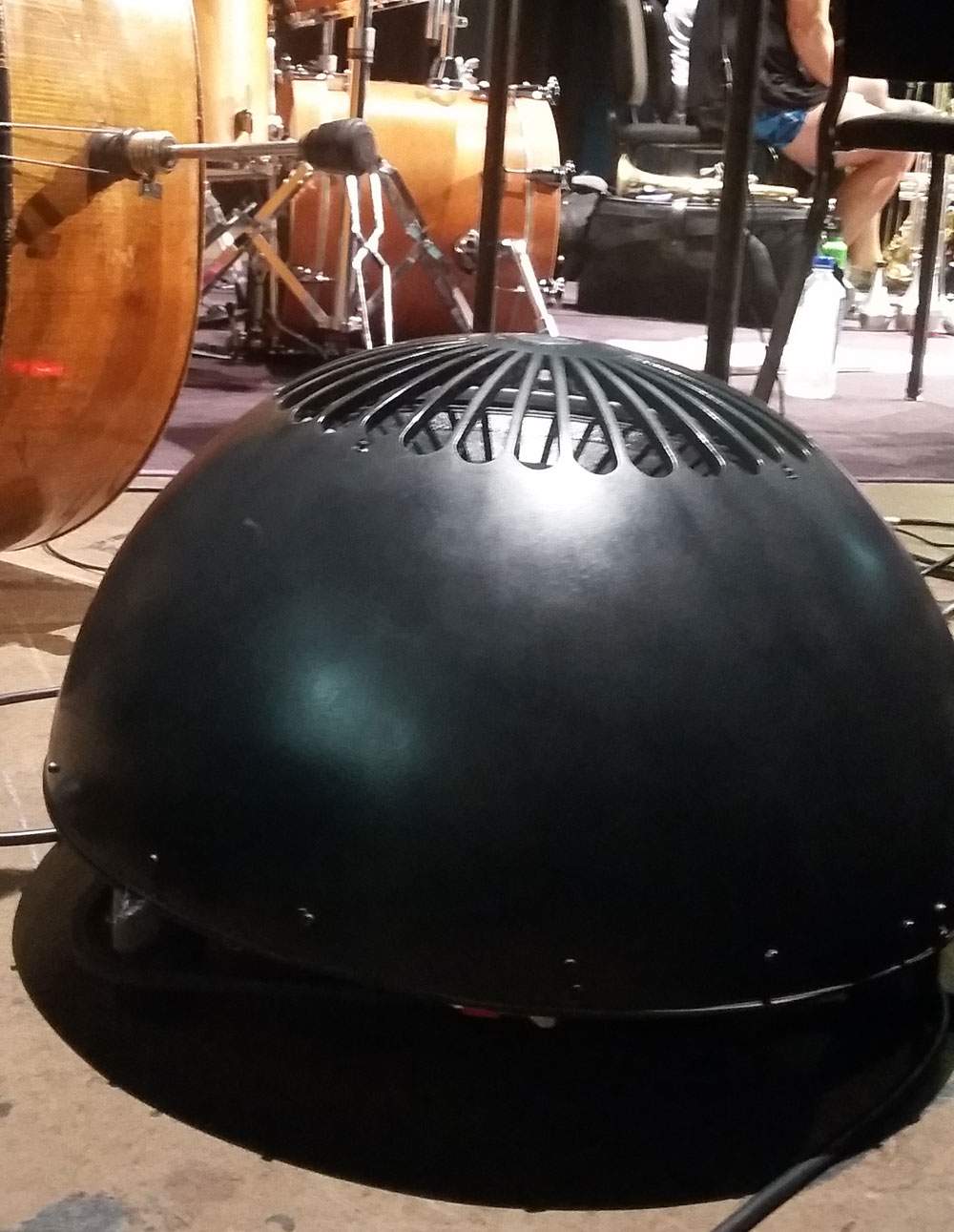
Enter the Sonusphere. Like the AI cabinet, it has a down-firing woofer to produce that big low end. Unlike the AI, the Sonusphere has a large speaker pointed straight up to give your ears (and your bandmates) access to all those spectrums above 100hz. The speaker is round and lets the top speaker project in all directions. The bottom speaker is merely a passive resonator responsible for the range under 100hz. Does it work? And then some! My recent experience on two very different gigs confirmed how great this cabinet is for upright bass.
The first gig was a run of three shows at an 825-seat theater where I played music from opera to jazz to arranged rock standards. To start, I pretty much require that I can carry my bass and my rig in one trip. Weighing in at around 15 pounds, I could easily carry the Sonusphere, my upright and my overstuffed gig bag, and throw an electric bass on my shoulder as well!
Positioning the cabinet on stage is very flexible. For these kinds of productions, I usually put the cabinet it in front of my bass on my left closer to the front line players and the drummer. With my long cable, I’ve even been able to put it under the grand piano when the soundman didn’t have enough channels to run me through the monitors. Wherever I put it, it sounds great: big and full on the low end and nice string detail. The winds and the brass appreciated that they could hear me really well, and I didn’t have to compromise on being able to hear myself. If it’s not loud enough, I can easily reposition the cabinet a little closer to me.
For this gig, I was running an AMT mic attached to my bass and a Realist Lifeline through my AI head, which has two channels. I took this great little head out of my Contra. Just because I replaced my cabinet doesn’t mean I don’t love AI products anymore! Since there was a lot of arco work on this show, I really wanted to use the mic to bring out the rich tones of my old French bass. It’s also really nice on pizz as well to bring more clarity to the front of the house.
Bottom line, this cabinet/amp setup is great for shows where you don’t need to push a whole ton of volume and the quality of your sound is most important to you and your fellow bandmates. Great, great tone it is.
The second gig was the polar opposite. My friend is a band director, and he needed some players to fill out his thin big band for a combined music/dance showcase. The venue was a large dance theater at the local university. The band was made up of students supplemented by local professionals. The stage was a huge mess spread wide across the dance floor. Horns on my left from 5 to 25 feet away, drummer right next to me, and grand piano about 20 feet on my right. Singers about 15 feet in front. No monitors whatsoever. Pretty much no rehearsal either. My job on this gig was to maintain time and hold together the two sides of the stages that couldn’t hear each other.
Loading into this huge stage/dance performance space, I wondered if I should have brought a larger rig. I do have half stack for outdoor shows and electric bass, but it would have been much more work to haul up the stairs of the building. No problem. I’m not sure if some of my huge sound had to do with the floor construction, but the Sonusphere produced a massive low end that projected all over the stage. I didn’t bring a mic to this show, only the Lifeline, but it was just what we all needed: a big, warm, clearly definable pitch to anchor the band.
After the gig, I also reveled in the fact that I could walk out the 3rd floor fire escape and carry my whole rig to my car in one trip. How very convenient. In case you can’t tell, I’m quite enamored with the Sonusphere. The low end is great, and the detail in the mid and upper ranges is fantastic. I feel so much more confident of my pitch because I can hear so much more of my range. I used to think that my rig did a great job of reproducing the sound of my bass and nothing more. When I first played through the Sonusphere, I thought it might have been coloring the sound of my bass because I’d never heard so much detail in the mid and upper registers. Then I played my bass toward a wall, and the sound bouncing back at me had all of those colors as well. I realized that I’d been shortchanging my ears of all those frequencies for years.
On top of all that, with a perfectly round shape that gives no hint to its function, the cabinet looks like a cool piece of 60s modern art that would be perfectly at home in a James Bond flick from that era. Thank you Sonusphere for your great cabinet. The quest is over!
----------------
Upright bass players face a common dilemma for amplifying live performances – either put the cabinet on the ground and get better low end response at the sacrifice of hearing the upper registers, or place the cabinet on something to point the speaker at the player’s ears so they can hear the higher frequencies, and lose some of the low end.
Recently, I met a bass player who tried to convince me that I didn’t have to choose between the two. I could have a bass cabinet that both put out great low end and let me hear the entire spectrum of my tone, from double digits to the tens of thousands hertz. The cabinet he was talking about is the Sonusphere.
After searching for a great amplified sound for over twenty years, I was pretty skeptical. My Acoustic Image Coda combo is a great sounding amp. It puts out a very neutral tone and moves quite a bit of air. I love the way it surrounds both me and the musicians on stage in a “bass bubble” of fat tone. Still, I’ve never been completely satisfied with the sound of the Coda. I get great low end, but I don’t get much in the high frequencies.
Enter the Sonusphere. Like the AI cabinet, it has a down-firing woofer to produce that big low end. Unlike the AI, the Sonusphere has a large speaker pointed straight up to give your ears (and your bandmates) access to all those spectrums above 100hz. The speaker is round and lets the top speaker project in all directions. The bottom speaker is merely a passive resonator responsible for the range under 100hz. Does it work? And then some! My recent experience on two very different gigs confirmed how great this cabinet is for upright bass.
The first gig was a run of three shows at an 825-seat theater where I played music from opera to jazz to arranged rock standards. To start, I pretty much require that I can carry my bass and my rig in one trip. Weighing in at around 15 pounds, I could easily carry the Sonusphere, my upright and my overstuffed gig bag, and throw an electric bass on my shoulder as well!
Positioning the cabinet on stage is very flexible. For these kinds of productions, I usually put the cabinet it in front of my bass on my left closer to the front line players and the drummer. With my long cable, I’ve even been able to put it under the grand piano when the soundman didn’t have enough channels to run me through the monitors. Wherever I put it, it sounds great: big and full on the low end and nice string detail. The winds and the brass appreciated that they could hear me really well, and I didn’t have to compromise on being able to hear myself. If it’s not loud enough, I can easily reposition the cabinet a little closer to me.
For this gig, I was running an AMT mic attached to my bass and a Realist Lifeline through my AI head, which has two channels. I took this great little head out of my Contra. Just because I replaced my cabinet doesn’t mean I don’t love AI products anymore! Since there was a lot of arco work on this show, I really wanted to use the mic to bring out the rich tones of my old French bass. It’s also really nice on pizz as well to bring more clarity to the front of the house.
Bottom line, this cabinet/amp setup is great for shows where you don’t need to push a whole ton of volume and the quality of your sound is most important to you and your fellow bandmates. Great, great tone it is.
The second gig was the polar opposite. My friend is a band director, and he needed some players to fill out his thin big band for a combined music/dance showcase. The venue was a large dance theater at the local university. The band was made up of students supplemented by local professionals. The stage was a huge mess spread wide across the dance floor. Horns on my left from 5 to 25 feet away, drummer right next to me, and grand piano about 20 feet on my right. Singers about 15 feet in front. No monitors whatsoever. Pretty much no rehearsal either. My job on this gig was to maintain time and hold together the two sides of the stages that couldn’t hear each other.
Loading into this huge stage/dance performance space, I wondered if I should have brought a larger rig. I do have half stack for outdoor shows and electric bass, but it would have been much more work to haul up the stairs of the building. No problem. I’m not sure if some of my huge sound had to do with the floor construction, but the Sonusphere produced a massive low end that projected all over the stage. I didn’t bring a mic to this show, only the Lifeline, but it was just what we all needed: a big, warm, clearly definable pitch to anchor the band.
After the gig, I also reveled in the fact that I could walk out the 3rd floor fire escape and carry my whole rig to my car in one trip. How very convenient. In case you can’t tell, I’m quite enamored with the Sonusphere. The low end is great, and the detail in the mid and upper ranges is fantastic. I feel so much more confident of my pitch because I can hear so much more of my range. I used to think that my rig did a great job of reproducing the sound of my bass and nothing more. When I first played through the Sonusphere, I thought it might have been coloring the sound of my bass because I’d never heard so much detail in the mid and upper registers. Then I played my bass toward a wall, and the sound bouncing back at me had all of those colors as well. I realized that I’d been shortchanging my ears of all those frequencies for years.
On top of all that, with a perfectly round shape that gives no hint to its function, the cabinet looks like a cool piece of 60s modern art that would be perfectly at home in a James Bond flick from that era. Thank you Sonusphere for your great cabinet. The quest is over!