Enjoy the benefits of a premium membership!
Upgrade Account
-
TalkBass has been independent since 1998. Add your voice.
Create a free account to reply to discussions, view embedded media, and browse with fewer display ads.
Join free Log in
Want zero display ads or expanded classifieds tools? Compare plans.
You are using an out of date browser. It may not display this or other websites correctly.
You should upgrade or use an alternative browser.
You should upgrade or use an alternative browser.
soundproofing - is it possible?
- Thread starter hgregs
- Start date
More options
Who Replied?
Another thing to keep in mind is that low frequencies are the hardest to isolate: kicks, bass guitar, etc. So when "testing" the effectiveness make sure you go through the whole spectrum of noises.

Wow they look nice, but they are really pricey. Cheapest one being $3000 at 4'x4' for a single wall and $4200 for the same size at double wall.
Wow - inflation! I got mine like 4 or 5 years ago and it was much less (even w/ shipping). AND I had to mod it. They had the door on the top - I'm usually by myself . . . it would have killed me to lift a 4x12 marshall cab in and outta there!
(Hey, instead of soundproofing that big room...soundproof a closet....
You can giver your rehearsal space a make over but also consider using white noise machines for the kid. They block out lots of noise. We use one all time.
This might be a question with a really obvious question, but I'll ask anyway!
If you're trying to prevent sound getting in a space do the 'best' methods of soundproofing change at all?
If you're trying to prevent sound getting in a space do the 'best' methods of soundproofing change at all?

Yes. I don't make much noise, but it's annoying to record using a microphone that picks up everything (dogs barking etc)
- May 25, 2010
- 18
- 0
- Disclosures
- Disclosure: I represent various soundproofing designs and materials

We did this at my drummer's house for our rehearsal space. He spent at least $5,000 and we put in a lot of time and effort beforehand in research to plan for everything we'd need. There is a lot of attention to detail to get this right. Get it wrong and you end up spending a lot of money and it won't be effective at quieting the sound.
Our result:
Inside the studio with drums, guitar, bass and vocals = 110 dB.
In the rest of the house = low audibility, like someone is playing a radio very quietly.
Outside the house = barely audible.
Out by the street or at the property line of the neighbors (30 feet away) = not audible at all.
Some problems:
Since he didn't have the funds to re-do all the ductwork to make it sound proof we simply bypassed it and installed a single A/C unit in the wall and soundproofed that. And since the studio is a very well insulated room within a room it gets very hot in there very quickly with bass, guitar and vocal amps running. The A/C is needed (even in the winter) while we're practicing. For this same reason, forget about using traditional incandescent light bulbs. They heat up the room as much as the amps. We use low wattage CF bulbs, but LED bulbs would be even better, although they're pricey.
Another problem is we lost a lot of usable room space - at least a foot of space on all four walls and ceiling. The ceiling was only 8' to start with and now that it's less than 7' the guitarist and I are constantly hitting our headstocks on it when we are putting on/taking off our instruments.
I think it's been well worth the expense and effort (although it wasn't my money being spent ) and it really makes rehearsals a lot better when we can play at any time of the day or night and not have to worry about neighbors complaining or making the house temporarily uninhabitable in other rooms.
But let me repeat - don't do this unless you know what you are doing ahead of time. Pay your dues and take the time to research and learn what the proper methods are and plan ahead in every detail. Once you've made the plans, run them by someone who is experienced at doing this and have them okay it (or make changes and suggestions).
Our result:
Inside the studio with drums, guitar, bass and vocals = 110 dB.
In the rest of the house = low audibility, like someone is playing a radio very quietly.
Outside the house = barely audible.
Out by the street or at the property line of the neighbors (30 feet away) = not audible at all.
Some problems:
Since he didn't have the funds to re-do all the ductwork to make it sound proof we simply bypassed it and installed a single A/C unit in the wall and soundproofed that. And since the studio is a very well insulated room within a room it gets very hot in there very quickly with bass, guitar and vocal amps running. The A/C is needed (even in the winter) while we're practicing. For this same reason, forget about using traditional incandescent light bulbs. They heat up the room as much as the amps. We use low wattage CF bulbs, but LED bulbs would be even better, although they're pricey.
Another problem is we lost a lot of usable room space - at least a foot of space on all four walls and ceiling. The ceiling was only 8' to start with and now that it's less than 7' the guitarist and I are constantly hitting our headstocks on it when we are putting on/taking off our instruments.
I think it's been well worth the expense and effort (although it wasn't my money being spent
) and it really makes rehearsals a lot better when we can play at any time of the day or night and not have to worry about neighbors complaining or making the house temporarily uninhabitable in other rooms.But let me repeat - don't do this unless you know what you are doing ahead of time. Pay your dues and take the time to research and learn what the proper methods are and plan ahead in every detail. Once you've made the plans, run them by someone who is experienced at doing this and have them okay it (or make changes and suggestions).
We did this at my drummer's house for our rehearsal space. He spent at least $5,000 and we put in a lot of time and effort beforehand in research to plan for everything we'd need. There is a lot of attention to detail to get this right. Get it wrong and you end up spending a lot of money and it won't be effective at quieting the sound.
Our result:
Inside the studio with drums, guitar, bass and vocals = 110 dB.
In the rest of the house = low audibility, like someone is playing a radio very quietly.
Outside the house = barely audible.
Out by the street or at the property line of the neighbors (30 feet away) = not audible at all.
Some problems:
Since he didn't have the funds to re-do all the ductwork to make it sound proof we simply bypassed it and installed a single A/C unit in the wall and soundproofed that. And since the studio is a very well insulated room within a room it gets very hot in there very quickly with bass, guitar and vocal amps running. The A/C is needed (even in the winter) while we're practicing. For this same reason, forget about using traditional incandescent light bulbs. They heat up the room as much as the amps. We use low wattage CF bulbs, but LED bulbs would be even better, although they're pricey.
Another problem is we lost a lot of usable room space - at least a foot of space on all four walls and ceiling. The ceiling was only 8' to start with and now that it's less than 7' the guitarist and I are constantly hitting our headstocks on it when we are putting on/taking off our instruments.
I think it's been well worth the expense and effort (although it wasn't my money being spent
But let me repeat - don't do this unless you know what you are doing ahead of time. Pay your dues and take the time to research and learn what the proper methods are and plan ahead in every detail. Once you've made the plans, run them by someone who is experienced at doing this and have them okay it (or make changes and suggestions).
Any pics of the construction available? Any links to the information resources used for research? Any details of what materials/construction techniques actually used available?
It'd be great if those were available?
- May 25, 2010
- 18
- 0
- Disclosures
- Disclosure: I represent various soundproofing designs and materials

This seems more like a pitch than a response to the thread.
How does acoustic fencing address the OP's (8-year old zombie) question: "is budget soundproofing practical for a rehearsal space underneath a baby's room"? Acoustic fencing isn't a budget product, it doesn't soundproof, and it isn't designed for interior applications.
BTW, you should disclose your commercial affiliation, especially if that affiliation is related to the acoustic fencing you're recommending here.
Just saying.
How does acoustic fencing address the OP's (8-year old zombie) question: "is budget soundproofing practical for a rehearsal space underneath a baby's room"? Acoustic fencing isn't a budget product, it doesn't soundproof, and it isn't designed for interior applications.
BTW, you should disclose your commercial affiliation, especially if that affiliation is related to the acoustic fencing you're recommending here.
Just saying.
Last edited:

Lets see the measurements
Since this is a bass forum ... Even a perfect fence will not help the lows and you'll still have to turn down the lows. The highway noise fence data has this well documented
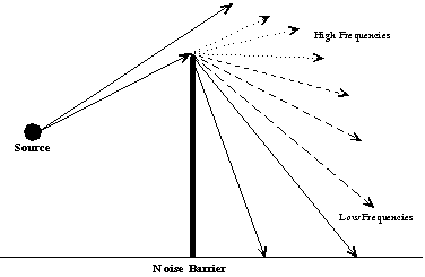
There has been some backfire that man people complain they can hear the big trucks more when a fence is erected.
There is also rarefaction that happens as moving air over the fence is less dense. People often mention they hear sound carried on the wind, but it's the sound bending back to ground from rarefaction.
Since this is a bass forum ... Even a perfect fence will not help the lows and you'll still have to turn down the lows. The highway noise fence data has this well documented
There has been some backfire that man people complain they can hear the big trucks more when a fence is erected.
There is also rarefaction that happens as moving air over the fence is less dense. People often mention they hear sound carried on the wind, but it's the sound bending back to ground from rarefaction.
Original poster's problem (May, 2008):
A full decade later, rheowasserman resurrects the thread to plug acoustic fencing (for which he borrows the misleading marketing term "sound proof"—which this stuff ain't):
Because the OP, whose baby is now ten years old, needs acoustic fencing inside, between his house's first and second floors? The zombie-resurrecting response is so off-point that it's no response at all. It's so off-point that I'm assuming it has to be commercial spam. (Unless rheowasserman has just been drunk-posting, in which case my apologies for imputing ill intent. Who among us has not been there?)
And the sound treatment advice is so terrible that if I were in the market for acoustic fencing for festival use, I'd really hesitate to engage this particular TBer for the order, even though I like to support TB's commercial users.
so i've got space in my house where my band rehearses. it's on the ground floor, just below my bedroom and the nursery. it's nice sized (roughly 20x20).
meanwhile, i have a 1.5yr old, and within the next week or so, a newborn. my days of rehearsing in the house are over unless i can effectively soundproof. i have been reading about it for over a year (room within a room stuff).
A full decade later, rheowasserman resurrects the thread to plug acoustic fencing (for which he borrows the misleading marketing term "sound proof"—which this stuff ain't):
Yes, you can try Invalid Link Removed .These are highly portable and easy to set up, they lend themselves to events that run over several days, with different requirements and venue layouts from one day to the next. Flexibility is so valuable.
Because the OP, whose baby is now ten years old, needs acoustic fencing inside, between his house's first and second floors? The zombie-resurrecting response is so off-point that it's no response at all. It's so off-point that I'm assuming it has to be commercial spam. (Unless rheowasserman has just been drunk-posting, in which case my apologies for imputing ill intent.
Who among us has not been there?)And the sound treatment advice is so terrible that if I were in the market for acoustic fencing for festival use, I'd really hesitate to engage this particular TBer for the order, even though I like to support TB's commercial users.
Last edited: