• TalkBass has been independent since 1998. Add your voice.
    Create a free account to reply to discussions, view embedded media, and browse with fewer display ads.
    Join freeLog in
    Want zero display ads or expanded classifieds tools? Compare plans.

Speaker size 10" vs 12"

if everything is "it depends", is there really no "rule of thumb"?
No. For example, I have 15" drivers here that run the gamut from very low extension, suitable for a home HT sub, to some that are midranges. The enclosure size, efficiency, bandwidth (top and bottom) vary markedly between all of them. The only thing they have in common is a nominal frame size.

I could say the same for the 12 and 18" drivers here too.

Someone mentioned Hoffman's Iron Law earlier which basically says, LF extension, enclosure size and efficiency are related and you'll only get 2 of 3 because of the way the parameters relate and interact. Acme cabs have a deeper LF response than many other cabs, but are noticeable less efficient for example, so you pay your money and take your choice.
 
So coming at it from the opposite direction then, if everything is "it depends", is there really no "rule of thumb"? I mean if the answer is no, then why should anyone even bother about whether a speaker is 10,12, 15 or 18?
Good question. It's because of the COMBINATION of the various performance parameters, not JUST related to low frequency.
 
Does a 12" cover lower fundamentals than a 10"? And will it "move a significant more amount of air" than a 10" given the same amplifier?
Thanks.

Let's make one change (sub 10" for 12" and ask the question again):

Does a 10" cover lower fundamentals than a 10"? And will it "move a significant more amount of air" than a 10" given the same amplifier?

Change the driver or the cab and the answer may be yes. Like with the original question, it depends.

Specifications
Model: Acme Low B-1 Series II
Frequency response: +/-3 dB 41Hz to 22 kHz -6 dB at 31 Hz
Power Handling:175 Watts RMS continuous, 150 Watts sine wave @ 30.87 Hz
Sensitivity: 90 dB 1W/1M
Impedance: Available in 4 or 8 ohms
Dimensions: 15.75″H x 15.75″W x 13.5″D
Weight:31 lbs. / 14.1 Kg

This cab was designed specifically to be able to reproduce the fundamental of the open B string. Response is down -6dB at 31hz. Notice the sensitivity is unusually low for a musical instrument speaker at 90dB 1W/1m.

Compare to:
Model: GR Bass GR 110
Frequency Response: 42hz to 18kHz
Power Handling: 300W RMS (AES standard)
Sensitivity: 98dB
Impedance: 4 or 8 ohms
Dimensions: 15.75"H x 12.2"W x 23.39"D
Weight: 15.6lbs. / 7.1kg

Notice the Acme gives tolerances with the frequency response specs, and GR Bass does not. When this occurs the indicated low frequency limit is frequently the -10dB point, which many consider the limit of "usable frequency response.

So most likely the GR 110 is -10dB at 42hz and the Low-B1 is -6dB at 31hz. They are both 110 designs but significantly different.

Another spec to pay attention to is Sensitivity. The Acme is rated at 90dB 1W/1m. The GR Bass is way higher at 98dB, but its' not clear if this is a 1W/1m spec or 2.83V/1m spec.

Here is what you need to know: If you apply a 2.83V signal to an 8 ohm load, the dissipated power will be 1W. In other words 90dB 2.83V/1m is the same as 90dB 1W/1m at 8 ohms.

If you apply a 2.83V signal to a 4 ohm load, the dissipated power will be 2W. To convert this from to a 1W/1m rating, simply subtract 3dB. In other words 98dB 2.83V/1m at 4 ohms is the same as 95dB 1W/1m.

It's not unusual four a 4 ohm variant of a certain driver to be slightly less efficient than the 8 ohm driver. So perhaps the Acme specs are also somewhat incomplete, because the claimed sensitivity is the same for both impedances.

Either way, the specs say the GR Bass cab is significantly more efficient but the Acme cab plays way lower. If your concern is low frequency output, at some point in the response curve, the Acme will most likely produce significantly more output than the GR Bass cab with available power, despite the Acme's much lower sensitivity rating.

Keep in mind that typically ported cabs cut off at a rate of 24dB per octave, and the woofer starts jumping around like crazy as the frequency drops below the intended pass band. So while the Acme can handle 150W at 31hz, it's very likely the GR Bass will suffer damage from over excursion if you feed it 150W at 31hz.

Acme calculated output at 31hz:

The overall sensitivity is 90dB. Response is down -6dB at 31hz. So let's assume sensitivity at 31hz is 84dB.

With 150W applied:

Calculated SPL = [Log(150) x 10] + 84 = 105.8dB.
My guess is power compression will rob the cab of at least 3-4dB at this frequency, putting the output down around 102 to 104dB.
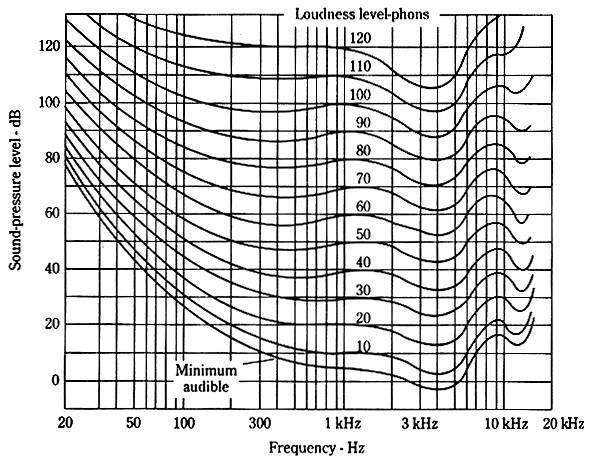
Now take a look at the Fletcher Munson curves.

Fletcher-Munson.gif

A decibel is a measure of actual loudness. The vertical axis of this chart is calibrated to decibels.

A phon is a measure of perceived loudness. The squiggly lines show the decibel level required to produce a certain perceived phon level by frequency. These are labeled to the right of the vertical line that designates 1kHz.

Bottom Line Up Front: For equal perceived loudness, bass must be louder than guitar.

Let's look at the 100 phon line. For 100 phon you need 100dB at 1kHz, but at 50Hz you need about 110dB. At 4kHz you get 100 phon with only 88dB.

So essentially 50hz must be 10dB louder than 1khz for equal perceived loudness:
- 100 phon = 110dB at 50hz and 100 phon at 1kHz.

Also 50hz must be 22dB louder than 4khz for equal perceived loudness:
- 100 phon = 110dB at 50hz and 88dB at 4khz.

Specifically relating to Acme: 31hz must be about 18-19dB louder than 1khz for equal perceived volume. Since the Acme can produce about 106dB at 31 hz, equal volume a 1khz would be 106 - 19 = 87dB. Many musical instrument speakers will make 87dB at 1khz with < 1W applied. My point is 106dB at 31hz, is not very loud in comparison to the 110dB of a rock concert
.
FAA-CNL-V2b-HR_trim.png
 
  • Like
Reactions: 5StringPocket
So coming at it from the opposite direction then, if everything is "it depends", is there really no "rule of thumb"? I mean if the answer is no, then why should anyone even bother about whether a speaker is 10,12, 15 or 18?

The two things that come closest to rules of thumb, are Hoffman's Iron Law, and one related to overall volume, "there's no replacement for displacement."

The Iron Law is a result found by combining the equations that govern low frequency performance of speakers. Displacement is simply the relationship between cone motion and acoustical power generated by the cones.

When I first joined TB, knowledge of speaker theory in the bass world was gradually emerging. I remember reading statements like, "Tens are fast and fifteens are deep, because physics." I began to wonder, "what physics?" This led me down the rabbit hole of trying to understand how speakers work, based on textbook physics principles. The articles and software at my "non-commercial" web page resulted from that study. The rules of thumb can only go so far before you have to break out the math, which is the reason for answers such as "it depends."

Now for another rule of thumb. I build my own speakers, so I'm always faced with the question of what driver to choose. What I've learned is that my bass response and overall volume requirements for a given amplifier power will dictate a particular speaker size, after I've considered high quality drivers that are available off the shelf. The general trend will be that a louder speaker needs to be bigger. I try to get the job done with a single driver rather than multiple smaller drivers, from the standpoint of cost, weight, and complexity.

To a fair extent, the commercial brands must walk a tightrope between satisfying technical and market needs. If there's market demand for speakers such as 4x10 and 8x10, those speakers will be offered or the customer will go elsewhere. Adherence to tradition makes it harder to assess pure technical merit. As a DIY'er, I'm not faced with the same dilemma.

For the record, I have a 1x12 and 1x8, and the 1x8 gets the most use.
 
So coming at it from the opposite direction then, if everything is "it depends", is there really no "rule of thumb"? I mean if the answer is no, then why should anyone even bother about whether a speaker is 10,12, 15 or 18?

Ampeg sells 4 cabs that are 1x15, each one voiced and performs differently.

The GK Neo 1x15 is very mid forward, all the other cabs in the Neo line play deeper.
MarkBass have several 1x15's also different in sound and performance.

The Mesa Subway 15 will be much deeper than the GK Neo 15 as well as deeper and louder than the Fender Rumble 15.

GK 1x15 Neo or CX, Mesa Subway 1x15, Ashdown 1x15, Ampeg 1x15, Orange 1x15, Hartke 1x15, Fender 1x15 Rumble or Pro Neo, Peavey 1x15.

All these 1x15's sound and perform quite different from each other. Only thing they share is the speaker size of 15.

Get the cab that performs to your needs and sound goals.
 
So coming at it from the opposite direction then, if everything is "it depends", is there really no "rule of thumb"? I mean if the answer is no, then why should anyone even bother about whether a speaker is 10,12, 15 or 18?

Because at some point you will (hopefully) need to move some air, at which point cone area will become important. In the end it is easy to get really loud if you don't care too much for the tone or definition...
 

Latest posts