• TalkBass has been independent since 1998. Add your voice.
    Create a free account to reply to discussions, view embedded media, and browse with fewer display ads.
    Join freeLog in
    Want zero display ads or expanded classifieds tools? Compare plans.

Speakers...Why Does The Myth that Size Matters, Still Exist?

The diameter of the cone most definitely tells you how the speaker might sound, 45° deg OFF AXIS.

There are 18 inch drivers with response simmilar to most 12s, say Eminence sigma 18, however once you move past the hot spot directly in front of the cone (where bass player's knees usually are) good chunk of midrange is lost along with all the upper midrange and treble where the articulation and punch lives, so one might perceive large diameter woofer bassier and/or darker with a good reason and physics behind it as the loudspeaker dispersion characteristics are inversely related to the cone diameter.

There is an audiophile cult based around large diameter fullrange drivers, say 12's and even 15's equipped with whizzer cones and phase plugs which do extend north of 15k and they do sound good indeed, the only issue is laser beam dispersion and listening sweetspot that covers only small part of the sofa.
Even this isn’t always true because there are things a designer can do to alter the purely predicted polar dispersion. These include the curvature of the cone, the shape V1 and material of the dust cap, and the dust cap’s attachment position relative to the top of the cone neck to bobbin bonding point.

Rules of thumb almost always have exceptions, and a knowledge designer will exploit this to their advantage.
 
I can't get past that low end cushion that 15" speakers provide. I also have come to recognize and dislike the 'honkiness' of 10" speakers. I've never experienced a 10" based cab, regardless of speaker numbers that can provide the warmth I'm after. YMMV. I also remember reading somewhere that only 15" speakers can reliably get down to the fundamental frequency of that low E.
Just because you haven’t experienced something doesn’t mean that it doesn’t exist, or may in fact be quite common. I know of quite a few 15“ drivers that have poorer low frequency extension than some 10”drivers that I know of.

Beware of drawing incorrect conclusions when reading things that are either wrong (a lot of information out there is simply bad information), or that you may not understand what is being said.
 
I'm not a cultist, but various Tannoy monitors with dual concentric speakers were considered to be the industry standard in the late '70s/early-to-mid '80s and were seen in a lot of European recording studios for a good reason...
Of course they can work perfectly fine in the studio setting, toed in just right to cover your place at the mixing desk.

I love fullrange speakers, especially on the open baffle, I tried my best to avoid crossovers and tweeters in my hifi system but ended up with 3 ways, go figure.
 
I'm not a cultist, but various Tannoy monitors with dual concentric speakers were considered to be the industry standard in the late '70s/early-to-mid '80s and were seen in a lot of European recording studios for a good reason...
Edit: those Tannoy dual concentrics were co-axial speakers, basically a 2 ways with the tweeter firing through the voice coil of the midbass driver. I was talking of fullrange single driver solutions, the idea is to avoid crossover.
 
Edit: those Tannoy dual concentrics were co-axial speakers, basically a 2 ways with the tweeter firing through the voice coil of the midbass driver. I was talking of fullrange single driver solutions, the idea is to avoid crossover.
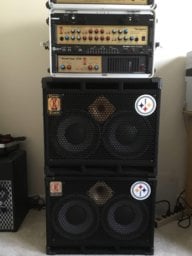
IMG_8117.jpeg
 
I'm not a cultist, but various Tannoy monitors with dual concentric speakers were considered to be the industry standard in the late '70s/early-to-mid '80s and were seen in a lot of European recording studios for a good reason...
I owned a pair of Tannoy studio monitors back in that timeframe and they were spectacular speakers IMO.
 
There have been many sound/tone topics covered over the years regarding speaker cabs. One of the most popular myths debunked is that bigger speakers produce more low end than smaller speakers (obviously removing anecdotal evidence).

At one time, back in the early years of speaker design, that may have been the case. But cab and speaker design has come a long way and we now know that cabinet design has a lot to do with how speakers of various sizes can perform. Again, removing anecdotal evidence to the contrary, just about any size speaker can produce deep low end in the right cab.

Why does the myth that size matters, still exist? I'm not saying size doesn't matter at all. Not every speaker is designed the same way another similarly sized speaker is. It obviously depends on the speaker(s) being used, along with the cabs they are loaded in. If one wants a smaller, lighter cab then smaller speakers can fit smaller, lighter enclosures. But even a single 15" cab can be smaller than 210's, etc.

But I still read a lot of posts where people still prefer one size over another, claiming that their favorite speakers are (insert size here) without any context of the speaker/cab design affecting their choice.

I know it can be hard to let go of the old paradigm, but in a blind test no one can discern what size speaker sounds good to them, based on size alone. We know that the phenomenon of psychoacoustics can make a very tiny headphone speaker appear to sound deeper than a 15" speaker, for one example.

So as a point of discussion (no arguments please, just polite discussion), why do you think the myth that size matters, still exist?
More so than the size thing that often comes up, what doesn’t come up often enough is speakers and cabinets are designed to work as a single unit for a specific result. Personally, In have no bias on speaker size, I do have a bias against loaded cabs that are inefficient and don’t sound that great.
 
Would everybody just shut up and tell me where to find a -30lb 1x10 that can faithfully reproduce a low B fundamental, carry the room and handle 500-600 real world watts?! I know that size doesn't matter and that major manufacturing companies DEFINITELY aren't trying to just pimp their own products so there must be a simple and inexpensive solution.
 
  • Haha
Reactions: ajkula66
Would everybody just shut up and tell me where to find a -30lb 1x10 that can faithfully reproduce a low B fundamental, carry the room and handle 500-600 real world watts?! I know that size doesn't matter and that major manufacturing companies DEFINITELY aren't trying to just pimp their own products so there must be a simple and inexpensive solution.
Well, there really isn't, not in RMS metrics anyway...
 
Speaker diameter does matter, If we compare apples to apples. That is why the high power subs are built with 18" or 21" drivers while mid/hi drivers are way smaller in 99% cases.

On the other hand regarding most of the bass guitar cabinets sold today (with garden variety of Eminence OEM speakers) the size of the speakers inside is completly irrelevant. It is definitely a try before you buy affair. The deepest, ground shaking bass I have heard from a bass guitar cabinet was Ampeg 410hlf, the muddiest and with an utter lack of any midrange content was again a 10, an Ampeg, 810, probably 90's model, the brightest was a vertical 2x15 loaded with old JBL's.

Never forget that the best speaker at the knee level will always sound considerably worse in most situations and stacking two identical cabs vertically more than doubles the goodnes.
 

Attachments

  • Screenshot_20260325_013913_com.android.chrome_edit_2012171998385668.jpg
    Screenshot_20260325_013913_com.android.chrome_edit_2012171998385668.jpg
    707.2 KB · Views: 11
Speaker diameter does matter, If we compare apples to apples. That is why the high power subs are built with 18" or 21" drivers while mid/hi drivers are way smaller in 99% cases.

On the other hand regarding most of the bass guitar cabinets sold today (with garden variety of Eminence OEM speakers) the size of the speakers inside is completly irrelevant. It is definitely a try before you buy affair. The deepest, ground shaking bass I have heard from a bass guitar cabinet was Ampeg 410hlf, the muddiest and with an utter lack of any midrange content was again a 10, an Ampeg, 810, probably 90's model, the brightest was a vertical 2x15 loaded with old JBL's.

Never forget that the best speaker at the knee level will always sound considerably worse in most situations and stacking two identical cabs vertically more than doubles the goodnes.
Except that there are some very high quality 12" and 15" high power subs on the market at the highest end of the market, so be careful of the generalities because they are true in many but not all cases (or even close in this case).

The loud speaker cookbook is both accurate and inaccurate at the same time because it's highly simplified when it comes to describing polar pattern. That's the most basic equation that is then modified by a bunch of additional factors (that are VERY important to polar pattern).
 
.Never forget that the best speaker at the knee level will always sound considerably worse in most situations and stacking two identical cabs vertically more than doubles the goodnes.
This, in spades. I’ve always been a proponent of a full stack of some sort. It accomplishes a number of things.

First, you get floor coupling. Particularly with guitar, this gives what’s ordinarily a mid-treble sound a little extra ‘thump’.
Second and most importantly, a full stack gets the sound up near head level. Which means you can hear yourself more clearly.
Third, the fact that you can hear yourself allow you to lower the overall volume! The front rows appreciate this lol
Fourth, the floor coupling (allowing you to reduce the bass EQ slightly) and decreased volume give your amp more available headroom. Want that low B to shine? This is the way.

With a 12” combo guitar amp, a lightweight 2x12 extension cab set vertically, with the combo up top, comes close enough to a full stack for the purpose.
 
  • Like
Reactions: rogypop
A few other things come to mind in driver selection. Often the larger the woofer, the lower the harmonic distortion in the bass region, but this is a gross generalization. Typically, the larger the woofer the lower the fs resonant frequency is, but not always. Every cab design is a trade-off of what problems to solve, and what the design goals are. For me, I would not want to install tons of small drivers like the PJB fridge, it's just too much effort. I'd rather make a 3 way cab with an 18, 10 and a hf horn in order to have reasonably good off axis response and a decent power response in room. The room is always a huge factor.
 
An array of 3"s with the same cone area as one 15", ok, maybe even better in some ways (I have an 8x8" that's pretty awesome).
But one 3" (manufactured within the limits of current materials/physics, in a cab idealized for it) being no different from one 15" (manufactured within the limits of current materials/physics, in a cab optimized for it)? No, I don't see why I should believe that.

If you aren't convinced yet, make it a 1" versus a 30". If not convinced yet, I wish you well.

I think this is one of our almost perverse, "Worst of Talkbass" topics.

I don't think so. I think 3" vs 15" exposes the absurdity that's already there, not mine.
No, you simply don't understand the physics involved.
There are plenty of 3" drivers out there that will do 40Hz, F3, same as many 15s (or 10s, 12s, 18s etc) will do. The difference is that a 3" will not be able to give the same SPL at 40Hz as the 15 because the 3" cannot move the same amount of air. SPL is dependent upon the volume of air displaced , so if you were to get enough of these 3" drivers do they had the same Vd as the 15, they would produce the same SPL as the 15.

Not discussing the tonal merits of different driver sizes, cone profiles, breakup behaviour or how they might be configured in an array if used in multiples.
 
I think this topic has become something of a mess, because the discussion is all over the place.

OP stated that "size matters" in speakers is a myth, and in his entire reasoning completely ignores SPL, mainly going on about how smaller drivers can do bass these days.

Furthermore, OP goes on about how some people have a preference of speaker sizes "I prefer 15 inch speakers because XYZ", but the same people would most likely fail a blind test with 15", 12" and 10" speakers.

I guess that is enough juice to get tow separate threads going, and with some fervor, but we got it loaded into one thread.

Now the confusion starts.

It should be obvious that a (mediocre, okay performing, mid priced) single 15" subwoofer will outperform ANY existing single 3" speaker when it comes to providing bass for a room filled with 200 people.
There might be a 3" speaker than can do 35Hz without dropping off - but it will not do that at SPLs needed for 200 people.

That line of discussion gets mixed and cross referenced with the people that use more hands on experience and who claim that you can use any speaker size - and by any, these people actually mean any of the three we have: 10, 12 or 15 - to create the sound you want to have and then just take as many of them as you need for the volume, and 10's can outperform 15's in bass - with well chosen drivers and clever design, you can basically make any of these sound like anything you want it to - and they are strictly utilitarian here, thinking about bass guitar amplification only.

When the hands on people collide with the theoretical physics people, a totally new flavor of discussion is created.