
IMO the whole point is it might be better to evaluate a speaker with your eyes closed. One’s preconceived notions of what a certain sized speaker sounds/feels like, would get in the way. That has nothing to do with SPL. Of course it needs to meet certain performance goals, but that is a given. Nobody in their right mind would use a headphone speaker other than what it was intended for.

Enjoy the benefits of a premium membership!
Upgrade Account
-
TalkBass has been independent since 1998. Add your voice.
Create a free account to reply to discussions, view embedded media, and browse with fewer display ads.
Join free Log in
Want zero display ads or expanded classifieds tools? Compare plans.
You are using an out of date browser. It may not display this or other websites correctly.
You should upgrade or use an alternative browser.
You should upgrade or use an alternative browser.
Speakers...Why Does The Myth that Size Matters, Still Exist?
- Thread starter M-Mittlesteadt
- Start date
More options
Who Replied?
(@crazycloud, you just repeated what I said. = it does matter)
The original poster said it's a myth that "bigger speakers produce more low end than smaller speakers".
No, bigger speakers generally do make "more low end" than smaller speakers.
As I said, look at the Eminence product line. They seem to believe that a bigger tends toward being better for "more low end".
The original poster said it's a myth that "bigger speakers produce more low end than smaller speakers".
No, bigger speakers generally do make "more low end" than smaller speakers.
As I said, look at the Eminence product line. They seem to believe that a bigger tends toward being better for "more low end".


Yes. For example, if they're small enough you might need multiples if it's a cab for bass guitar, because the smaller driver's output of bass is generally less. "That is a given" because we all know this. = size mattersOf course it needs to meet certain performance goals, but that is a given.
Of course.Nobody in their right mind would use a headphone speaker other than what it was intended for.
The main reason why these threads always get tangled is, some people are talking about frequency response, some about SPL, and some both.
It seems to me that saying "size doesn't matter" (if they mean frequency response without regard to power output, which would include ear buds) **in a thread about bass cabs** isn't helpful.

StephenMcLuckie
Commercial User
There is one cab that meets that spec. It's the LFSys Monza 1x10. 600W (AES) bass driver, handles low B with ease, and is five lbs under your weight target. It also delivers a solution to the issue of midrange beaming in small cabinets that @rogypop brought up. Not sure if I'm permitted to include a link, but here goes: Buy Bass Systems at LFSys - 12" Silverstone, Monaco, Monza.Would everybody just shut up and tell me where to find a -30lb 1x10 that can faithfully reproduce a low B fundamental, carry the room and handle 500-600 real world watts?! I know that size doesn't matter and that major manufacturing companies DEFINITELY aren't trying to just pimp their own products so there must be a simple and inexpensive solution.
You‘re still missing the point.Yes. For example, if they're small enough you might need multiples if it's a cab for bass guitar, because the smaller driver's output of bass is generally less. "That is a given" because we all know this. = size matters
Of course.
The main reason why these threads always get tangled is, some people are talking about frequency response, some about SPL, and some both.
It seems to me that saying "size doesn't matter" (if they mean frequency response without regard to power output, which would include ear buds) **in a thread about bass cabs** isn't helpful.

You continue to be willfully obtuse and/or argumentative.Yes. For example, if they're small enough you might need multiples if it's a cab for bass guitar, because the smaller driver's output of bass is generally less. "That is a given" because we all know this. = size matters
Of course.
The main reason why these threads always get tangled is, some people are talking about frequency response, some about SPL, and some both.
It seems to me that saying "size doesn't matter" (if they mean frequency response without regard to power output, which would include ear buds) **in a thread about bass cabs** isn't helpful.

- Feb 12, 2006
- 61,019
- 5
- 220,879
- Disclosures
- Development Engineer-Mesa Boogie, Development Engineer-Genzler (pedals), Product Support-Genz Benz
Agreed, it’s obvious to everyone but him too…You‘re still missing the point.
Sure appears this way with many of his posts these days.You continue to be willfully obtuse and/or argumentative.
I understand everything that has been said by those who say I'm not understanding them.
I think it's not helpful to say "size doesn't matter" in a thread about bass cabs.
Ok, I'll leave it there. Thanks everyone.
I think it's not helpful to say "size doesn't matter" in a thread about bass cabs.
Ok, I'll leave it there. Thanks everyone.

Here's the paradox of speaker myths: If you state the myth precisely enough for it to be meaningful, then it ceases to be a myth. 

Only for SPL, not for low frequency extension. They are different things.(@crazycloud, you just repeated what I said. = it does matter)
Just humor me one last time. Imagine you start a conversation with speaker size doesn’t really matter when trying to reach a max SPL of let’s say 125 db. You are able to reach that with 10s,12s, and 15s. Then somebody comes along and states but an 8x10 weighs more.I understand everything that has been said by those who say I'm not understanding them.
I think it's not helpful to say "size doesn't matter" in a thread about bass cabs.
Ok, I'll leave it there. Thanks everyone.

Al Kraft
Supporting Member
- May 2, 2016
- 10,771
- 40,450
- Disclosures
- Mesa Boogie beta product tester and player support
This is the classic engineering trade study problem. You start with requirements and to the extent possible prioritize them.. Compromises will come later and it's good to know what you value "most to least" when that time comes.Just humor me one last time. Imagine you start a conversation with speaker size doesn’t really matter when trying to reach a max SPL of let’s say 125 db. You are able to reach that with 10s,12s, and 15s. Then somebody comes along and states but an 8x10 weighs more.
The fewer requirements you have to accommodate in the design, the easier it usually it is to hit the mark(s), and especially if size, weight, and cost don't matter. Existing technology speakers (including ones that can be easily and economically modified/custom tailored a bit) in standard sizes are likely are good compromises for most cab designs.
IMO some these drivers will likely be much better choices for certain design goals than others for reasons other than their diameter. Once again IMO, many of the speaker parameters other than simply "nominal geometric diameter" will likely be the key ones to achieving performance in an enclosure (as a system).
As examples of how variable this whole process is, I offer the previous generation GK NEO 115 and its bass/mid frequency response compared to the GK NEO 112...most players would have guessed based on speaker diameter and cab size only that the voicing would have been reversed.. I also recall the Aguilar 112 GS and DB cabs had the same 12" speaker but the cabs (an often overlooked element compared to speakers) were so differently voiced in the design prcess that many players strongly preferred one to another.
I thought this was just a conversation.This is the classic engineering trade study problem. …

Al Kraft
Supporting Member
- May 2, 2016
- 10,771
- 40,450
- Disclosures
- Mesa Boogie beta product tester and player support
I thought I was just conversing!I thought this was just a conversation.

My original post was mostly sarcasm. Thank you for the link, though. I've actually checked those out before and they look very interesting. If there were some state side I'd love to play through one of those.There is one cab that meets that spec. It's the LFSys Monza 1x10. 600W (AES) bass driver, handles low B with ease, and is five lbs under your weight target. It also delivers a solution to the issue of midrange beaming in small cabinets that @rogypop brought up. Not sure if I'm permitted to include a link, but here goes: Buy Bass Systems at LFSys - 12" Silverstone, Monaco, Monza.

There are no generalizations if we compare apples to apples. Take any manufacturer's top of the line subwoofer driver series and the largest ones always win regarding sensitivity and sheer output for what their primary duty is- pushing large amounts of lows.Except that there are some very high quality 12" and 15" high power subs on the market at the highest end of the market, so be careful of the generalities because they are true in many but not all cases (or even close in this case).
The loud speaker cookbook is both accurate and inaccurate at the same time because it's highly simplified when it comes to describing polar pattern. That's the most basic equation that is then modified by a bunch of additional factors (that are VERY important to polar pattern).
I have already said that discussing the diameter of the mistery driver in some off the self bass cabinet which as well could be of questionable design and alignment, as a sole parameter is meaningless.
This post is strictly for fun, and only took me a few minutes, because I knew what to look for. Also, when I see broad statements like "size doesn't matter," I'm less interested in whether it's provably true or false, than in what can be learned from it. And I have my handy theory-bot to help me out.
The Eminence 3012HO is a respectable bass speaker. I decided to look for a smaller driver capable of producing a curve with the same shape, albeit at lower sensitivity, at low frequencies. That's the basic claim. I found a 4" driver in the Parts Express catalog for 16 bucks. Let's see how I did:
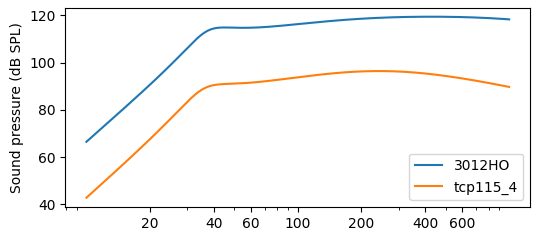
Not bad, up to about 400 Hz. Above that frequency, differences in coil inductance take over. Both are modeled in ported boxes.
I chose power levels for each graph that caused the excursion plots to hit Xmax: 100 and 15 Watts. Even without that measure, the difference in overall sensitivity is still profound. But I think my comparison is fair because Class-D power is cheap these days and you might as well use it.
Anyway I think this illustrates what "same bass response curve, different overall sensitivity" means. Now, it's interesting what limitations I ran into:
1. This can't be done with any old 4" driver. The one I chose has a huge rubber surround. I had to find a driver with roughly the same Fs and Qts specs. Those get harder to find for smaller drivers.
2. Sensitivity per Watt isn't the only thing. Total power handling adds to the difference between the big and small drivers in actual use.
3. This says nothing about high frequency behavior, beaming, etc.
The Eminence 3012HO is a respectable bass speaker. I decided to look for a smaller driver capable of producing a curve with the same shape, albeit at lower sensitivity, at low frequencies. That's the basic claim. I found a 4" driver in the Parts Express catalog for 16 bucks. Let's see how I did:
Not bad, up to about 400 Hz. Above that frequency, differences in coil inductance take over. Both are modeled in ported boxes.
I chose power levels for each graph that caused the excursion plots to hit Xmax: 100 and 15 Watts. Even without that measure, the difference in overall sensitivity is still profound. But I think my comparison is fair because Class-D power is cheap these days and you might as well use it.
Anyway I think this illustrates what "same bass response curve, different overall sensitivity" means. Now, it's interesting what limitations I ran into:
1. This can't be done with any old 4" driver. The one I chose has a huge rubber surround. I had to find a driver with roughly the same Fs and Qts specs. Those get harder to find for smaller drivers.
2. Sensitivity per Watt isn't the only thing. Total power handling adds to the difference between the big and small drivers in actual use.
3. This says nothing about high frequency behavior, beaming, etc.
Al Kraft
Supporting Member
- May 2, 2016
- 10,771
- 40,450
- Disclosures
- Mesa Boogie beta product tester and player support
Nice points, well articulated...and posts with pictures or graphs or always more fun to read!This post is strictly for fun, and only took me a few minutes, because I knew what to look for. Also, when I see broad statements like "size doesn't matter," I'm less interested in whether it's provably true or false, than in what can be learned from it. And I have my handy theory-bot to help me out.
The Eminence 3012HO is a respectable bass speaker. I decided to look for a smaller driver capable of producing a curve with the same shape, albeit at lower sensitivity, at low frequencies. That's the basic claim. I found a 4" driver in the Parts Express catalog for 16 bucks. Let's see how I did:
View attachment 7460533
Not bad, up to about 400 Hz. Above that frequency, differences in coil inductance take over. Both are modeled in ported boxes.
I chose power levels for each graph that caused the excursion plots to hit Xmax: 100 and 15 Watts. Even without that measure, the difference in overall sensitivity is still profound. But I think my comparison is fair because Class-D power is cheap these days and you might as well use it.
Anyway I think this illustrates what "same bass response curve, different overall sensitivity" means. Now, it's interesting what limitations I ran into:
1. This can't be done with any old 4" driver. The one I chose has a huge rubber surround. I had to find a driver with roughly the same Fs and Qts specs. Those get harder to find for smaller drivers.
2. Sensitivity per Watt isn't the only thing. Total power handling adds to the difference between the big and small drivers in actual use.
3. This says nothing about high frequency behavior, beaming, etc.

- Feb 12, 2006
- 61,019
- 5
- 220,879
- Disclosures
- Development Engineer-Mesa Boogie, Development Engineer-Genzler (pedals), Product Support-Genz Benz
What I was saying is that there are some 12" subwoofers that are as good as (or better than) other manufacturer's 15" or 18" subwoofers. I wasn't talking about comparing within a driver family, which is why generalizations aren't always accurate. Of course, different manufacturers place different emphasis on different performance parameters, so this shouldn't come as much of a surprise, and of course there may be a sensitivity penalty with the smaller drive (like I have discussed earlier).There are no generalizations if we compare apples to apples. Take any manufacturer's top of the line subwoofer driver series and the largest ones always win regarding sensitivity and sheer output for what their primary duty is- pushing large amounts of lows.
Here's an example of one I have worked with that is +/-4dB down to 25Hz and -10dB down to 22Hz: Datasheet — Amie-Sub
Latest posts
-
 Do stainless steel strings loose there sound quicker than other material
- Latest: Thunderthumbs73
-

-

-

