• TalkBass has been independent since 1998. Add your voice.
    Create a free account to reply to discussions, view embedded media, and browse with fewer display ads.
    Join freeLog in
    Want zero display ads or expanded classifieds tools? Compare plans.

Special Edition Build Off - 2nd build but like 1st

I have been mostly a lurker here, and this helped me in building my first bass from scratch a couple of years ago (test build with "Brico" wood, I think Home Depot is the US equivalent). Test build never followed by anything due to scarcity of free time.
However, some day ago something changed after lockdown.
I found this Build off only today, but the "very strict" rules allow me to participate even if the result is already playable although not finished :) .
Warning: no great woodworking here, no luthiery, no enviable results here: just building for fun, with moderate capabilities and mostly manual tools.

Anyway, the lockdown here started suddenly and did not leave me the time to bring my bass(es) at home from the rehearsal room that is in another town. I was left alone with my ukulele bass (which is not a bad company, but too short).
Last week, after some secret experimentation with the keyboard player of my band (incidentally, he left his keyboards in the room and remained only with his saxophone, which is still learning to play), we met together to play at distance with the Jamulus software. Despite the network delay, it was a joy, after one month and half without playing together (4 out of 6). We were at least able to hear the sound of the beer cans opened :). So we will do it again.
So, since I had a neck bought on eBay months ago, plus almost everything needed except good wood, one week ago I started to build a body with what I had in my garage.
Material:
- a no-name used Fender-style neck (20€ inclusive of delivery);
- an eBay humbucker (Chinese),
- A Wilkinson bridge,
- no-name bass tuners,
- old strings I forgot to throw away,
- a couple of pots left from the previous build,
- and finally: two laminated wood boards (fir or pine?).

I had almost everything at home.

wood.JPGfirst.JPG
 
Last edited:
I started from a Precision template for size and overall balance, but I drafted a shape I liked.
The basic idea was to have a sandwich of 3 layers, limited by the wood I had: one board 1.5cm thick, and another one 2cm thick. Bear in mind that I wanted this bass quickly, so perhaps I did some quick but not optimal step.

I do not own a router, so I wanted to saw the necessary holes in the layers to have everything in the (almost) right place after gluing.
I have cut everything with a jig saw, finishing with rasp, sandpaper and a small orbital sander.

three.JPG holes.JPG dryfit.JPG
 
I glued together the three grossly cut layers with Titebond (bought for the previous build). Then I rasped and sanded to make it usable - no pictures in that phase, too much dust around. The neck socket has been refined using a file - it is mostly ok, but not perfect.
One issue I knew due to the fact I did not want to route the neck socket is that the layer was too thin to have the neck and bridge at the right height, so I tested a couple of wedges behind the bridge. The first was a piece of Lyptus from the previous build, but it was too thick. The current one is a rectangle of ply, but I have to cut it straight around the bridge (and paint it black to hide it). Please note the finesse of the bridge ground wire already there.

glue.JPG glued.jpg almost.JPG
 
It already playable, and also played (at distance, via software) :) . 3.7kg, I expected more because the total thickness of the body is 5cm (~ 2").
However, it is not finished. I have to smooth the area around the neck socket, still very rough, cut the shim below the bridge, add the tone control (too guitarish on the highs), and I want to give it some colour - likely semi-transparent. I like the body shape, I will redo it with better wood as soon as we can buy wood (actually, I have some mahogany because, together with the guitar player of my band with which I did the first build, I wanted to do a nice body with a couple of alternated woods... but I do not have the second wood).

playable.jpg
 
To add tone control, I scavenged a fuzz I built many years ago for the potentiometer, and looked around for capacitors. To test the effect of what I had at home, I exploited a servo extension from the times I were building flying models (actually, the only source of knowledge about wood working for me). Apart some unusable capacitor found in a box, I had some capacitors in an Arduino set, the closest to my needs being 0.01 µF. I have tested from 1 to 3 of them in parallel, and found a suitable solution with 3. However, the small socket was not sufficiently reliable, so after experimentation I soldered capacitors in place.
Doing so, I also, ehm, discovered, that I did a butcher job around the back cavity, which will not be easy to adjust in an elegant way. I am so ashamed that I will not take pictures of it :) . Not that the pickup cavity is well done... I will create a frame in some way.

capacitor.jpg
 
  • Like
Reactions: Beej
Still waiting for a blue color from Ebay (Veleca Tingilegno), delayed by courier overload... my plan for the step I like less is: taint the body with this semi-transparent thing, then filler, then some poliurethanic varnish remained from the previous build. Some sanding in the middle.
I do not own a router, however I considered to buy a cheap one for future uses, which now might be used to make the neck socket deeper (3mm is sufficient). Alternatively, I am thinking to ask the closest carpenter, ~ 200mt from my home, to do the work for me (meeting with masks, gloves, etc). Done with my current tools is a secure way to disaster, but maybe also doing it with my current router knowledge is not a good idea.
Anyway, I played the bass other 2-3 times through Jamulus. Since I used it, and everything is water-based, I suppose to have to degrease it, but alcohol is almost as rare as flour here (except in drinkable versions :) .
 
  • Like
Reactions: Scoops
In the meantime, lockdown has been relaxed, and a bandmate who has access to our rehearsal room brought me my "true" bass (the one in the avatar). This means I can dismantle the CovidBass to finish it without being in a hurry.
Just to compare, I attach a picture of our (me and bandmate) first build, made with unconventional wood (lyptus and beech for neck, laminated fir for the body, from a brico center), and almost without electric tools (almost - some large cut has been helped by electricity).

completo.jpg
 
A couple of days ago I borrowed a router because I decided the neck socket was too easy to fix. Today the (almost) right bit arrived from Amazon, and I deepened the socket. A cheap bit: everything ok except the grub screw of the locking collar for the bearing (I do not know the right words for it); it is slightly too long, over the bearing and it routes too :( (but discovered in time).
I had to look at the 1st post in the challenge thread to remember the final date: I am sure I will end in time :)
 
  • Like
Reactions: Matt Liebenau
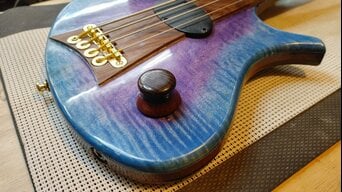
Since primary school times, painting and drawing was not my best capacity. There was always distance between what I had in my mind and the final result. It is something I do not like to do, and also colors and brushes do not like me. This can be easily seen in how the body is now - semitransparent electric blue, but not as it was in my mind.
Furthermore, I already knew from other areas of my life that, sometimes, defects are better hidden in an overall rough environment, and that if you try to embellish the environment without curing defects, they become even more apparent.
The blue color made visible some subtle lines not visible before, likely coming from scratches done by pieces of wood I used to protect the body from scratches -ahem.
Anyway, seen from far is not too bad. A friend of mine, in similar situations but about some pretty people, tells that "he/she has a good distance", meaning that when close, he/she is not as pretty as when far.

blue.jpg
 
So, I tried to recover from mistakes on the front side (half successful); then again filler and 8 layers of wipe-on satin poly (it seemed to me the technique least prone to disaster). I also sanded in between and ended with steel wool.
I understood now I have to wait "curing" for what seems a lot of time. But my patience is almost at the end, as is the paint can. So, how much do I have to really wait, to polish (if needed)? I want to close.

At present the result is: sufficient on the back side, smooth and planar; it could have been the same on the front, but I have been too much superficial (no pun intended) in sanding after the first failed attempt. Borders are so and so - I can blame the wood (fir or whatever, far from luthiery), but likely it's again me.
Anyway, the bass was playable before painting and it will be also after.

filler.jpg
 
Last edited:
  • Like
Reactions: TerribleTim68
I'm curious exactly what it is you aren't happy with. To me it looks pretty good, but that could also be just how it's coming across in the photos and looks totally different in person.
It is still in the basement, half suspended. With a better light, I will ruthlessly show defects :)
Maybe if I bring it at home, in a warmer environment, the curing process will speed up (the can tells "some days of particular attention").
 
This is my submission for the Special Edition Build off
Special Edition Build Off - 2nd build but like 1st

Ok, although I have an inner voice telling me that it's not yet completed (it keeps repeating "sand and wipe-on again!"), considering the deadline, I declare it's finished. Its name is CovidBass.

It's far from perfect, but at the end, it was born to help during quarantine and indeed it helped: in few days I was able to play with friends through Jamulus.
I understood some of the mistakes I made - I have to sand way more carefully before painting, and 8 layers are not sufficient. However, considering the wood I started from, and also my own experience, I am happy with the result. I was also thinking at a matching headstock, but I am sure I will reuse the neck, so no destructive works on it.

Specifications

Body
: 3 layers of laminated fir/pine board (what I had in the basement...)
Neck: used no-name Jazz-style bought on Ebay
Scale Length: 34"
Tuners: Fender style, no brand, bought on Amazon.
Bridge: Wilkinson
Pickup: very cheap MusicMan-style humbucker, from China
Electronics: CTS pots; 3 0.01 capacitors in parallel for tone.
Finish: Veleca Tingilegno (blue), water-based filler, water based poly (Syntilor AquaUrethane) wiped on.
Strings: residuals hanging around, likely Galli.
Weight: 3.7kg

1.png


3.jpg


4.jpg


origin.jpg


bad.jpg


0.jpg
 
Last edited: