• TalkBass has been independent since 1998. Add your voice.
    Create a free account to reply to discussions, view embedded media, and browse with fewer display ads.
    Join freeLog in
    Want zero display ads or expanded classifieds tools? Compare plans.

SPECTOR® Owners Club

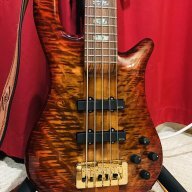
If I can't get a decent bass gig, at least I can rock these
 

Attachments

  • IMG_0157.JPG
    IMG_0157.JPG
    352.3 KB · Views: 61
Just got my NS5 back from getting Plek'd at Crossroads Guitars in Falls Church, VA. Man it plays great now. Had some buzzy spots before, but not anymore!
I think that the Plek is to flatten the neck and file down the frets to match the lowest, what happens when you restring and add the relief back to the neck as all of the frets are no longer in the same plane so to speak....is it just correcting between the one fret to the next?
 
  • Like
Reactions: jack7265
I think that the Plek is to flatten the neck and file down the frets to match the lowest, what happens when you restring and add the relief back to the neck as all of the frets are no longer in the same plane so to speak....is it just correcting between the one fret to the next?

It's a fret job done by a robot, nothing more and nothing less. But if the operator gets it set up right, it should do a perfect fret job every time.
 
I understand this and have seen what it does, just wondering how it might fix a condition when you have relief?

So an old-fashioned fret job by hand, if done right, is done with the neck in a jig that simulates string tension. The Plek machine scans the frets while under actual string tension and at proper relief, so when it's leveling the frets, it's making them level with respect to what it will be under tension. Then you add relief as normal.
 
I understand this and have seen what it does, just wondering how it might fix a condition when you have relief?

So an old-fashioned fret job by hand, if done right, is done with the neck in a jig that simulates string tension. The Plek machine scans the frets while under actual string tension and at proper relief, so when it's leveling the frets, it's making them level with respect to what it will be under tension. Then you add relief as normal.
That's how I understand it....In a perfect situation, frets are to be level with the fretboard. Adding a touch of relief with string tension is normal and needed.

I had a Warmoth bass PLEK'd a few weeks ago. It came back perfect.
 
That's how I understand it....In a perfect situation, frets are to be level with the fretboard. Adding a touch of relief with string tension is normal and needed.

I had a Warmoth bass PLEK'd a few weeks ago. It came back perfect.

Yeah, sorry, I seem to have misunderstood the question. Once the bass is set up, you pretty much want the neck straight. Just a touch of relief to give the strings some room to vibrate, but just a little.
 
Here's yet another question in my quest to learn:
Forever and ever I played a 34" 4 string. Next year I am going to get a 5r. My question is about any advantage of a 35" 5 string.
Do you think it's a big adjustment to go from 4 to 5 and a longer scale or should I consider a 34" 5 string?
Its unlikely that I will ever tune down. What are the advantages of moving up to a 35"scale? Thanks.
 
Here's yet another question in my quest to learn:
Forever and ever I played a 34" 4 string. Next year I am going to get a 5r. My question is about any advantage of a 35" 5 string.
Do you think it's a big adjustment to go from 4 to 5 and a longer scale or should I consider a 34" 5 string?
Its unlikely that I will ever tune down. What are the advantages of moving up to a 35"scale? Thanks.
I've never noticed it feeling different when going back and forth. I think the low notes benefit sonically from the longer scale.
 
Here's yet another question in my quest to learn:
Forever and ever I played a 34" 4 string. Next year I am going to get a 5r. My question is about any advantage of a 35" 5 string.
Do you think it's a big adjustment to go from 4 to 5 and a longer scale or should I consider a 34" 5 string?
Its unlikely that I will ever tune down. What are the advantages of moving up to a 35"scale? Thanks.

At 35", you can use a lower gauge B string and keep a tighter/higher tension feel.

If I'm just picking single notes, I don't really notice the extra scale length. But if I do some fast popping/slapping across multiple strings by the nut, I feel it immediately and it hurts my left wrist. YMMV.
 
I've never noticed it feeling different when going back and forth. I think the low notes benefit sonically from the longer scale.

There is absolutely a difference: the lengthening the scale starts to remove overtones and makes for a stronger fundamental with less "mud" farther up the neck.
 
  • Like
Reactions: iceboxbass
Here's yet another question in my quest to learn:
Forever and ever I played a 34" 4 string. Next year I am going to get a 5r. My question is about any advantage of a 35" 5 string.
Do you think it's a big adjustment to go from 4 to 5 and a longer scale or should I consider a 34" 5 string?
Its unlikely that I will ever tune down. What are the advantages of moving up to a 35"scale? Thanks.

See my post above, but the advantages are generally lessened if you aren't down tuning.

It also depends on what kind of tone you are going for, warm/vintage stuff is harder to achieve with the longer scale and modern/"piano like" tones are easier to achieve with a longer scale.
 
Tonight's backline, sounded pretty good actually. GK1001RB and an SWR Goliath II cab. Didn't even come close to pushing the amp hard, surprised at how loud it was, and sounded decent. Spector / Haz providing the signal never hurts tho.
View attachment 1005944

That is the exact cab that mademe go to modular cabs.....:laugh: Threw my back out moving it upstairs and as soon as I healed up, I built a couple 1X12 cabs. As long as it's a backline you don't have to move, I'm sure it was great.
 
  • Like
Reactions: jack7265

Latest posts