• TalkBass has been independent since 1998. Add your voice.
    Create a free account to reply to discussions, view embedded media, and browse with fewer display ads.
    Join freeLog in
    Want zero display ads or expanded classifieds tools? Compare plans.

Spokeshave?

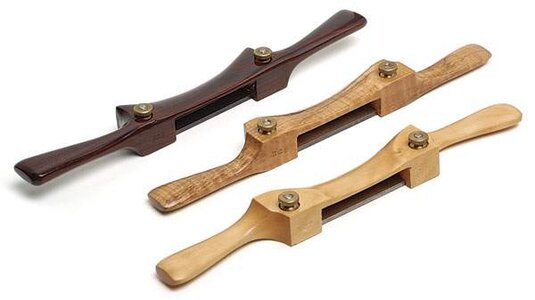
I was thinking about using a spokeshave to shave down my squires p-neck to a middle ground between p and j thickness. (I'll also tung oil it but that's another question.) Where is a good place to get a good spokeshave (a carpenters son can't buy crappy tools) and what blade should I get. I know they come in flat and concave, but I'm assuming they probably have cutting radii like any other precision woodworking tool.

Any info you experienced builders can spare would be really appreciated, and I can't wait to get started.

P.S. I know this will probably end up getting moved because it mentions a tool, and that's on a sticky, but I'm more interested in opinions here. Good tool suppliers and what you think works best. Thanks everybody!

 
I use older Stanley spokeshaves I acquired off of ebay. The first one was a dual unit, with one straight blade and one concave. It needed some rehab to become usable, but I found that there were situations where it was too cumbersome to use. My second one has the top mounted adusters on the single flat blade, and is a pleasure to use. Bypass the cheap Chinese copies: I bought one and it was useless: traded it at the local used tool store for a digital caliper (score!).
Look for a local independent hardware store for Stanley or Kunz. Woodcraft and Rockler carry both.
http://www.woodcraft.com/Search/Search.aspx?query=spokeshave
[Invalid or Expired Link Removed]

IMO the new Stanley spokeshaves aren't as good as the older ones. Kind of like a P-bass, the older ones have mojo. Kunz are supposed to be decent quality, and reasonably priced, but I can't vouch for that.

A step up in quality would be Veritas
http://www.leevalley.com/US/wood/Search.aspx?action=n
 
You can use a spokeshave or sander for this but you do need to figure out just how much wood you can remove and still leave enough material around the truss rod. This will be difficult to determine without getting an xray image of the neck.
 
I use a Sandvik cabinet scraper followed by sandpaper to alter neck profiles.

W833.jpg
 
You can use a spokeshave or sander for this but you do need to figure out just how much wood you can remove and still leave enough material around the truss rod. This will be difficult to determine without getting an xray image of the neck.

Meh, if it goes bad I'll just have an excuse to throw on a nice aftermarket neck. This bass is a learner in every sense of the word; if I mess it up, I'll learn from fixing it, If not, good for me. After all, I have two basses for a reason.
 
You ask, everyone says it's a bad idea and you say you're gonna do it anyway. I don't get why you asked in the first place if you were just gonna do it despite what people with experience had to say.

If you read more, you could see that as of right now its about half and half. A few people at the top ok it, one or two say just to sand, one guy says to use a cabinet scraper, others lean towards not trying. Since I've previously spoken to my local luthier who said they use a spokeshave to thin out necks, so I figured it was a safe bet to try. And since this is a project bass, which actually needs fretwork, a new nut, and a number of other repairs, it seems like the best media to start on.

But thanks for contributing to the conversation and not just being critical. And I'm also glad that you realize my initial question was about HOW to do the procedure, and not IF I should do it.
 
If you read more, you could see that as of right now its about half and half. A few people at the top ok it, one or two say just to sand, one guy says to use a cabinet scraper, others lean towards not trying. Since I've previously spoken to my local luthier who said they use a spokeshave to thin out necks, so I figured it was a safe bet to try. And since this is a project bass, which actually needs fretwork, a new nut, and a number of other repairs, it seems like the best media to start on.

But thanks for contributing to the conversation and not just being critical. And I'm also glad that you realize my initial question was about HOW to do the procedure, and not IF I should do it.

You wanna cop attitude it's no sweat off my balls sonny. Just because ONE luthier said he used a spokeshave doesn't mean it's an easy tool tool to use or that it's an especially common method for fine shaping a neck....it isn't, block sanding is. Since you're so stuck on it though here's one that I own and know works well: Veritas Low-Angle Spokeshave. Practice on an old baseball bat or something first or you will **** up your neck. It probably doesn't really matter very much though......with all the worry you have about getting it done fast you'll probably ruin the thing whatever method you use. :rollno:
Now go out and prove me wrong!
 
You wanna cop attitude it's no sweat off my balls sonny.
The only attitude in this thread is your own.

OP, you could use a spokeshave, but considering the neck is already finished, sanding will be easier to help you reach your goal. It won't take forever, it goes pretty quickly actually and allows you much more control in the process. Even though its an inexpensive bass that you can learn on, its still nice to have pleasant fruits of your labours...
 
The only attitude in this thread is your own.

Really dude, this falls as deep into the "why bother" category as anything I've said. The OP seems to have the necessary determination to pull this off and I'm pretty sure he can deal with my badgering his own self.

OP, you could use a spokeshave, but considering the neck is already finished, sanding will be easier to help you reach your goal. It won't take forever, it goes pretty quickly actually and allows you much more control in the process. Even though its an inexpensive bass that you can learn on, its still nice to have pleasant fruits of your labours...

This advise sounds vaguely familiar....
 
To the OP:

This style is my favorite. I make mine using blades from Ron Hock. They can take exceptionally fine cuts or hog off a lot of stock depending on how the throat is adjusted and the blade is set.

You may want to practice a little before you try to shape your neck.

Oh yeah, I'll definitely be practicing A LOT on some scrap hardwood or maybe closet rod stock beforehand. It may not be the same since its a softer wood, but it should help me get down the fundamentals of usage and allow me to experiment and find the right blade settings. I'm all about over-preparation for things, if I wasn't I wouldn't come here. Come to think of it, I maybe be able to get a broken little league bat from one of my friends if I talk to him. Oh, the perks of knowing teachers/coaches.
 

Latest posts