
Enjoy the benefits of a premium membership!
Upgrade Account
-
TalkBass has been independent since 1998. Add your voice.
Create a free account to reply to discussions, view embedded media, and browse with fewer display ads.
Join free Log in
Want zero display ads or expanded classifieds tools? Compare plans.
You are using an out of date browser. It may not display this or other websites correctly.
You should upgrade or use an alternative browser.
You should upgrade or use an alternative browser.
Double Bass Spooky sounding scales intervals and chords
- Thread starter GC34
- Start date
More options
Who Replied?
Any modes of 7-note scales with an augmented second in it. That means modes of harmonic minor and harmonic major (major up to the fifth, harmonic above the fifth).
The ones with a lot of flats (starting from C) should work well like melodic minor VII (altered scale), locrian and Phrygian.
Maybe also some gypsy scales with two augmented seconds in it (each surrounded by halftones).
Whole tone and diminished scales.
Modes of melodic minor are close to the wholetone scale.
Don’t restrict your chords to stacks of thirds. Any note in the scale could be used to build a chord as long as the bass note is the root of the mode and strong.
But for a stack of thirds chord the diminished and augmented ones work.
Using diminished or augmented intervals, stepwise or connected by a line work melodically.
Depends on taste what you think would fit for Halloween.
The ones with a lot of flats (starting from C) should work well like melodic minor VII (altered scale), locrian and Phrygian.
Maybe also some gypsy scales with two augmented seconds in it (each surrounded by halftones).
Whole tone and diminished scales.
Modes of melodic minor are close to the wholetone scale.
Don’t restrict your chords to stacks of thirds. Any note in the scale could be used to build a chord as long as the bass note is the root of the mode and strong.
But for a stack of thirds chord the diminished and augmented ones work.
Using diminished or augmented intervals, stepwise or connected by a line work melodically.
Depends on taste what you think would fit for Halloween.


I've got three chords: diminished 7th chords (A-C-Eb-Gb), minor-major 7th chords (A-C-E-G#) and augmented triads (top 3 notes of previous chord).
Two scales: whole tone scale, diminished scale. I think of the latter as a dim 7 chord that you fill in either by whole step + half step or half-step + whole step.
-S-
Two scales: whole tone scale, diminished scale. I think of the latter as a dim 7 chord that you fill in either by whole step + half step or half-step + whole step.
-S-

The '3 semi tone walk' to either octave is pretty spooky.
E G Bb Db E
E G Bb Db E
This bass player I heard a while back is scary enough to scare everybody. This guy shoulda stayed home and practiced!
The augmented major 7 chord is another one, i.e., C+maj7, spelled C, E, G#, B.
Or....anything played by a first or second year violin, viola, cello, or bass student.....
Or....anything played by a first or second year violin, viola, cello, or bass student.....

Halloween is right around the corner. What are some common chords and scales uses for spooky effect?
Any sus2 chord.


Common chords are built on thirds. The spookiest chord are not built on thirds IMHO.
I suggest looking at the sounds you can create by stacking 2nds and the sounds you can create by stacking 4ths.
Try stacking minor 2nds. Next try open voicing by raising every other note an octave.
Try stacking diminished 4ths.
Tertian examples:
@Whousedtoplay may be able discuss this more intelligently...I only have vague memories of something I didn't learn long ago.
I suggest looking at the sounds you can create by stacking 2nds and the sounds you can create by stacking 4ths.
Try stacking minor 2nds. Next try open voicing by raising every other note an octave.
Try stacking diminished 4ths.
Tertian examples:
@Whousedtoplay may be able discuss this more intelligently...I only have vague memories of something I didn't learn long ago.
Last edited:

Beyond the tritone which on the old days was called „diavolo in musica“ (devil in music), a tempered interval can have dual functions, a standard one and an augmented or diminished one. (Some even more than two functions.)
It depends on the harmonic context (scale with melodic development or harmonic development) if the interval has its standard function (major/minor/pure) or an altered one.
BTW, even the tritone has dual functions, depending on the resolution (inside or out) or from where the tritone was entered.
The mode locrian didn‘t exist in the old church modes (which anyway were a misinterpretation of the Greek modes) because it contained the tritone in the root triad.
Musically it might have been used by witches and devil circles therefor, but that is only guessing.
In general, the unexpected in a high density is spooky. Even a short sweet harmonic phrase in a chaotic surrounding.
@Wasnex: How do you recognize a stack of diminished fourths as diminished fourths and not as a stack of major thirds (or maybe a mix of both)?
The notation might be possible, but I doubt that ear and mind will recognize it as such. And notation should be as correct as music theory (if a certain one could be applied to this kind of music) and recognition shows.
But maybe that was just a joke or an unsolvable challenge for the OP.
To the OP: asking for a „spooky“ chord without a good knowledge of harmony is a bit like picking up a buzz word without knowing the language where it is related to.
It depends on the harmonic context (scale with melodic development or harmonic development) if the interval has its standard function (major/minor/pure) or an altered one.
BTW, even the tritone has dual functions, depending on the resolution (inside or out) or from where the tritone was entered.
The mode locrian didn‘t exist in the old church modes (which anyway were a misinterpretation of the Greek modes) because it contained the tritone in the root triad.
Musically it might have been used by witches and devil circles therefor, but that is only guessing.
In general, the unexpected in a high density is spooky. Even a short sweet harmonic phrase in a chaotic surrounding.
@Wasnex: How do you recognize a stack of diminished fourths as diminished fourths and not as a stack of major thirds (or maybe a mix of both)?
The notation might be possible, but I doubt that ear and mind will recognize it as such. And notation should be as correct as music theory (if a certain one could be applied to this kind of music) and recognition shows.
But maybe that was just a joke or an unsolvable challenge for the OP.
To the OP: asking for a „spooky“ chord without a good knowledge of harmony is a bit like picking up a buzz word without knowing the language where it is related to.
@Wasnex: How do you recognize a stack of diminished fourths as diminished fourths and not as a stack of major thirds (or maybe a mix of both)?
Answering the OP has me a bit out over my skis. Sorry I thought I made that clear
 .
.In regards to your question:
A to Db = Dim 4th
A to C# = Maj 3rd
To the ears these intervals sound the same. The distinction is in how the tones are written.
Enharmonics
A = A
C# = Db
E# = F = Gbb
Quartal: Stacked dim 4ths: A,Db,Gbb
Tertian: Stacked Maj 3rds: A,C#,E#
A,Db,F is also the same sound. You could call this "tertian" Db Augmented in 2nd inversion. The spelling makes sense if considered in root position. Db Augmented = Db,F,A. However A,C#,E# does not sound the same as Db,F,A.
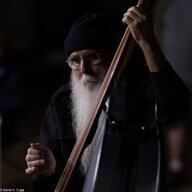
The original Godzilla roar from 1954 was created by rubbing a leather glove coated in pine-tar resin against the strings of a double bass.
That's pretty scary.

That's pretty scary.
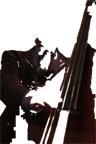
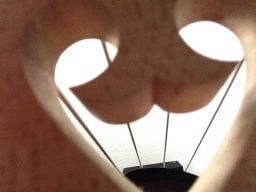
I like to bow between the bridge and the tailpiece occasionally when I feel like I'm not getting enough attention. Definitely spooky.
A bowed tritone glissando on different string by pairs also works very well.
Another is putting a second bow between the strings below the fingerboard and play pizz or with the first bow.
But now we get into special playing techniques and sounds.
Another is putting a second bow between the strings below the fingerboard and play pizz or with the first bow.
But now we get into special playing techniques and sounds.
I don't know if this piece could be characterized as "Spooky", but I would leave the lights on while listening...
Also - my last name is spelled Kasper, not Casper.
IMFO, of course.
Also - my last name is spelled Kasper, not Casper.
IMFO, of course.
As you might have read, I know the difference.Answering the OP has me a bit out over my skis. Sorry I thought I made that clear
In regards to your question:
A to Db = Dim 4th
A to C# = Maj 3rd
To the ears these intervals sound the same. The distinction is in how the tones are written.
Enharmonics
A = A
C# = Db
E# = F = Gbb
Quartal: Stacked dim 4ths: A,Db,Gbb
Tertian: Stacked Maj 3rds: A,C#,E#
A,Db,F is also the same sound. You could call this "tertian" Db Augmented in 2nd inversion. The spelling makes sense if considered in root position. Db Augmented = Db,F,A. However A,C#,E# does not sound the same as Db,F,A.
I just doubt that you can find two diminished fours that are harmonically correct diminished fifths in a chord that would be recognized by ear as two diminished fourths. With any chords around them.
You can try to give an example as a proof, but I doubt you can find one. Even two adjacent diminished fourths melodically are hard if not impossible to find or construct.
Example: B - Eb -Abb are two diminished fourths, but what is the scale that contains these notes?
B - C - D - Eb - Fb - Gb - Abb but now you have seven tones and still an augmented third to fill. And in a way that the Abb is still recognized as an Abb and not as a G.
It might work if only these notes without octave copies are used, but this is a very special case.
You cannot use the same construction 1-2-1 halftones, because then you do not reach the B enharmonically.
I cannot find a way to fill the space up that makes sense. And I think you need three more notes to fill up the space as with two you gave an augmented second that won’t fit well to the two diminished fourths.
But anyway, I agree that any notes from the scale could be used to build a chord, some more useful than others and the placement can be very different, just the root note must be clearly audible as the lowest note.
But I’m sure that is far beyond most of our colleagues knowledge of harmony.
I just wanted to explain that a chord with two diminished fourths that are recognized as such are (almost?) impossible to find.
Of course the construction might have an intervall in between like a major second Eb - F and Bbb - B:
B - C - D - Eb - F - Gb - Ab - Bbb (- B)
But I’m still not sure if that would work, but it is the only (theoretical) case that I can find where two (actually four) diminished fourths are contained.
And with a closer look this is the (dominant) diminished scale. It is rather difficult to make the diminished fourths in it clear.
BTW, you won’t have two consecutive halftone steps in a scale as it makes them stepwise melodically unpleasant and harmonically blurring. The only way there could be used is around the root and its octave(s) and the pure fifth. Mainly with a fixed root note and constant scale to choose notes melodically from.
You can add chromatic adding that lead to consecutive halftone steps, but the more you add, the more unclear the chord gets (which might be intended in some kinds of music).
Last edited:
I wouldn't be surprised if it exists in some esoteric 20th century piece. I also wouldn't be surprised if it doesn't. UNSUBYou can try to give an example as a proof, but I doubt you can find one. Even two adjacent diminished fourths melodically are hard if not impossible to find or construct.

While playing, too! As Prof. Kasper and others suggest, above, think big, CG! Four-note arps, tritones . . . them's for squares! You want to scare the whole neighborhood, you want segments! Long concatenations of notes; a page of demented licks! No, er, half-measures when seeking a descent into terror!. . . I would leave the lights on while listening...
And forget thumping on an electric - if it's not arco, it's not a nightmare!
Last edited:


