• TalkBass has been independent since 1998. Add your voice.
    Create a free account to reply to discussions, view embedded media, and browse with fewer display ads.
    Join freeLog in
    Want zero display ads or expanded classifieds tools? Compare plans.

Spraying Clear, Let's Talk Supplies/Equipment & Process

Hey gang,
For those of you spraying clear coats instead of hand applying, I'd like to get a sense of what you are using, what all is needed, what you find works and what doesn't.

I've got a Craftsman 30 gallon air compressor already, I rarely ever use it, it just kind of hangs out in the corner. I have a cheapo HF siphon feed spray gun. I'm wondering what it would take to move to spraying finishes using these things I already have. Really I just need to set up a pseudo spray booth of some sort, right?

Gimme some guidance here, or is my existing equipment just not gonna work?
And what are we looking at for a clear coat product I can spray, what do I need for thinner, all that stuff. I know very little about mixing paint for spraying, but I know that you don't just pour it in the gun straight out of the container.

I have other questions, but let's start there. :cool:
You've got a 30 gallon compressor (that should work out. Depending on the motor), you've got a cup gun...you just need some material, and a water filter.
 
  • Like
Reactions: TerribleTim68
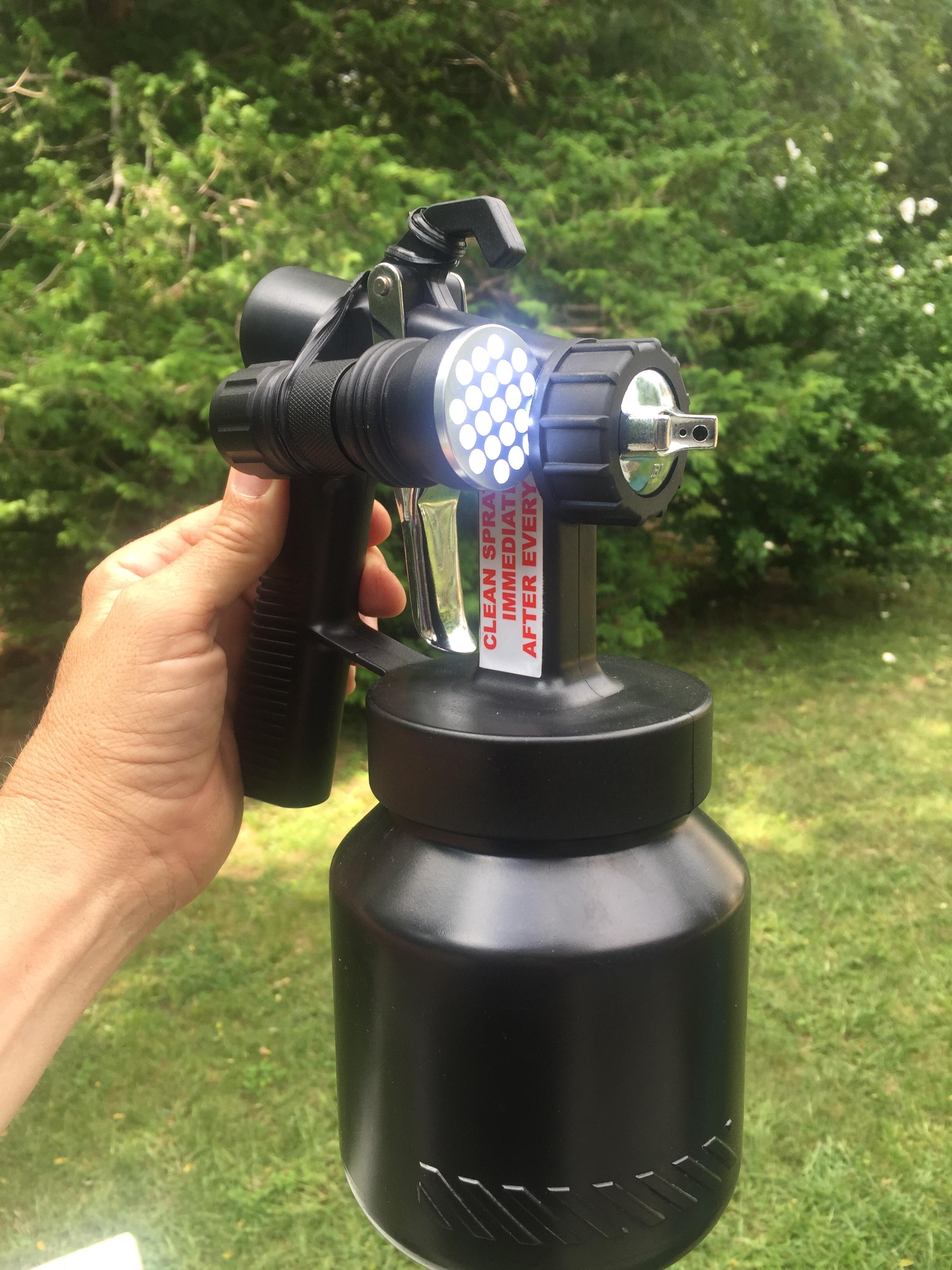
I did my first real spray job with a HF all-in-one single stage HVLP gun using Varathane Ultimate water based clear. It has the advantage of being non-explosive and non-toxic, but the cheapo gun left some pretty heavy orange-peel that took hours of hand wet sanding to remove.
gfHTZQt.jpg

I really wanted to like it, but I found it to be a finicky finish to apply right, and it doesn't cure any harder than nitro, so it scratches easily. There's a whole thread dedicated to it, and the techniques evolved as the thread went on, so just read the latest posts to see if it interests you.
Using water based products for instrument finishing, Target Coatings 9000 6000 and Varathane WB

Bruce Johnson is getting good results with a cheap HF HVLP gun, so it's do-able. As I understand it, the problem with a small compressor like a "pancake" model is you literally run it dry on air, but 30 gallon seems like plenty. The technique on the WB finishes seems to be low pressure, no fan air, and lay it on pretty wet, it self-levels. I can't say I mastered it though. You can get WB clearcoat in rattlecans now too, though I've never tried them.

All the traditional VOC finishes are hideously toxic and explosive, so I'll say Don't Go There, but plenty of people do, as the techniques and materials are fully worked out. All that stuff is getting phased out eventually, so if you have no investment in VOC based equipment, might as well go water base.

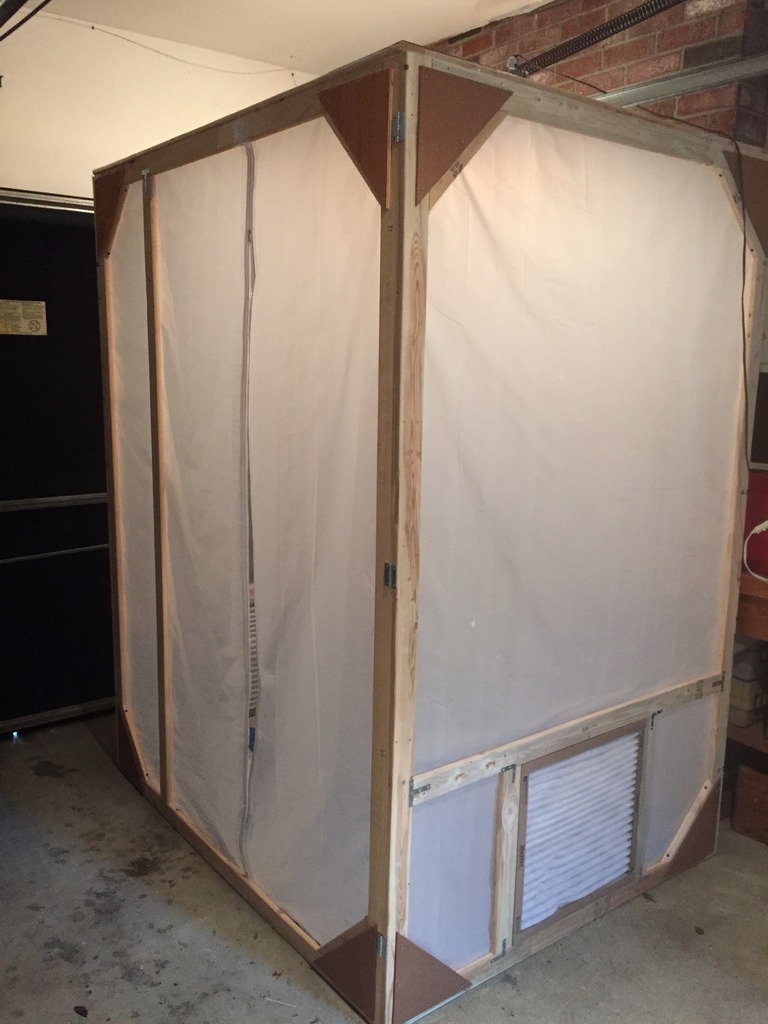
Whatever you spray, count on making a hell of a mess. I built this "spray booth" out of 1x3 and plastic sheet, with HVAC filters on intake and exhaust. It knocks down flat to store it. I found just mounting a cheap box fan on the intake side creates a bit of positive pressure that tends to push pollen, bugs, and dust OUT the "door", which is just one of the jobsite plastic sheeting zippers painters use, they sell them at Home Depot. In retrospect, something oriented horizontally would have worked better, I was hanging the bass from the top, so I had a lot of trouble with runs. I think most finishes level better horizontally.
uHJJmml.jpg


A rabbit hole for sure, and you will get some widely varying opinions, I am in no way settled on the best technique for clearcoat.
? There is no pressure in a siphon system. Your material get siphoned as your air passes over it. It makes a Vacuum. The best way, is to mix it really thin, and do multiple coats. Very little air, just enough to atomize the paint, and as much material as you can get away with. Glass.
 
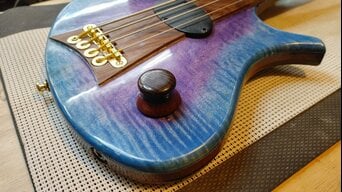
I did auto painting as a hobby. I painted my 65 Mosrite the same way. After 20 years it looks like the day I painted it. This is what I used. Nason 465-00 clearcoat, Nason 441-21 reducer (works on base coat and clear coat). Nason 483-84 activator. I mixed the clearcoat and reducer 50/50.added 20% activator. You can use either conventional high pressure 40-50 psi or hvlp 7-10 psi (high velocity low pressure) guns. The vender usually gives you a few filters and stir sticks. Apply repeated coats lightly (3 or 4) 15 minutes apart. If you get a run or blob, you can always wet sand with 1000 grit when it dries and it will spray over like you never sanded.
65 Mosrite Mark 1 FM101.JPG
 
In all my years of using water-base finishes in cheap spray guns, I've never yet seen any rust inside the guns that I use regularly. I've only seen it in guns that I left filled with straight water for, like, months.

Same here, Bruce. I have 3 of those guns and none of them have black oxide parts in them. Nearly bulletproof workhorses and they come with a regulator to boot! :thumbsup:
 
General Finishes makes a great line of both solvent and waterbourne products. Many of the GF WB products are so easy to hand apply, I no longer set up my $1000 Fuji spray system for smaller items. Many apply glass-smooth with a throwaway foam brush, and dry to the touch very quickly. Employees of the company moderate a tech support forum on Facebook.

One thing to understand about high tech WB products is they tend to get really weird looking as they cure, sometimes like cottage cheese. You might cry and think you're ruined your project. LEAVE IT ALONE. :cool:

No matter what you use, test on scrap prepared with all the same steps, such as sanding, scraping, filling, sealing... you'll do on your project. If necessary, write your steps on the back of the test part for later reference.
 
I've been building and refinishing guitars and basses for over 20 years and refuse to use water born clear. It's just not there yet IMHO. My preference are catalyzed urethanes due to ease of use and superior final product. They are also easy to cut and buff and are far easier to repair. Also, using a gravity feed gun is way better and easier than an old siphon feed IMHO.
 
I use a HF gravity feed touch up gun. I shoot 2k catalyzed poly. My EXPERIENCE: you'll never get that deep glossy, durable finish out of a purely water based poly. I've tried several. I always go back to catalyzed poly. I mix up about 4 ounces at a time and clean up with lacquer thinner (product name) or an MEK substitute. I wear a respirator, etc... I shoot a light coat and let that tack up. I shoot a second wet coat and let that tack up. If that looks good, I'm done. Normally, that's not enough. I usually shoot one more coat pretty heavy. That should do it. I've used 4 ounces of catalyzed poly and that's enough material to wet sand and buff. It will look like a mirror. To get that same thickness from water based poly, I believe a minimum of 20 coats would be necessary. Probably closer to 30 or 40. I never spray that much water based poly. I just don't have the time. You can probably do it with less, but you're not going to get that grain filling, glass like fluidity from water based products.
 
I've been building and refinishing guitars and basses for over 20 years and refuse to use water born clear. It's just not there yet IMHO. My preference are catalyzed urethanes due to ease of use and superior final product. They are also easy to cut and buff and are far easier to repair. Also, using a gravity feed gun is way better and easier than an old siphon feed IMHO.

I use a HF gravity feed touch up gun. I shoot 2k catalyzed poly. My EXPERIENCE: you'll never get that deep glossy, durable finish out of a purely water based poly. I've tried several. I always go back to catalyzed poly. I mix up about 4 ounces at a time and clean up with lacquer thinner (product name) or an MEK substitute. I wear a respirator, etc... I shoot a light coat and let that tack up. I shoot a second wet coat and let that tack up. If that looks good, I'm done. Normally, that's not enough. I usually shoot one more coat pretty heavy. That should do it. I've used 4 ounces of catalyzed poly and that's enough material to wet sand and buff. It will look like a mirror. To get that same thickness from water based poly, I believe a minimum of 20 coats would be necessary. Probably closer to 30 or 40. I never spray that much water based poly. I just don't have the time. You can probably do it with less, but you're not going to get that grain filling, glass like fluidity from water based products.
10 years ago, that was absolutely true, but these days, you can definitely get there with WB finishes and different techniques. Many of us have been doing it for some time now. :thumbsup:
 
10 years ago, that was absolutely true, but these days, you can definitely get there with WB finishes and different techniques. Many of us have been doing it for some time now. :thumbsup:
I suppose you and others do, but I prefer the catalyzed solvent based finishes for ease of application and over all durability. I would put up a catalyzed clear against a water born clear any day of the week for scratch and chip resistance and overall durability.
 
I keep seeing it repeated that water based stuff is as good as catalyzed poly. I just don't see any proof.
I suppose you and others do, but I prefer the catalyzed solvent based finishes for ease of application and over all durability. I would put up a catalyzed clear against a water born clear any day of the week for scratch and chip resistance and overall durability.
 
I keep seeing it repeated that water based stuff is as good as catalyzed poly. I just don't see any proof.
I've been in the autobody trade for 50 years and doing refinishing of guitars for 25 and based on my experience, water born is NOT equivalent to catalyzed. Also, the long term track record for water born is not there yet. catalyzed urethanes have been around since the late 60s or early 70s. I've seen 30+ year old paint jobs that still look great. Water born urethanes have only been used for only around 20 years and I've seen 10 year old paint jobs that are faded and delaminating.
 
I don't think the argument is that water-based is "as good as" catalyzed finishes; I agree the ones I have tried are not. Some are very good, though.

Generally speaking, catalyzed finishes are nastier to work with and not as conducive to spraying in a home shop or garage and not as approachable for DIYers.

Personally, I have sprayed automotive clears and conversion-varnishes for a living (many years ago), I know how well they work, but I don't want to deal with that in my garage.

They all have their merits!:)
 
Very valid. I don't mind dealing with it properly. It's worth it to me.
I don't think the argument is that water-based is "as good as" catalyzed finishes; I agree the ones I have tried are not. Some are very good, though.

Generally speaking, catalyzed finishes are nastier to work with and not as conducive to spraying in a home shop or garage and not as approachable for DIYers.

Personally, I have sprayed automotive clears and conversion-varnishes for a living (many years ago), I know how well they work, but I don't want to deal with that in my garage.

They all have their merits!:)
 
  • Like
Reactions: BishopJP