• TalkBass has been independent since 1998. Add your voice.
    Create a free account to reply to discussions, view embedded media, and browse with fewer display ads.
    Join freeLog in
    Want zero display ads or expanded classifieds tools? Compare plans.

Squier Classic Vibe Club

Status
Not open for further replies.
Fair enough. as i said, no offense meant.
I do agree with you that it could well be different batches that have different parts on them. Maybe Squier change thier sources every now and then.
The covers on mine are definitely smaller than the fender covers i have on the new pup I asked bout these covers and was told they are the same as fender and allparts use.
I must admit i haven't tried any other pickups but i have read of others having to file the Squier PG to fit different pickups. The coils also wont fit in the Squier covers.
There is no issue with other pickguard and pickups of course but it does seem like the Squiers are non standard, just like the HM bridge.

I dont mind filing mine, and i do expect to make a bit of a mess of it, although so far its going well. At this price point i would rather learn how to do all this rather than throw too much money at it.
 
I'm getting a classic vibe in this week. The 60's P and I wanna upgrade the tuners and bridge a bit. I've already got a Leo Quan Bad Ass II coming for it. Would "Wilkinson" brand tuners fit this bass or what size tuning pegs do?

You may want to try search another thread here - can't recall exact name - that is definitive guide to Squier upgrades and user experiences with parts that fit. AFAIK the tuner holes are none standard.

My advice to anyone who is getting a CV 60's P is to play it for awhile before changing anything. You may want to change strings to your preferred brand and gauge and tweak the setup a bit but these are fabulous playing and sounding basses right out of the box. I've probably played 8 or 10 P and J's and they are very consistent. IMO the only real weak parts are the pots and output jack so I'd swap those simply for reliability purposes. I've had zero issues with the tuners and find them to be just as solid and reliable as the ones on my 2 Fender AV basses. As always, YMMV.
 
You may want to try search another thread here - can't recall exact name - that is definitive guide to Squier upgrades and user experiences with parts that fit. AFAIK the tuner holes are none standard.

My advice to anyone who is getting a CV 60's P is to play it for awhile before changing anything. You may want to change strings to your preferred brand and gauge and tweak the setup a bit but these are fabulous playing and sounding basses right out of the box. I've probably played 8 or 10 P and J's and they are very consistent. IMO the only real weak parts are the pots and output jack so I'd swap those simply for reliability purposes. I've had zero issues with the tuners and find them to be just as solid and reliable as the ones on my 2 Fender AV basses. As always, YMMV.


Good to know friend. I'm a fan of high mass bridges so that's the reason the bridge will be changed. If the tuners hold tuning well, I don't mind leaving them stock.
 
My advice to anyone who is getting a CV 60's P is to play it for awhile before changing anything. You may want to change strings to your preferred brand and gauge and tweak the setup a bit but these are fabulous playing and sounding basses right out of the box. YMMV.

Definitely a good idea.
I had to gig mine before i changed the pup and it sounded great. The reason im changing the pup is to get a bit more growl. Other than that i love the tone and might one day go back to it.

I like the pots but as ive damaged one, due to it being a bit fiddly to work on for a semi novice like me, i have no choice but to change it. Ive ordered a full size CTS pot but if i have trouble with it ill order up a mini version.
 
I can't tell what Fender is up to these days in terms of their standardization. Based on what I've read the following are non-standard on the CVs:

-- bridge
-- PG shape (per Britbonic)
-- PG pickup openings
-- pickup and cover
-- tuner holes

and I'll add these:

-- body thickness (standard is 1-3/4" but mine is 1-5/8")
-- headstock thickness (not sure what's standard but mine appears slightly thinner)

None of these details had to be this way so the question is why they are. Is it just a matter of cutting close to the bone to keep costs down and possibly sourcing issues? Or is it done with the intent to distinguish the bottom price point from the rest by making the Squiers less upgradable?

Note: I'm not complaining or pointing a finger at Fender. I think the CVs are great basses and great bargains and I'm glad that Fender has made them available. But it is kind of interesting.
 
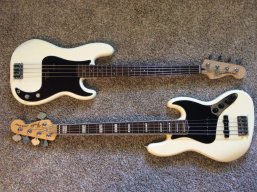
My new Classic Vibe 60's in Fiesta red beside a Geddy.
5209377582_be7a6c14e5_z.jpg
 
Very nice. I've got the Sonic Blue version.

How do you like it and how does it stack up against your other basses?

Well, The Geddy is better in terms of build quality. and playability. There is nothing negative I can put on the Geddy. The CV P bass is very good regardless of the price but considering the price its almost a must have!
Well, the Geddy, the CV and the Cort (which is a P-J bass) are all Fender style. The Geddy (Alder) and the Cort (Agathis) are quite heavier than the CV which is made out of Basswood. While the Cort is ok for starters, it lack the quality for being more than a beginner bass. Even though it have the thickest and widest neck I had to adjust the trust rod several times to keep it in good conditions. The electronics are also "cheep", the bass is VERY loud but sound wise sound is good but you get what you pay for.
The Eastone is a totally different animal as is is a Hofner copy, and a good one, like the CV, very good for its price.
Now, the Geddy and the CV: Even though the Geddy have a thinner neck (and SOOOO fast) it seem to be more "stable". It is actually the body on the Geddy that seem to be "stiffer". I guess Alder is not only heavier but also stiffer. The CV seems to move/ vibrate a bit more. Again not movement on the neck but kind of more resonance/ vibration in the body.
Otherwise, the Geddy have more possibility's regarding tone (as it is Jazz bass). Basically I think the Geddy and the CV have similar low end, while the CV have darker low mid-range and the Geddy brighter high-mids and more highs in general. Not so easy to hear all the different now as the CV have totally new strings (the org. Fenders) while the Geddy have EB slinky rounds which are 1 month old.
 
Here's an update on my CV60s PBass upgrade progress. After reading Zenrad's excellent posts and photos on bridge and finish mods, I decided to tackle the same thing for mine. On the bridge front, I went with a Fender Vintage style with threaded barrels as he did. Project was fun but a bit tricker than I anticipated in a couple of places, mostly due to me own lack of experience in this area. I've very comfortable with any electrical work and have gotten good with truss rod and set up tweaking but less so with wood work. I bought a dowel to stuff the holes and found that it was too large so whittled it down to fit. Worked OK but would recommend with Zenrad did which was to drill the holes larger to fit the dowel correctly. My holes came out OK but I was less worried about it looking good since it's under the bridge. Tricky part for me was determining correct location for holes. The vintage bridge is narrower than the hi mass Squier one so you have to get it just right in terms of left/right position so the old holes aren't visible. I used a piece of masking tape to hold the bridge in place to get correct position. After I lined it up, I lifted the bridge to put another piece of tape on the body for drilling to minimize cracks on edge of holes. The bridge lined up nicely and covered all but a fraction of the holes, probably visible only to me.

Zenrad had mentioned a difference in the tone with the switch an I can confirm the same on mine. I was frankly surprised given the trend towards hi mass bridges in basses and the fact that the Squier bridge actually has brass or at least brass colored bridge pieces. After some rough adjustments, the difference was apparent right away. Much fuller sounding in the bass and just overall felt more solid. Also, and can't yet confirm this, seems like I'm able to get the action even lower than before. Maybe just because I haven't done a full setup yet.

My basis for comparison for tone comparison is my AV57 PBass. Swapping the very good sounding Squier CV pickups for some Fender Originals got some of the way there but changing the bridge sealed the deal. My Squier now sounds like a classic PBass and I can't stop playing it!

Part of what inspired me to go ahead with the mod came from spending some time with Jim Coppolo of Alleva-Coppolo basses. I played several of his amazing basses at Bassplayer Live and also chatted with him. He installs either a high mass or very nicely made Fender style bridges in his very expensive basses and explained that the Fender style bridge works best if you're going for classic Fender tone.

Highly recommend this mod/upgrade. For $35 and a couple of hours really does make a difference. If I were to do it again would of course take half the time.

I had also planned to dull the finish as Zenrad had done since I love the look in his photos. I bought grey scotchbrite, 000 and 0000 steel wool and polishing compound. I did the area under the pickguard as an experiment and wasn't happy with the results. Even with the steel wool and polishing compound it just looked like a badly scratched finish. Maybe I went to far on with the scotchbrite or maybe more polishing is required. I'm sure there's an art to getting it to look right. Any tips would be appreciated.

Lastly, I switched back to the original CV pickguard. The 62 RI one has better looking tort but it left a small gap near the output jack on the bridge side of the guard. No way to realign it to fit so went back to stock one. Had no trouble refitting with Fender Original pickups and covers installed.
 
I agree with the bridge mod. I have a Fender Vintage bridge on mine and it did indeed alter the tone (slightly) for the better.
Ive now got a Wizard thumper pup, a CTS pot (just the volume) and a Orange drop cap in mine, plus a CV Jazz neck and with Chromes on i cant put it down.

This is the bass that could have saved me a few £1000 over the past few years. Im not saying its the best all round but its the tone ive been after and much cheaper than the other basses ive brought and sold, trying to get this tone.
 
Here's an update on my CV60s PBass upgrade progress. After reading Zenrad's excellent posts and photos on bridge and finish mods, I decided to tackle the same thing for mine. On the bridge front, I went with a Fender Vintage style with threaded barrels as he did. Project was fun but a bit tricker than I anticipated in a couple of places, mostly due to me own lack of experience in this area. I've very comfortable with any electrical work and have gotten good with truss rod and set up tweaking but less so with wood work. I bought a dowel to stuff the holes and found that it was too large so whittled it down to fit. Worked OK but would recommend with Zenrad did which was to drill the holes larger to fit the dowel correctly. My holes came out OK but I was less worried about it looking good since it's under the bridge. Tricky part for me was determining correct location for holes. The vintage bridge is narrower than the hi mass Squier one so you have to get it just right in terms of left/right position so the old holes aren't visible. I used a piece of masking tape to hold the bridge in place to get correct position. After I lined it up, I lifted the bridge to put another piece of tape on the body for drilling to minimize cracks on edge of holes. The bridge lined up nicely and covered all but a fraction of the holes, probably visible only to me.

Zenrad had mentioned a difference in the tone with the switch an I can confirm the same on mine. I was frankly surprised given the trend towards hi mass bridges in basses and the fact that the Squier bridge actually has brass or at least brass colored bridge pieces. After some rough adjustments, the difference was apparent right away. Much fuller sounding in the bass and just overall felt more solid. Also, and can't yet confirm this, seems like I'm able to get the action even lower than before. Maybe just because I haven't done a full setup yet.

My basis for comparison for tone comparison is my AV57 PBass. Swapping the very good sounding Squier CV pickups for some Fender Originals got some of the way there but changing the bridge sealed the deal. My Squier now sounds like a classic PBass and I can't stop playing it!

Part of what inspired me to go ahead with the mod came from spending some time with Jim Coppolo of Alleva-Coppolo basses. I played several of his amazing basses at Bassplayer Live and also chatted with him. He installs either a high mass or very nicely made Fender style bridges in his very expensive basses and explained that the Fender style bridge works best if you're going for classic Fender tone.

Highly recommend this mod/upgrade. For $35 and a couple of hours really does make a difference. If I were to do it again would of course take half the time.

I had also planned to dull the finish as Zenrad had done since I love the look in his photos. I bought grey scotchbrite, 000 and 0000 steel wool and polishing compound. I did the area under the pickguard as an experiment and wasn't happy with the results. Even with the steel wool and polishing compound it just looked like a badly scratched finish. Maybe I went to far on with the scotchbrite or maybe more polishing is required. I'm sure there's an art to getting it to look right. Any tips would be appreciated.

Lastly, I switched back to the original CV pickguard. The 62 RI one has better looking tort but it left a small gap near the output jack on the bridge side of the guard. No way to realign it to fit so went back to stock one. Had no trouble refitting with Fender Original pickups and covers installed.

Don't use the scotch brite,just go on with the 0000 steel wool. I did this on my old squier and it came out great.

[Invalid or Expired Link Removed]

[Invalid or Expired Link Removed]
 
Here's an update on my CV60s PBass upgrade progress. After reading Zenrad's excellent posts and photos on bridge and finish mods, I decided to tackle the same thing for mine. On the bridge front, I went with a Fender Vintage style with threaded barrels as he did. Project was fun but a bit tricker than I anticipated in a couple of places, mostly due to me own lack of experience in this area. I've very comfortable with any electrical work and have gotten good with truss rod and set up tweaking but less so with wood work. I bought a dowel to stuff the holes and found that it was too large so whittled it down to fit. Worked OK but would recommend with Zenrad did which was to drill the holes larger to fit the dowel correctly. My holes came out OK but I was less worried about it looking good since it's under the bridge. Tricky part for me was determining correct location for holes. The vintage bridge is narrower than the hi mass Squier one so you have to get it just right in terms of left/right position so the old holes aren't visible. I used a piece of masking tape to hold the bridge in place to get correct position. After I lined it up, I lifted the bridge to put another piece of tape on the body for drilling to minimize cracks on edge of holes. The bridge lined up nicely and covered all but a fraction of the holes, probably visible only to me.

Zenrad had mentioned a difference in the tone with the switch an I can confirm the same on mine. I was frankly surprised given the trend towards hi mass bridges in basses and the fact that the Squier bridge actually has brass or at least brass colored bridge pieces. After some rough adjustments, the difference was apparent right away. Much fuller sounding in the bass and just overall felt more solid. Also, and can't yet confirm this, seems like I'm able to get the action even lower than before. Maybe just because I haven't done a full setup yet.

My basis for comparison for tone comparison is my AV57 PBass. Swapping the very good sounding Squier CV pickups for some Fender Originals got some of the way there but changing the bridge sealed the deal. My Squier now sounds like a classic PBass and I can't stop playing it!

Part of what inspired me to go ahead with the mod came from spending some time with Jim Coppolo of Alleva-Coppolo basses. I played several of his amazing basses at Bassplayer Live and also chatted with him. He installs either a high mass or very nicely made Fender style bridges in his very expensive basses and explained that the Fender style bridge works best if you're going for classic Fender tone.

Highly recommend this mod/upgrade. For $35 and a couple of hours really does make a difference. If I were to do it again would of course take half the time.

I had also planned to dull the finish as Zenrad had done since I love the look in his photos. I bought grey scotchbrite, 000 and 0000 steel wool and polishing compound. I did the area under the pickguard as an experiment and wasn't happy with the results. Even with the steel wool and polishing compound it just looked like a badly scratched finish. Maybe I went to far on with the scotchbrite or maybe more polishing is required. I'm sure there's an art to getting it to look right. Any tips would be appreciated.

Lastly, I switched back to the original CV pickguard. The 62 RI one has better looking tort but it left a small gap near the output jack on the bridge side of the guard. No way to realign it to fit so went back to stock one. Had no trouble refitting with Fender Original pickups and covers installed.

Glad it worked out for you. I love the sound, feel and look of mine now. It's got Chromes on it and it's my go-to bass for playing Meters, Gov't Mule, Headhunters and other things where I just really want a P Bass tone.

When I installed my bridge I left the center hole untouched and filled the others on either side. I didn't need to worry about alignment that way.

The trick with the scotchbrite is to just touch the surface lightly. I found that a few long broad strokes with barely any pressure would place just enough scratches in it to make it appear as if they got there from repeated polishing. If you press too hard then yes, it'll go too deep - I have a similar small scuffed up area under my pickguard where I first tested it. The 0000 steel wool will knock off the shine, but it doesn't make it look like it's been wiped with a polishing cloth hundreds of times over the decades, which is what I was going for. Whichever you decide to use, I'd avoid using small circular strokes because it ends up looking unnatural. If you can, take a look at a Fender relic job and check out the direction of the scratches in those. It looks more naturally worn.
 
If you can, take a look at a Fender relic job and check out the direction of the scratches in those. It looks more naturally worn.

Swirl marks are key to the impressive realism of the Fender relics. Swirls are inevitable on instruments that get played and polished and just generally rubbed against by clothing and arms and cuff buttons and whatever. It's a subtle effect but you can really see how it adds to the age-correct appearance:

FenderRelicSwirls.jpg


Fender even does it on the Road Worns, which means they figured out a production-line method of creating the swirls. It would be interesting to know what it is.
 
Glad it worked out for you. I love the sound, feel and look of mine now. It's got Chromes on it and it's my go-to bass for playing Meters, Gov't Mule, Headhunters and other things where I just really want a P Bass tone.

When I installed my bridge I left the center hole untouched and filled the others on either side. I didn't need to worry about alignment that way.

The trick with the scotchbrite is to just touch the surface lightly. I found that a few long broad strokes with barely any pressure would place just enough scratches in it to make it appear as if they got there from repeated polishing. If you press too hard then yes, it'll go too deep - I have a similar small scuffed up area under my pickguard where I first tested it. The 0000 steel wool will knock off the shine, but it doesn't make it look like it's been wiped with a polishing cloth hundreds of times over the decades, which is what I was going for. Whichever you decide to use, I'd avoid using small circular strokes because it ends up looking unnatural. If you can, take a look at a Fender relic job and check out the direction of the scratches in those. It looks more naturally worn.

Yes, like all similar projects I'd do a much better job the second time now that I know how to do it ;) I took same approach - left middle untouched, filled in other 4 holes - but found like you did that the middle hole was wider at the top so there was a certain amount of play with respect to the positioning of the bridge using middle hole as guide. Also I wanted to make sure the bridge covered as much of the outer screw hole edges as possible so they wouldn't be visible with new bridge.

Thanks for tips on Scotchbrite - glad I tested under pickguard! I did press on it pretty hard so maybe I'll try again with a light touch. I've used 0000 steel wool successfully on lacquered necks to smooth them and take away stickiness but it seems to have zero impact on poly necks like the CV. My Squier Affinity Jazz V has a nice satin finish and as much as I dig the vintage look of the CV neck, I do wish it had a similar finish to the Affinity.

Interesting, I have my 57AV Pbass set up with Chromes for exactly the same purpose and use. In fact, that was my tone bench mark when working on the CV. The pickups made a difference but I have to say I was surprised how much difference the bridge made in getting closer to the sound of the AV. I've been debating either moving the chromes to the CV or trying the set of TI flats that I have on the CV for Pino vibe. However, I tempted not to mess with a good thing. Both basses are set up perfectly and sound fantastic, 57AV with Chromes, CV PBass with DR Sunbeams so maybe I'll just play'em for a while :bassist:
 
Swirl marks are key to the impressive realism of the Fender relics. Swirls are inevitable on instruments that get played and polished and just generally rubbed against by clothing and arms and cuff buttons and whatever. It's a subtle effect but you can really see how it adds to the age-correct appearance:

FenderRelicSwirls.jpg


Fender even does it on the Road Worns, which means they figured out a production-line method of creating the swirls. It would be interesting to know what it is.

I think there's a trailer hitch involved in it somehow.
 
I thought there was another thread for showing off basses with covers, I can't find it, so I figured I'd post a photo of my bass here with both hubcaps on it.

As much as I like the look of it I find it very distracting to play with the pickup cover on, so I leave it off.

Anyhow, I was playing this bass last night and I was thinking that I almost don't want to admit that it feels plays and sounds as good as any of my other way more expensive basses, and it would be near perfect except that it's a P bass

:D
:hiding:

Seriously, there are some things that a P bass does just right (for me at least) and I'm so glad I have this one. This one is not versatile enough (for me) to be my only bass, but I can't imagine not having one now, and there's no way I'll ever part with my beloved nearly pink Squier.
 

Attachments

  • pbass9 copy.jpg
    pbass9 copy.jpg
    102.3 KB · Views: 167
Status
Not open for further replies.